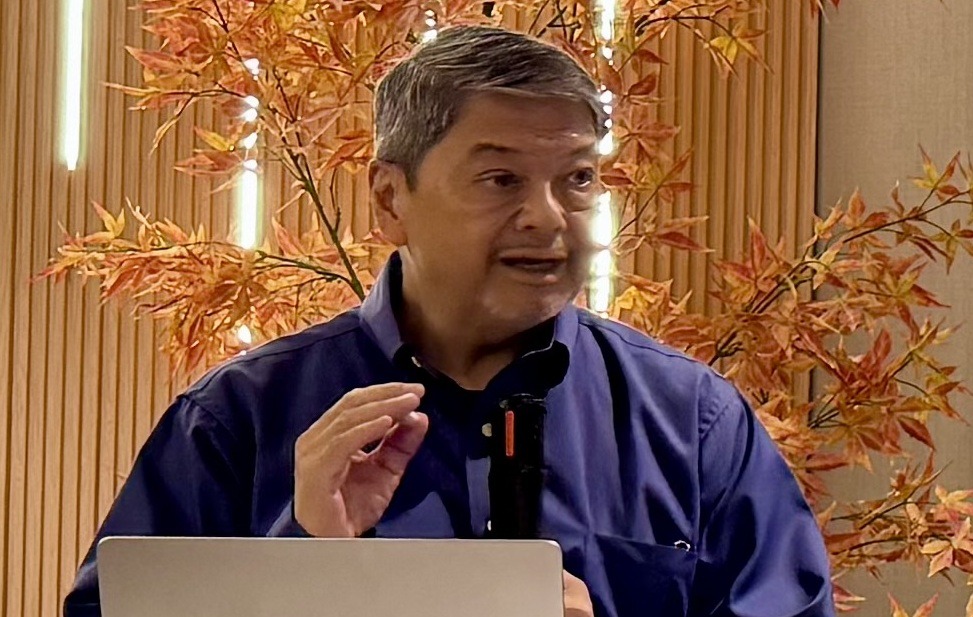
The Philippines could reach a critical point in artificial intelligence adoption within the next two to four years, making it imperative for the country to avoid falling behind another major technology wave, according to Filipino tech pioneer and entrepreneur Joey Gurango.
Gurango, who previously worked for Apple and Microsoft in the United States and later founded software startups, said AI represents a more profound shift than earlier transitions involving mainframes, client-server computing, the Internet, the Web, and mobile technologies.
“I don’t think we’re there yet, especially in the Philippines, but it’s on the horizon, 24 to 48 months from now. We’ll get to that inflection point. And my fear, about Philippines in particular, is that we might be left behind again,” Gurango said.
“Just as we have been left behind in many other technology waves. We can’t allow it to happen with this technology,” he added.
Gurango said he has traditionally assessed technology shifts by looking at applications and how people actually use them rather than focusing primarily on hardware and connectivity.
“If people are not using applications, then it’s not going to take action, whether it’s a mobile application or a Web application, or whatever,” he said.
One major difference with AI, Gurango said, is the speed and breadth of its adoption. Older computing technologies generally gained traction first among businesses and governments before reaching consumers, while later technologies such as social media were largely consumer-driven.
AI, by contrast, has been adopted by consumers and enterprises at roughly the same time, he said. Gurango argued that widespread use among employees and customers has also pressured companies to adopt the technology.
“There’s a little bit of FOMO in there. They didn’t want to be left behind. But that’s just the adoption part of the revolution,” he said.
Gurango said the more significant technological break from the past is AI software’s ability to change based on data and learning instead of relying solely on humans to make subsequent improvements.
“To me, that is the most technologically revolutionary aspect of AI. It’s self-modifying. That’s never happened before,” he said.
He rated AI’s potential impact far above previous technological shifts.
“If you ask me on a scale of 1 to 10, what is the impact of AI compared to previous technological revolutions, on a scale of 1 to 10, it’s based a lot on 15. That is how impactful it is,” Gurango said.
Gurango also distinguished current concerns over AI from earlier fears about automation. Previous technologies displaced particular occupations, he said, while debate over AI increasingly centers on whether machines could take over functions associated more broadly with people.
“The fact that we’re even talking about this technology, potentially replacing human beings, makes it very different from previous technologies,” he said, stressing that he still considers the idea of AI replacing humans a theory.
Despite that concern, Gurango said the direction of AI development should ultimately remain a human choice.
“Technology should always serve humanity, not the other way around,” he said.
Gurango said the challenge is not simply developing more capable AI models but ensuring that the technology preserves human agency, dignity, and values as its use expands.
“The future of AI is not something that merely happens to us. It is something we explicitly choose to build together for ourselves,” he said.