Salesforce has launched Slack Code, a new feature that allows software development teams to work with AI coding agents inside shared Slack channels, as the company seeks to move AI-assisted programming beyond individual developers working in separate tools.
Slack Code, available across all Slack plans, supports AI coding agents including Anthropic’s Claude Code, Cognition’s Devin, GitHub Copilot, OpenAI’s ChatGPT, and Vercel agents. Access to the partner AI services must be obtained separately.
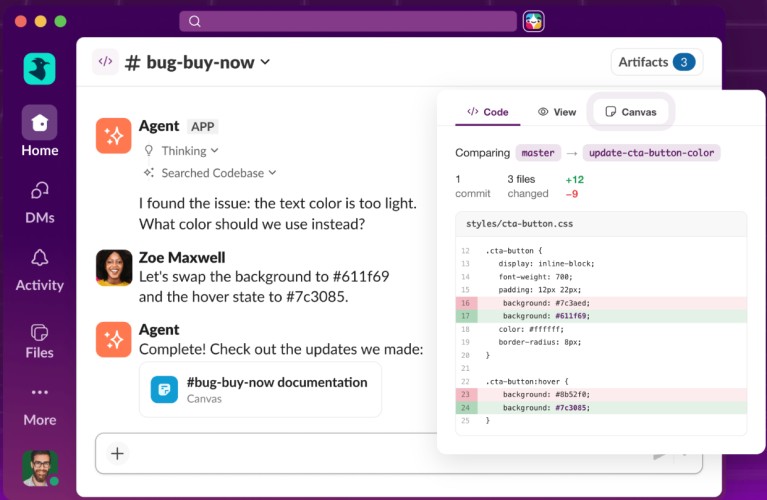
The feature introduces dedicated “code channels” where developers and other team members can interact with AI agents while keeping conversations, development plans, code changes, and previews of running software in one workspace.
Each code channel includes separate tabs for team discussions, the AI agent’s proposed plan, line-by-line code differences, and a live preview of the output. This allows team members to inspect and intervene in an agent’s work while development is underway.
Salesforce said the setup is intended to address a limitation of current AI coding workflows, where developers typically interact with coding assistants through private terminals, browser tabs, or development environments that other members of a project cannot readily see.
“AI only creates value when it’s part of how a team actually works, not something people go do alone in another tab. Code channels bring that work into the open, where the rest of the team can see it, shape it, and build on it,” said Rob Seaman, EVP and GM of Slack at Salesforce.
Users can start a code channel by tagging a supported AI agent in a Slack conversation. Slack then creates a project-based channel for the task, which can be archived when the work is completed while retaining its history as a searchable record.
The approach also gives non-developers such as product managers, designers, and marketers a way to participate in AI-assisted software development by providing requirements, reviewing output, and giving feedback without moving into traditional developer tools.
Human controls remain part of the workflow. Salesforce said participants can pause, redirect, or stop an AI agent while it is working, while final changes require human approval before being pushed to production.
Slack Code also operates under Slack’s existing administrative permissions and security controls, allowing companies to apply their existing governance policies to AI agents operating within the platform.
Anthropic said the shared environment reflects how many software tasks already originate from conversations among team members.
“So much engineering work already starts as a conversation in Slack with Claude Tag: a bug report, a piece of feedback, a ‘what do you think about…’. Slack Code gives teams a dedicated channel where the people, the context, and Claude work together from the start. Review the code diff and see a live HTML preview right in the channel, without anyone leaving the conversation,” said Cat Wu, head of Claude Product at Anthropic.
GitHub is similarly bringing Copilot into Slack Code as AI agents increasingly become integrated into development workflows rather than operating as standalone assistants.
“Slack is a strategic part of a broader GitHub promise: humans set direction, agents close the loop. That has to be true wherever developers are working, which is why we’re bringing Copilot into the flow of conversation in code channels to help teams turn shared intent into shippable software,” said Mario Rodriguez, chief product officer at GitHub.
Vercel chief technology officer Malte Ubl said code channels could make increasingly complex interactions with AI agents visible to an entire development team.
“Slack is already where our teams collaborate, and Code Channels bring that same collaboration into how we work with agents. A thread is great for a quick back-and-forth, but the work with an agent has gotten valuable and complex enough that it deserves its own space. A whole team can gather in one Code Channel, watch the agent work, steer it together, and ship a preview, with all the context and history staying in one shared place. It turns building software from something that happens in one person’s local session into something the whole team does together,” Ubl said.
Cognition president for New Enterprise Jeff Wang said the integration is also designed to limit unnecessary agent activity in team conversations.
“Agents earn their place on a team the same way people do, by knowing when to contribute and when to stay out of the way. With code channels, Devin responds in Slack autonomously, verifies its work by running end-to-end in cloud agents, and brings the right people together without cluttering the conversation,” Wang said.
Rebecca Wettemann, CEO and principal analyst at Valoir Research, said collaborative AI development could help companies move beyond measuring AI primarily through individual worker productivity.
“For companies to unlock the full value from AI, it has to move beyond individual productivity gains to operational transformation. Slack Code enables AI to move beyond individual copilots to embedded, contextual AI orchestration to deliver real AI ROI at scale,” she said.
Salesforce said Slack Code is built on APIs that will also allow companies to connect custom enterprise agents. The company plans to extend the model beyond software development to workflows involving other functions, including legal and marketing.
Slack Code and code channels are available on all Slack plans, although users need separate access to supported third-party AI agents.