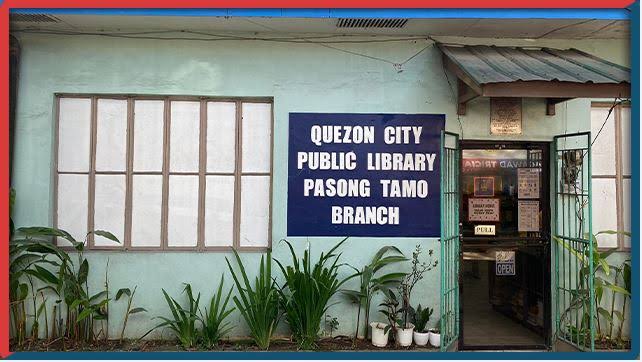
A policy brief from the University of the Philippines has proposed using artificial intelligence (AI) and machine learning to overhaul the country’s public library system, including identifying libraries at risk of closure and directing government funding based on actual needs.
The paper, published under the UP Center for Integrative and Development Studies’ Program on Data Science for Public Policy, called for changes to Republic Act No. 7743, the 1994 law requiring the establishment of congressional, city, and municipal libraries and barangay reading centers nationwide.
More than three decades after the law was enacted, the researchers said only about 30 percent of registered libraries are currently open. They cited inadequate resources, limited technology skills and a lack of flexible technologies as among the problems affecting the system.
The policy brief also pointed to disparities across regions. NCR and Region I were described as having relatively stable operations, while BARMM, Caraga and Region II were identified as having low operational capacity and being at risk of library closures. It also cited weak IT services and internet connectivity, particularly outside more developed areas.
The researchers analyzed data from the 2025 National Library Directory using four machine-learning classification models — Random Forest, Logistic Regression, Support Vector Machine using an RBF kernel, and Gradient Boosting.
Gradient Boosting performed best, posting an accuracy and weighted recall of 0.788 and a weighted F1 score of 0.736. Random Forest recorded 0.727 accuracy, while Logistic Regression reached 0.667. The SVM model performed poorly because of severe class imbalance in the dataset, according to the paper.
The researchers said machine learning could be used to determine which libraries are active, inactive, or closed and help the government decide where intervention and funding are needed.
Among their proposals is a National AI-Enabled Library Monitoring System, or NAELMS, which would use machine-learning algorithms to classify libraries in real time as active, at-risk or closed.
“This allows for early intervention rather than reactive measures,” the policy brief said.
The researchers also proposed a “Library Digital Readiness Index” that would measure infrastructure, connectivity and learning engagement across public libraries.
They recommended using AI in annual assessments so implementation of RA 7743 would shift its emphasis from merely establishing libraries to ensuring that they remain operational.
Another proposal calls for predictive funding models that would direct government resources to libraries identified as at risk instead of relying on uniform allocations regardless of their condition or needs.
The brief also recommended a national library data dashboard for real-time monitoring and predictive maintenance.
The paper proposed setting up AI resource centers alongside established provincial libraries to provide training and support smaller city centers.
Nonperforming libraries and reading centers could meanwhile be converted into hybrid community learning centers offering e-learning, digital-skills training and access to government services.
The researchers acknowledged obstacles to deploying AI in the public library system, including privacy concerns, inadequate infrastructure, costs and limited AI literacy.
They argued, however, that using predictive systems could allow the government to move away from reactive planning and allocate more resources to underserved rural and municipal libraries.
“For example, the current version of RA No. 7743 is like a map that was printed decades ago; it shows where the roads should be, not where the traffic jams or roadblocks are,” the researchers said.
“Following these AI and ML suggestions turns such a map into a living GPS that will give you real-time information, warn you about problems or closures before they happen, and quickly reroute resources to make sure that every community gets to its goal of digital literacy and lifelong learning.”