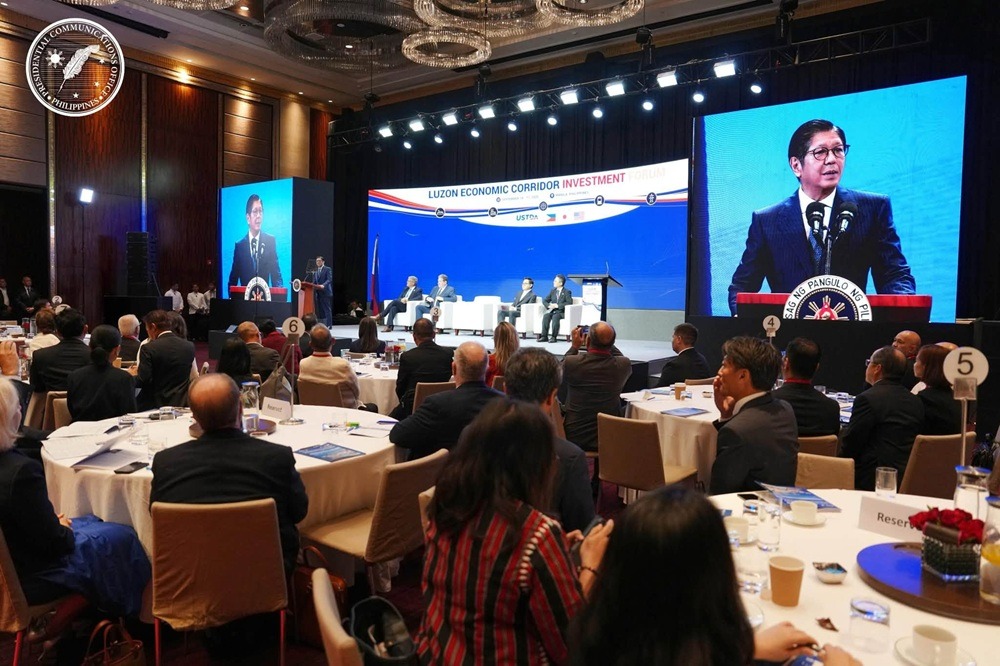
Pres. Ferdinand Marcos Jr. pitched the Philippines as a destination for digital infrastructure, semiconductor, and advanced manufacturing investments as the contentious US-led Pax Silica initiative emerged as a central component of the Luzon Economic Corridor.
Speaking at the 2026 Luzon Economic Corridor Investment Forum at the Grand Hyatt Manila in Taguig City, Marcos said the corridor was intended to coordinate infrastructure, industrial development, energy, and logistics investments rather than serve merely as a collection of construction projects.
“It is our strategy for organizing growth,” Marcos said.
The two-day forum was organized with the US Trade and Development Agency (USTDA) and co-hosted by the governments of the Philippines, United States, and Japan. USTDA said the event brought together about 600 investors, business executives, and senior government officials to develop commercial partnerships and mobilize private investment in the corridor.
Senior US officials attended the gathering, including Lee Lipton, the newly appointed US ambassador to the Philippines, and USTDA deputy director Thomas Hardy. Japanese government representatives and executives from international companies also participated.
The USTDA said the forum would focus on infrastructure projects intended to strengthen supply chains and improve connectivity.
At the center of the corridor’s technology agenda is Pax Silica, a US-led international initiative aimed at building secure supply chains for semiconductors, artificial intelligence infrastructure, critical minerals, and other advanced technologies.
The Philippines joined Pax Silica in April and subsequently proposed a 1,620-hectare industrial complex in New Clark City.
The government has projected that the development could attract as much as $70 billion in investments and create up to 190,000 direct jobs, although the identities and firm commitments of prospective investors have not been fully disclosed.
The Bases Conversion and Development Authority has clarified that the proposed complex would focus primarily on semiconductor manufacturing and related industrial activities, not hyperscale data centers.
Any data centers within the site would mainly support semiconductor companies operating there, the BCDA said. The first 500-hectare phase could begin within three to five years, while full development could take about 30 years.
Pax Silica has nevertheless attracted scrutiny over its potential electricity and water requirements, environmental effects, land use, treatment of affected communities, and expected benefits for Filipino workers and companies.
A Senate inquiry showed that a detailed development plan had yet to be submitted and that consultations with local officials, indigenous peoples, farmers, and other affected groups had not been completed.
Lawmakers and technology experts have also called for binding commitments on technology transfer, skills development, local supplier participation, and the retention of more economic value in the Philippines.
Against this backdrop, Marcos said the government was expanding secure connectivity and advanced computing infrastructure, strengthening cybersecurity, and developing safeguards for the responsible use of AI.
The administration also wants to move the country’s digitally capable workforce into higher-value industries and enable local companies to develop technologies instead of remaining primarily users of foreign products and services.
The digital economy push will be accompanied by investments in renewable energy, power-grid upgrades, transport links, and logistics infrastructure across the corridor. The government expects these projects to reduce the cost of moving people and goods and support manufacturing activities.
“We are reinforcing these advantages through better connectivity, reliable energy, modern digital infrastructure, and stronger domestic industries,” Marcos said.
The president urged foreign companies to bring capital, technology, and expertise while developing Filipino workers and local suppliers.
“Build your next enterprise in the Philippines. Bring your capital, technology, your expertise. Develop Filipino talent and local suppliers. Form lasting partnerships with our businesses and communities,” Marcos said. “You can place your trust in the Philippines. The Philippines is ready.”