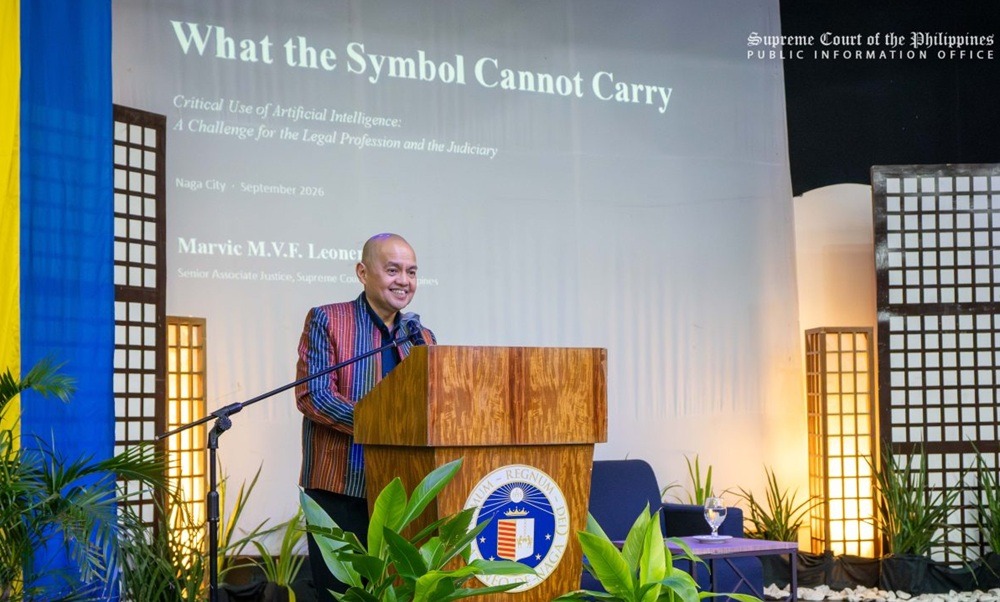
Supreme Court (SC) senior associate justice Marvic Leonen has warned judges and lawyers that using artificial intelligence without careful scrutiny could produce errors and deepen injustice.
Speaking during a lecture titled “The Critical Use of AI: Challenges for the Philippine Legal Profession and the Judiciary” at Ateneo de Naga University, Leonen said AI tools may assist with legal work but cannot replace human judgment, empathy, and accountability.
He cautioned legal professionals against treating confidently written AI responses as necessarily accurate. Users must be capable of detecting errors, verifying information, and taking responsibility for the resulting work, he said.
“Critical use means that when you use AI, you should be capable of catching its errors,” Leonen said.
AI systems can analyze documents and generate language, but they cannot fully understand the experiences, intentions and social context involved in legal disputes, according to Leonen.
“An AI model can parse a contract; it can analyze it, but it cannot tell you whether these two parties understood the words the way the words read,” he said.
He noted that machines may fail to recognize irony, regional expressions, and the difference between the literal words of a witness and what the witness actually means.
“The difference of human thinking from that of AI can never be covered by an update or the next release note,” Leonen said.
He stressed that lawyers and judges must preserve a space between receiving information and making a decision, allowing them to examine the circumstances and exercise independent judgment instead of automatically accepting an AI-generated answer.
“If you want injustice to be overturned, no AI or application can help you do that,” Leonen said.
The SC has adopted a Governance Framework on the Use of Human-Centered Augmented Intelligence in the Judiciary, approved by the Court en banc on Feb. 18, 2026.
The framework allows AI-assisted tools for functions such as transcription, translation, legal research, document summarization, proofreading and data redaction. However, AI output cannot serve as the sole, primary or determinative basis of a ruling.
It also requires disclosure of AI use, human supervision and compliance with data privacy and anti-discrimination safeguards. Users remain personally accountable for AI-generated work and cannot invoke the technology to avoid liability.
The policy covers members of the Judiciary, court officials and employees, lawyers appearing before courts and contractors developing AI tools for the judicial system.
The court currently uses Scriptix, an AI-powered transcription tool designed to reduce the time court stenographers spend transcribing proceedings while retaining human review.
Leonen, who chairs the SC’s Committee on Human-Centered Augmented Intelligence, said technology should support rather than displace the distinctly human task of administering justice.
The framework forms part of the Supreme Court’s Strategic Plan for Judicial Innovations 2022–2027, which seeks to expand the use of technology while protecting fairness, accountability and access to justice.