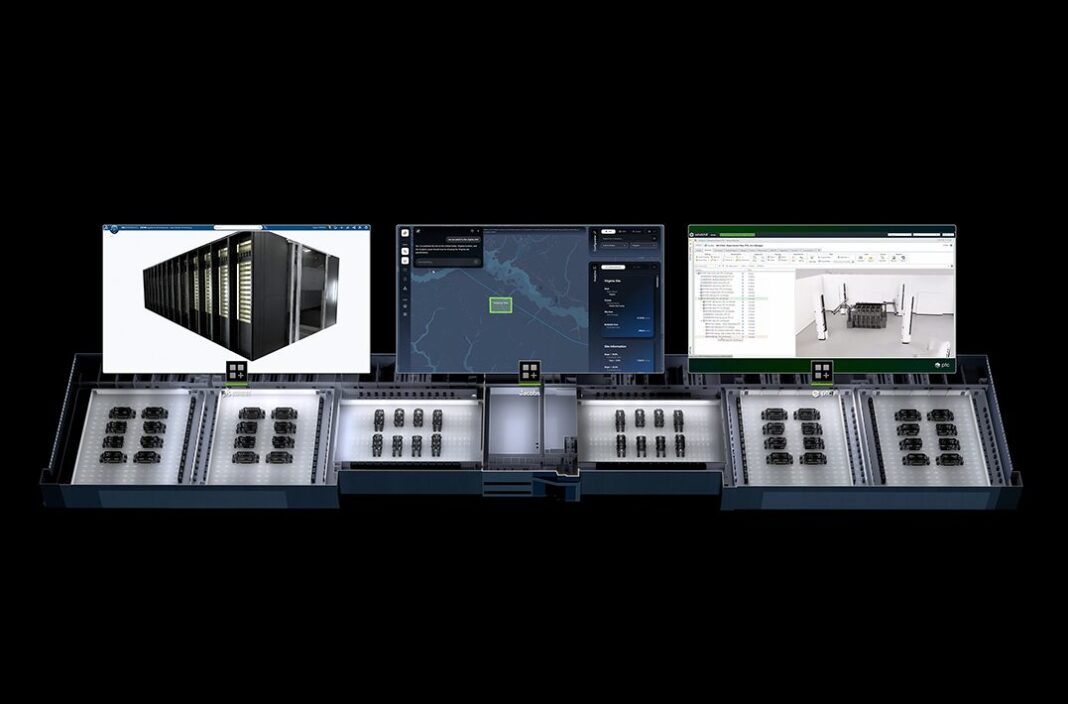
Chipmaker Nvidia has unveiled new hardware designs, networking technologies, and industry partnerships aimed at accelerating the construction of “AI factories”, the company’s term for specialized data centers optimized for artificial intelligence workloads.
The announcements were made on Oct. 12 during the opening day of the Open Compute Project (OCP) Global Summit 2026 in San Jose, California.
Among the developments were the contribution of Vera Rubin rack and tray designs to OCP, the shipment of the Vera CPU MGX rack, the introduction of a new networking module developed with Cisco, and collaborations with hyperscale cloud providers.
Nvidia contributed its third-generation Vera Rubin MGX rack and tray designs covering power, cooling, and mechanical systems to OCP, making the architecture for its modular AI supercomputer openly available.
Joe Delaere, Nvidia senior manager of AI Factory Solutions, highlighted three innovations in the Vera Rubin MGX architecture.
The rack’s liquid-cooled compute tray eliminates hoses, cables, and fans, simplifying assembly and maintenance throughout its lifecycle.
The addition of liquid cooling to the busbar allows it to support 5,000 amperes despite its compact size, enabling higher compute and power density within a smaller footprint.
Nvidia also introduced two in-tray liquid-cooling connectors, the MGX Quick Disconnect (MQD) and MGX Quick Disconnect Blindmate (MQDB), designed to reduce leakage risks and make cold plates easier to replace.
The company also announced that its Vera CPU MGX rack, designed for agentic AI workloads, is now shipping.
According to Nvidia, the Vera CPU delivers twice the performance of its predecessor, the Grace CPU, for workloads such as scripting, compression, and code compilation, based on industry benchmarks.
Meta also reported a twofold performance improvement in hyperscale cloud workloads using its DCPerf benchmark.
The modular CPU rack is available in several configurations to accommodate different workloads, including agentic AI, inference, and storage.
In networking, Nvidia and Cisco introduced the Ultra-dense Small Form Factor Pluggable (USFP) module, described as the first pluggable module designed for 400Gb base fabrics.
The module doubles per-lane bandwidth from the previous 200Gb limit to 400Gb while improving power efficiency by 1.3 times per 200Gb.
It also provides four times the bandwidth density of existing 200Gb solutions, supporting high-density 1.6Tb/s network fabrics and up to 32 electrical lanes for 12Tb/s of capacity.
Nvidia also disclosed that Meta is adopting its Spectrum-6 Ethernet switches for Vera Rubin deployments in its AI factories.
The switches will allow Meta to build multiplane networks capable of detecting hardware failures and rerouting traffic 30 times faster than software-based alternatives.
Meanwhile, Google’s Falcon transport technology is now supported on Nvidia’s Spectrum-X Ethernet platform.
The integration enables multipath load balancing to distribute network traffic, congestion control to reduce delays, per-connection security to protect data in transit, and hardware-based loss recovery.
Nvidia and its industry partners also released new open specifications intended to establish common standards for AI factory construction and operation.
AMD, Google, Meta, and Nvidia published the Open Data Center Specification v0.7, which provides a blueprint for next-generation AI factories covering power architecture, cooling infrastructure, and physical layout.
Google, Meta, Microsoft, and Nvidia also introduced the OCP Grid Resilience Specification, which outlines how large-scale AI infrastructure can remain connected during utility grid disturbances.
Under the specification, AI infrastructure would automatically respond to grid disruptions and restore operations to near-full load in less than two seconds.
The developments reflect Nvidia’s efforts to expand beyond graphics processing units (GPUs) into a broader range of data center infrastructure, including processors, networking equipment, cooling systems, and software.
The company has also been providing free initial workflow blueprints, reference architectures, and developer tools to support AI factory construction and operation.
“The real bottleneck for the AI industry right now, is how fast the world can manufacture and deploy AI factories,” Delaere said.
“Everything that we’re announcing and contributing today comes from many generations of product experience across the entire stack and overall, these contributions help the ecosystem accelerate AI factory build-out and increase AI productivity, so it benefits the entire industry.”
“So this open ecosystem and the contribution of our open platform accelerates the whole industry, the ecosystem grows, and we grow with it,” he added.