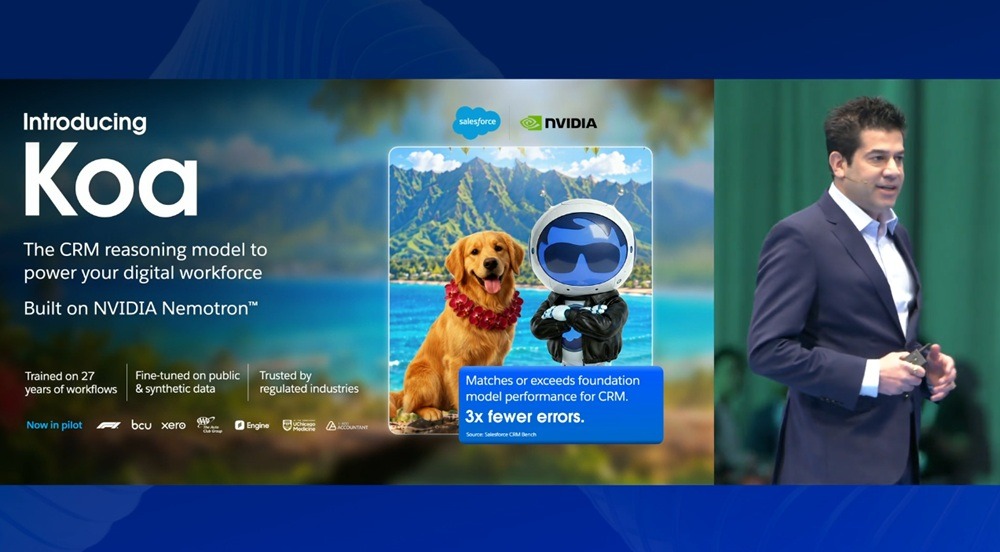
SAN FRANCISCO – Cloud computing giant Salesforce has introduced Koa, its first customer relationship management reasoning model for Agentforce, developed with Nvidia to handle complex, multistep business processes.
Unveiled at the ongoing Dreamforce 2026 conference, Koa is based on Nvidia’s Nemotron 3 Super open model and was post-trained using a proprietary synthetic dataset modeled on knowledge drawn from nearly three decades of Salesforce CRM deployments.
Salesforce said no customer information was used to train the model. The training data instead consisted of synthetic scenarios designed to represent the reasoning, tool use and decisions involved in CRM processes such as generating leads, qualifying sales opportunities and resolving service cases.
The scenarios covered more than 14 industries, including manufacturing, financial services, healthcare and travel. Each paired a user persona with specific tasks and mapped the actions and software tools an AI agent would need to complete the work.
Rohan Kumar, Salesforce’s new president of platform and engineering, said the company developed Koa after customers asked for more flexibility in selecting AI models based on cost, performance, and intended outcomes.
“For the last three months, I’ve traveled around the world, met a lot of customers, and one consistent piece of feedback that I’ve heard from everyone is that they want a choice for AI,” Kumar said during the Dreamforce keynote.
“They essentially want to pick the AI model which is best in terms of price performance for the outcome that they are seeking.”
Kumar said Koa was designed for long-running AI agents that execute several tasks to complete a complex process.
“Think about a sales agent that’s trying to figure out the next best step to take to actually pursue a complicated but a very valuable sales opportunity. Koa can help with that,” he said.
“Think about a service agent that’s actually figuring out the next best step to take to handle a complicated customer case, a customer-support case, to get the customer to the right place. Koa can help with that.”
Salesforce used supervised fine-tuning and reinforcement learning to train the model on selected enterprise tasks. The process used Nvidia’s NeMo RL, NeMo Gym, and NeMo AutoModel tools.
In Salesforce’s own CRM benchmark, Koa matched or exceeded the performance of leading models while recording three times fewer errors in tasks such as updating a sales opportunity, routing a customer case and scheduling a follow-up.
Salesforce controls Koa’s model weights and conducts post-training and inference within its infrastructure. It said this arrangement prevents customer data from crossing its trust boundary when the model processes company information.
“Not a single byte of customer data was used,” Kumar said.
Salesforce chair and CEO Marc Benioff said the model incorporates the company’s accumulated knowledge of enterprise processes.
“The most valuable thing Salesforce has built isn’t our platform — it’s the accumulated knowledge of how enterprise business actually works,” Benioff said.
“With Koa, the knowledge is put inside the model itself. We trained a reasoning engine that understands the structure of a deal, the lifecycle of a service case, and the workflows that vary across industries.”
Nvidia founder and CEO Jensen Huang said the Nemotron open models gave Salesforce a foundation for building a specialized CRM model.
“Every company needs useful AI, tailored to its knowledge, expertise, and work,” Huang said. “Nvidia Nemotron open models give Salesforce the foundation to turn decades of enterprise expertise into specialized AI with Koa, creating a CRM model that can reason and securely take action.”
Salesforce is already using Koa internally, including in a Slack-based agent that helps employees retrieve information and complete routine tasks.
The company has also begun customer pilots with 1-800Accountant, Baxter Credit Union, Engine, Formula 1, UChicago Medicine and accounting software company Xero.
Salesforce and Nvidia are separately integrating Nemotron-based models and Nvidia computing systems into Missionforce, Salesforce’s platform for government and regulated organizations.
The companies said the integration would allow agencies and other organizations with strict security requirements to train and deploy specialized models in private clouds, classified networks and air-gapped systems that are isolated from public infrastructure.
Post-trained Nvidia models will initially support Missionforce Operations, which covers government processes such as procurement, supplier management and logistics. The models may be trained on an organization’s operational data and terminology and deployed on its own infrastructure.
Koa is currently available to selected Agentforce pilot customers. Salesforce expects general availability in US regions in winter 2026.
Missionforce Operations is already generally available in US regions, while post-trained Nvidia models are scheduled to become available to selected customers in October 2026.