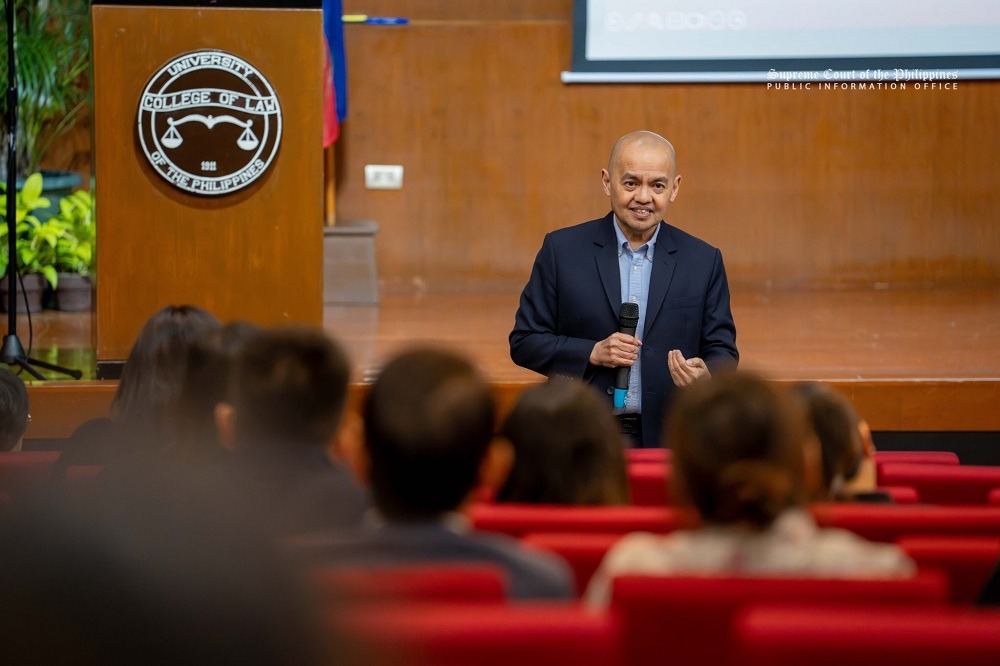
Supreme Court (SC) senior associate justice Marvic Leonen has warned lawyers, judges, and law students against relying uncritically on artificial intelligence (AI), saying the technology can reproduce past injustices and cannot replace human judgment in the administration of justice.
“Justice is not a statistical frequency. It is not an inference from past data. Justice is never artificial. Certainly, justice is not artificial intelligence,” Leonen said during a lecture at the University of the Philippines College of Law in Diliman, Quezon City, on Oct. 12.
Speaking at the SC’s AI Caravan lecture, titled “The Critical Use of AI: Challenges for the Philippine Legal Profession and the judiciary,” Leonen said legal professionals must understand how AI works, recognize its limitations, and remain accountable for decisions made with its assistance.
“For leaders of our profession, for champions like you, like all of you, and for our judiciary, ignorance of artificial intelligence is simply irresponsible,” he said.
The lecture formed part of the SC’s efforts to guide the legal profession and the public on its Governance Framework on the Use of Human-Centered Augmented Intelligence in the judiciary.
Leonen distinguished digitalization from AI, saying the former moves court records and procedures from paper to digital platforms, while the latter analyzes data and can generate recommendations or draft legal documents.
“Digitalization simply wants to replace the platform, the paper. It is the how of justice, it is about records, the filings, summonses, raffles, hearings from paper to a digital platform. It’s the plumbing, the logistics, the medium that carries the data of a case from grievance to judgment. And it matters.”
Through the eCourt system, digitalization has shortened processes involving the filing and service of pleadings, judgments, and other documents in civil cases, he said.
AI, meanwhile, “is working with the data to do analysis, to write the order, to actually doing some form of a judgment on the data that you have in that particular case.”
Leonen cautioned that both technologies carry risks, including cybersecurity threats, unequal access, dependence on technology vendors, and the loss of institutional control over critical systems.
“Digitalization is necessary, but it is not neutral. The question is never whether we should modernize, the question is whether we can remain sovereign and fair over the tools that we adopt,” he said.
Within the judiciary, the SC has authorized the use of Scriptix, a voice-to-text transcription tool used by court stenographers.
Leonen said stenographers remain necessary to review and edit machine-generated transcripts before these become official court records.
He also warned that digital-only processes could disadvantage people without reliable access to technology or the skills to use it. Without adequate training and change management, modernization could deepen existing inequalities.
AI can reproduce past injustices
Leonen explained that AI systems draw inferences from patterns in large volumes of data, a process associated with inductive reasoning. Such inferences, however, are constrained by the quality and limitations of the data on which they are based.
“[Artificial intelligence] was made possible by three things. The first one is a huge amount of data. Almost all the techs in the planet that is digitized has been accessed by big tech.
“Second is technology. Technology in two ways. Cheaper memory and powerful processing, powerful processors, powerful ways to process that particular data.
“And then the last one is a huge amount of money that is funneled to the development of using the inference in order to gather conclusions. The inference being done is done statistically.”
Citing philosopher David Hume, Leonen warned against assuming that outcomes observed in the past will necessarily recur under similar circumstances.
That limitation becomes particularly significant in the justice system, where historical decisions may reflect discrimination or other forms of injustice.
“A past injustice is never authority. Artificial intelligence, when you deploy it, can infer that same injustice based upon an unjust decision. So you will keep on repeating something which may be already unjust.”
Leonen cited the disproportionate number of poor people accused in criminal cases as an example of how AI could produce misleading conclusions when it fails to account for social and institutional realities.
He identified embodiment, emotion, context, situation, and culture as five characteristics that distinguish human intelligence from AI.
Data showing that more than 90% of people accused in criminal cases are poor could lead to the inference that poverty drives criminal behavior.
But such a conclusion would overlook how access to resources can affect a person’s treatment at different stages of the criminal justice system.
“Ang daming [way] out if you have the resources. Okay, but if you are poor, wala ka na,” Leonen said.
AI can identify patterns and report frequencies, but the figures do not necessarily explain the circumstances behind them.
“A true judge with experience knows that sometimes the frequency of criminal cases is merely the result of an arrangement (areglo) which they cannot control,” he said.
Human judgment remains essential
Leonen also warned that AI cannot fully capture the realities behind court records, which consist of representations of events through witness testimony, exhibits, transcripts, affidavits, and pleadings.
Returning to the example of a woman testifying in court, he explained that a transcript may not reflect her pauses or emotional state unless these are specifically brought to the court’s attention.
“You cannot record the weeping, you cannot record the pauses. That’s the reality. But it is represented by the words,” he said.
Other risks include bias, overreliance on confident-sounding but inaccurate answers, AI hallucinations, diminished memory from dependence on digital tools, distraction from multitasking, and the concentration of control in technology vendors.
Leonen also cautioned that AI could deprive users of the reflection and learning that come from independently researching a question and working through possible answers.
“You live in the interval as a human being. The interval between all the facts of the case, all the law that has been presented, and then there is a pause. And in that pause, you should be able to reflect. AI removes that from you. Because what AI does, it does its own reflecting based upon statistics, gives you an answer.”
He stressed that courts must assess individuals on their own circumstances rather than draw conclusions from group characteristics.
“In a court of law, you look at the individual not because it is the product of a society. You look at an individual because it’s an individual. You call that due process of law. You do not convict, you do not place privileges or burdens simply because of the identity of this individual in the group.”
Guidelines for critical AI use
Leonen outlined several practices for using AI responsibly, including formulating questions independently before consulting a machine, checking sources, evaluating generated answers, maintaining an audit trail, and reading all AI-produced material.
He also advised users to determine whether AI is necessary for a particular task and to ensure they can perform the work delegated to the technology.
Users should broaden their research before turning to AI, craft prompts carefully, and verify the accuracy of the information generated, he said.
Leonen urged legal professionals to educate others about the risks of uncritical AI use.
“Because your polity, your sovereigns, your citizens, when they use AI unthinkingly, we can all become automatons.”
He also encouraged lawyers and students to engage with communities and learn from people whose experiences may not be adequately represented in digital records.
For Leonen, preserving the time between asking a question and receiving an answer is central to responsible AI use.
“The interval between your question and the answer is the only place in this whole apparatus where our humanity still exists. The space is also the first thing every one of these tools called artificial intelligence is built to remove through speed, convenience, apparent fluency.”
He returned to the woman whose testimony opened his lecture, noting that the account could pass through a series of transformations — from transcript to file, variable, and AI model — until it became data used to make predictions about people with similar characteristics.
“A machine can work that chain at a speed none of us possess … [but] what it cannot do is climb back up the chair to her again and decide what would, in the future rather than in the past, actually amount to justice.”
While AI can infer what usually happens to people based on historical data, Leonen said it cannot determine what an individual is owed as a unique person.
“Justice is not a statistical frequency. It is not an inference from past data. Justice is never artificial. Certainly, justice is not artificial intelligence. Definitely, it is more.
“Remember also what a machine can never hold. It holds no office. It takes no oath. It cannot be disciplined, suspended or removed. Nothing it produces carries authority of its own. AI may assist a court’s work. It may never sit on the bench.”
Leonen closed by urging participants to use AI critically while following the SC’s guidelines.
“Use it critically, but follow the guidelines of our court,” he said.