
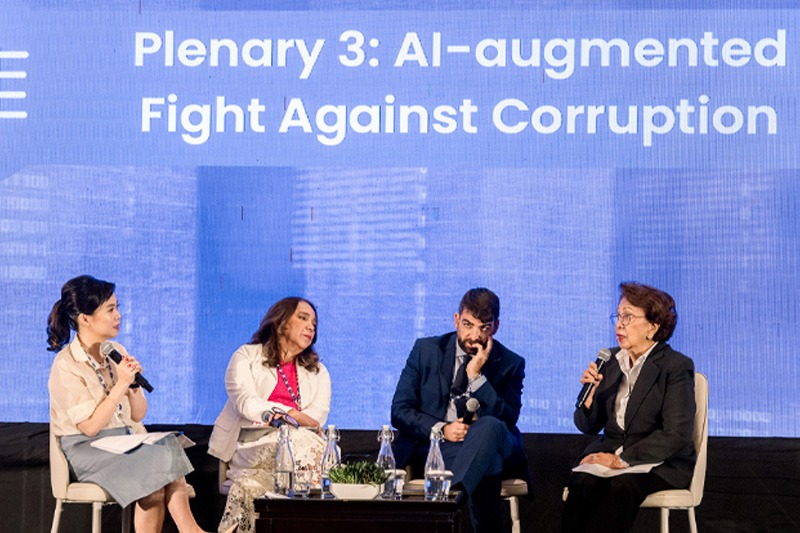
Artificial intelligence (AI) may help uncover fraud and misuse of public funds, but experts warn that technology alone cannot eradicate corruption without integrity, strong institutions, and political will.
This was the central message at the 11th Annual Public Policy Conference (APPC), organized by the Philippine Institute for Development Studies (PIDS) as part of the 23rd Development Policy Research Month (DPRM).
Themed *“AI-Augmented Fight Against Corruption,”* the plenary session gathered experts and former public officials to discuss the opportunities and limits of using AI in governance.
Dr. Jacopo Costa, senior specialist at the Basel Institute on Governance, said AI is most effective in processing massive datasets and spotting irregularities in procurement, border activities, and public spending.
His team’s tools, including BaselAI and the Horizon Europe FALCON project, aim to help investigators detect red flags in government transactions.
But Costa cautioned against blind reliance on algorithms. “We are humans, we have an incredible computational machine — our brains — and I’m sometimes a little bit scared that we are relying completely and entirely on artificial intelligence,” he said.
Former Commission on Audit (COA) commissioner Heidi Mendoza echoed this concern, noting that the Philippines still lacks the basic data infrastructure to maximize AI tools.
She pointed to outdated systems, fragmented records, and delayed reforms such as the Government Integrated Financial Management System (GIFMIS).
“Yes, there is no debate in terms of the advantages of using AI in the fight against corruption. But in the Philippines, it is as basic as the culture of silence and the over-compromised oversight system,” she said.
Local leaders also underscored the importance of leadership and accountability.
Baguio City mayor Benjamin Magalong highlighted AI’s potential in flagging anomalous transactions but warned that its success depends on political will and ethical standards.
“AI will not replace integrity, but it can augment and strengthen our collective fight against corruption,” he said in a recorded message.
Former Ombudsman Justice Conchita Carpio-Morales was more direct: AI must always go hand-in-hand with “HI — human intelligence.” Stressing that public office is a public trust, she reminded officials to uphold accountability and modesty in public service.
While recognizing the promise of AI, Morales warned that technology must be fraud-proof, entrusted only to personnel with integrity, and complemented by transparency measures such as access to Statements of Assets, Liabilities, and Net Worth (SALNs).
“The age of AI is upon us,” Morales said. “But without moral values, respect for the rule of law, and deep-seated integrity, it will not be enough to defeat corruption.”


