
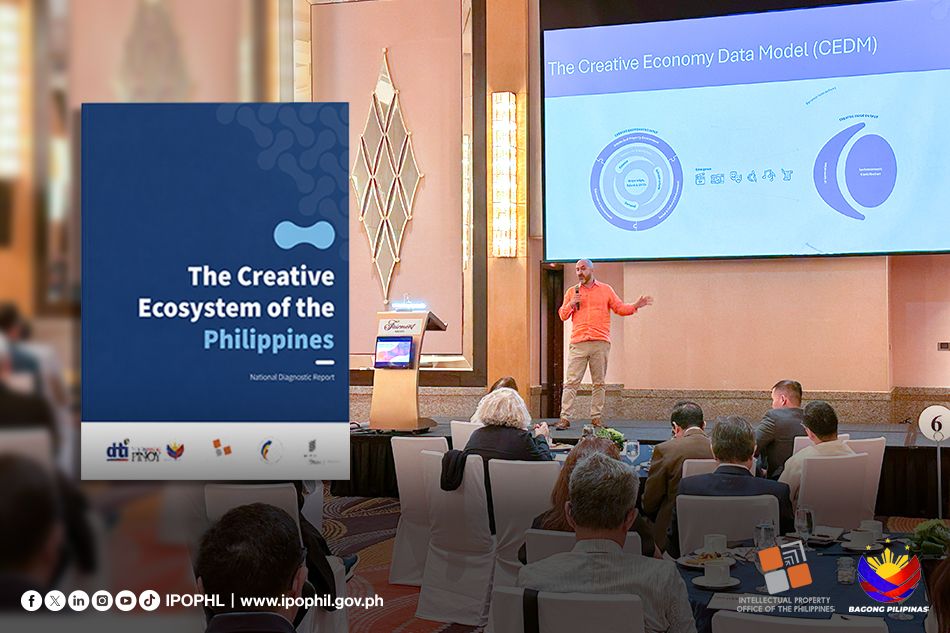
The Philippines has built a creative economy that is becoming increasingly competitive globally, but the country must generate, own, and commercialize more Filipino intellectual property (IP) if it hopes to become a leading creative hub in Asia by 2030, according to a new report released on June 9.
The study, titled “The Creative Ecosystem of the Philippines: National Diagnostic Report, was launched by the World Intellectual Property Organization (WIPO), the Department of Trade and Industry (DTI), the Intellectual Property Office of the Philippines (IPOPHL), and the Philippine Statistics Authority (PSA).
The report assessed various aspects of the country’s creative ecosystem, including IP protection, governance, talent development, financing, infrastructure, and market demand.
It found that creative industries accounted for 7.8% of the Philippines’ gross domestic product and 17.8% of total employment in 2025, underscoring the sector’s growing role in economic activity.
“The Philippines is well positioned to move from a global service provider to a higher-value partner in the creative economy. Overall, the sector is advancing institutionally and is economically significant,” the report stated.
Despite these gains, researchers said the country’s long-term competitiveness will depend on its ability to move beyond providing creative services to foreign clients and instead develop more Filipino-owned intellectual property and scalable creative businesses.
The report cited improvements in the country’s IP ecosystem, particularly through IPOPHL’s efforts to modernize registration systems, digitalize services, and strengthen online enforcement.
It also noted that the Philippines has remained off the United States Trade Representative’s piracy watch list for 12 consecutive years and has not appeared on the European Union’s intellectual property rights watch list since 2019.
Copyright registrations reached a record 6,552 filings in 2025, nearly 75% higher than in 2022, while trademark and other IP filings also continued to rise.
However, the report said commercialization remains a weak point. The Philippines continues to be a net importer of IP services, meaning payments for foreign-owned intellectual property exceed revenues generated from Filipino-owned IP.
Researchers also observed a gap between high digital consumption and low levels of legal purchases of creative content, suggesting that many consumers continue to access content through informal channels.
“Converting strong export participation into Filipino-owned IP and scalable business models will be critical to enhancing competitiveness and building sustainable creative industries. Future policy should therefore be focused on the transition from fee-for-service production to ownership-based, creative business models,” the report said.
Another challenge identified was the underutilization of creative talent. A survey by the Technical Education and Skills Development Authority (TESDA) found that 41% of workers in selected creative industries could take on more complex roles, indicating untapped human capital.
Stakeholders consulted for the study also pointed to training gaps in areas such as monetization, business development, and original content creation.
Access to financing remains another obstacle. The report noted that the use of intellectual property assets as collateral for loans and investments remains limited in the Philippines compared to other countries.
It highlighted IPOPHL’s ongoing work on IP valuation and commercialization, including efforts to develop an ASEAN-wide IP valuation framework that could support broader use of IP-backed financing.
The study also cited the Creative Industry Development Fund as a mechanism that could help attract investment and support workforce development, trade promotion, and research and development activities.
“The next chapter of the Philippine creative economy is not just about creating for the world — it is about owning what we create. Our goal is to help Filipino creators, innovators and enterprises generate intellectual property that can thrive on the world-stage while creating lasting economic value at home,” IPOPHL director general Teodoro C. Pascua said.
The report identified software, gaming, animation, and digital content as higher-value creative sectors with strong potential for innovation and export growth.
For her part, DTI secretary Cristina A. Roque said the report provides policymakers with data needed to strengthen support for creative enterprises.
“To fully unlock [artists’] potential, talent is not enough. We need clear data. We need to understand the gaps. And that is exactly what this National Diagnostic Report gives us. Developed through WIPO’s Creative Economy Data Model, this report is our tool to protect intellectual property, support our creative MSMEs and bring Filipino talent to the global stage with a clear, strategic map,” Roque said.
The study is the first in the world to use WIPO’s Creative Economy Data Model, a framework designed to assess the strengths and performance of national creative economy ecosystems.


