Alibaba has launched Qwen3.8-Max, a multimodal artificial intelligence model built to handle coding, visual analysis, and tasks that require extended autonomous execution.
The model has 2.4 trillion total parameters but activates only 95 billion parameters for each operation. Alibaba said this is made possible by a sparse mixture-of-experts architecture and hybrid attention mechanism designed to reduce computing requirements and latency compared with similarly sized dense models.
Qwen3.8-Max supports a context window of up to 1 million tokens, allowing it to process large volumes of text and visual material. According to Alibaba, the model can turn lengthy documents, television series, and livestreams into searchable knowledge bases.
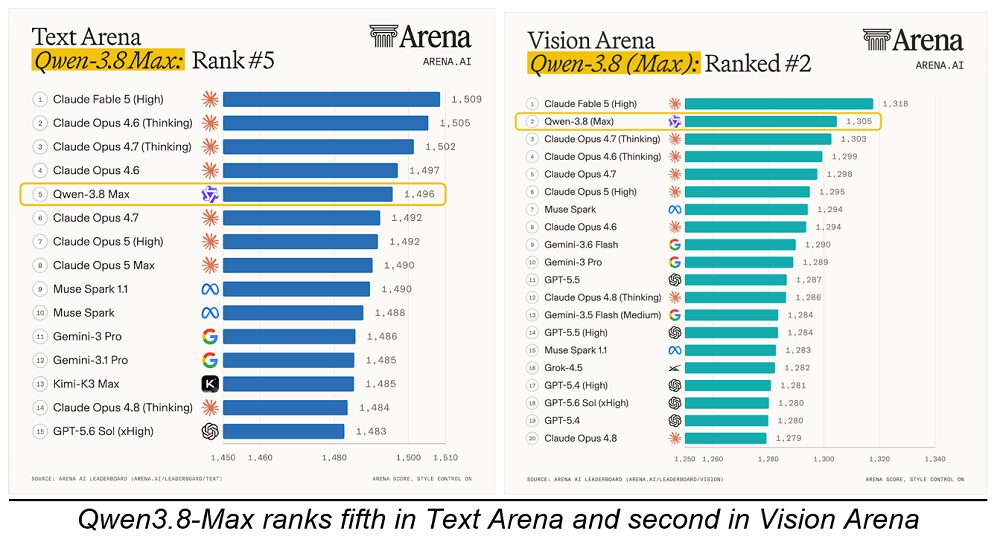
The company said Qwen3.8-Max ranked fifth in Text Arena, second in Vision Arena and fourth in Frontend Code Arena. These rankings were cited by Alibaba in its announcement.
Alibaba is making the model available to developers through application programming interfaces on Alibaba Cloud Model Studio. It can also be accessed through QwenWork, the company’s workplace AI agent platform. Alibaba said it plans to release the model weights next week.
The company is positioning Qwen3.8-Max for autonomous software development and other long-running tasks. In an internal test, Alibaba said the model worked for 16 days on a software engineering project that involved generating and testing code, reviewing logs and incorporating feedback.
The test produced “oh-my-cli,” which Alibaba described as a self-evolving agent framework that has since been released as open-source software on GitHub.
Alibaba also claimed the model reproduced published research experiments and developed methods that performed better than those in the original papers.
It said Qwen3.8-Max outperformed human participants in the WWW2025 Multimodal Dialogue Intent Recognition Challenge, which involved interpreting customer-service conversations and user requests.
For visual tasks, the model can generate front-end projects from interface screenshots, convert two-dimensional floor plans into three-dimensional interior models, edit video footage and create interactive games from natural-language instructions, according to the company.
Alibaba also introduced RecreationBench, a benchmark designed to test whether an AI system can recreate applications through visual feedback and interaction.
The company said Qwen3.8-Max reconstructed applications in an isolated environment without internet access or visibility into their source code.