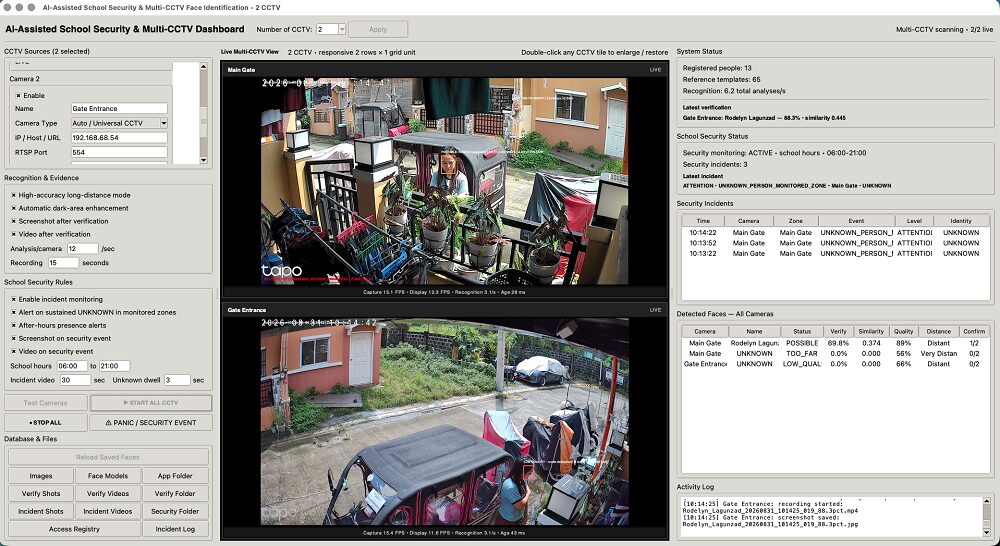
A faculty researcher at National University Fairview has developed an artificial intelligence-assisted security platform designed to help Philippine schools monitor multiple CCTV feeds and preserve digital evidence during campus incidents.
The working prototype, called the AI-Assisted School Security and Multi-CCTV Face Identification System, was developed by Herminiño C. Lagunzad, an IT faculty member and SET-Research coordinator at NU Fairview.
The platform is designed to work with existing school CCTV infrastructure. It can monitor several cameras simultaneously, match detected faces against a database of registered individuals, flag people whose identities cannot be verified, and record events in designated security zones.
Other functions include restricted-area monitoring, after-hours alerts, long-distance and low-light face processing, multi-frame verification, automatic screenshots and video recording, incident logging, and manual activation of panic or security events.
Lagunzad said the system was developed as schools examine their security measures following several fatal shooting and stabbing incidents involving students in 2026.
These cases show that threats may come not only from unidentified outsiders but also from people authorized to enter a campus, he said. The prototype therefore separates identity verification from incident monitoring, allowing it to preserve footage even when facial recognition fails to identify the person involved.
Lagunzad stressed that the system is not intended to predict criminal conduct or classify students as threats.
“An individual marked ‘UNKNOWN’ simply means that the system could not establish a verified match with the authorized reference database,” he said.
He also said the platform is intended to support — not replace — school personnel and existing safety procedures.
“The goal is not to replace security guards, teachers, administrators, emergency procedures, or other school-safety measures,” Lagunzad said. “Instead, the project is intended to serve as an AI-assisted situational awareness and decision-support digital platform.”
The use of facial recognition in schools, however, would require safeguards covering student privacy, data collection, access to biometric information, data retention, false matches, and human review of system-generated alerts.
Lagunzad said he is prepared to demonstrate the prototype and discuss its technical limitations, privacy considerations, and possible applications in educational institutions.