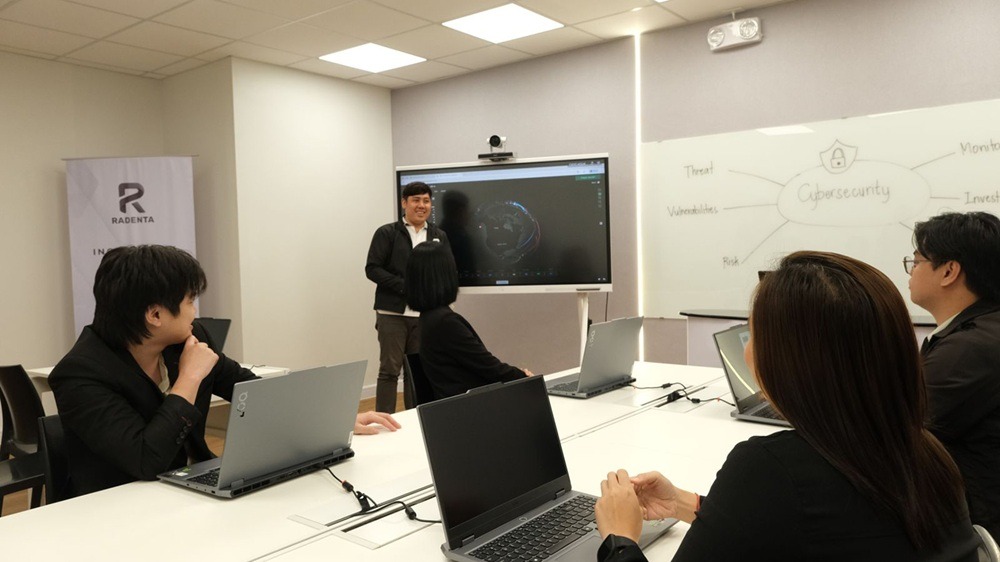
Radenta Academy now offers seven TESDA-accredited courses, including Cyber Threat Monitoring I, Contact Center Services NC II, and Data Analytics Level III. All courses are open to college students and working professionals.
Cyber Threat Monitoring provides the skills needed to proactively monitor networks for threats, analyze security alerts, and conduct vulnerability scanning of assets using industry-standard tools and protocols.
The course offers an entry-level cybersecurity qualification through institution-based and enterprise-based training modalities for the ICT sector.
The 144-hour program leads to a Certificate of Competency (COC) and National Certification upon assessment. Graduates may pursue career opportunities as Cybersecurity Analysts, Cybersecurity Support Staff, and Cybersecurity Help Desk Staff.
Contact Center Services NC II is designed to develop the essential communication, customer-handling, and computer-based operational skills required in modern contact center environments.
Trainees learn to manage inbound and outbound calls, identify customer needs, document interactions accurately, and engage professionally using English as the primary medium of communication.
The 144-hour course prepares students for careers as Inbound or Outbound Contact Center Agents, Customer Service Representatives, Entry-Level Technical Support Representatives, Customer Support Staff, and Service Desk Support Personnel.
The Data Analytics Level III program is designed to equip beginners with the foundational skills needed for a career in data analytics.
Applicants must have completed at least 10 years of basic education or the ALS Grade 10 equivalent, possess basic computer literacy, and demonstrate good written and oral communication skills.
The 144-hour course covers the end-to-end data analytics process, from gathering and cleaning “dirty” data to performing statistical analysis and presenting insights through interactive dashboards. Trainees gain practical, job-ready skills using Microsoft Excel, Google Sheets, and Google Looker Studio.
The program is divided into four modules.
Module 1 covers Basic Statistical Concepts and Analysis. Students learn to distinguish between categorical and numerical data, as well as nominal and ordinal data.
The module teaches how to use historical data to answer questions about past performance and trends. Trainees learn to calculate and interpret measures such as mean, mode, standard deviation, and quartiles.
The module also introduces the Data Privacy Act of 2012 and the proper handling of sensitive information.
Module 2 focuses on Preparing Data Sets. The course follows the principle of “Garbage In, Garbage Out” and teaches students how to fix broken data.
Topics include data importing from CSV files, databases, and Web tables; data cleaning techniques such as addressing missing values, removing duplicates, and standardizing formats; data transformation methods for converting text to numerical values and handling date formats; and data filtering techniques using slicers and tables to isolate relevant information.
Module 3 covers Summarizing Data Sets and transforming large volumes of data into meaningful insights. Students learn to use Pivot Tables, one of the most powerful tools in spreadsheet applications.
The module also covers data aggregation techniques, including calculations such as sums, counts, averages, and minimum and maximum values.
Frequency analysis teaches students how to group data by age, price range, or date to identify trends and patterns.
Pivot Charts training enables students to create dynamic visualizations that automatically update as filtered data changes.
Module 4 focuses on Preparing Data Visualizations and communicating findings effectively to stakeholders.
Topics include understanding the differences between dashboards and reports, applying data storytelling principles to create clear and effective visualizations, building interactive dashboards using Google Looker Studio, and publishing reports securely through PDF files or Web-based links.
The program provides hands-on training in tools and technologies commonly used by employers, including spreadsheet applications such as Microsoft Excel and Google Sheets; data visualization tools such as Google Looker Studio and introductory Microsoft Power BI; and presentation tools such as Microsoft PowerPoint and Google Slides.
Upon completing the course, trainees receive a Certificate of Training for Data Analytics Level III and may undergo the TESDA National Assessment to earn a National Certificate (NC).
Radenta’s Enterprise-Based Education and Training (EBET) program also features an 80-hour Robotics and Virtual Reality Integration course.
Key offerings include Collaborative Robot Programming Level III, which focuses on programming and maintaining collaborative robots; Mobile Robotics System Servicing Level II, which covers the installation, testing, and maintenance of mobile robots; and Artificial Intelligence (AI) Prompting for Automation Level III, which teaches the configuration of automation workflows used in modern robotic systems.
Radenta Academy is a TESDA-accredited Technical Vocational Institute and the training arm of Radenta Technologies, one of the country’s leading solutions integrators. To learn more, call 0998-577-2613 or visit www.radenta.com.