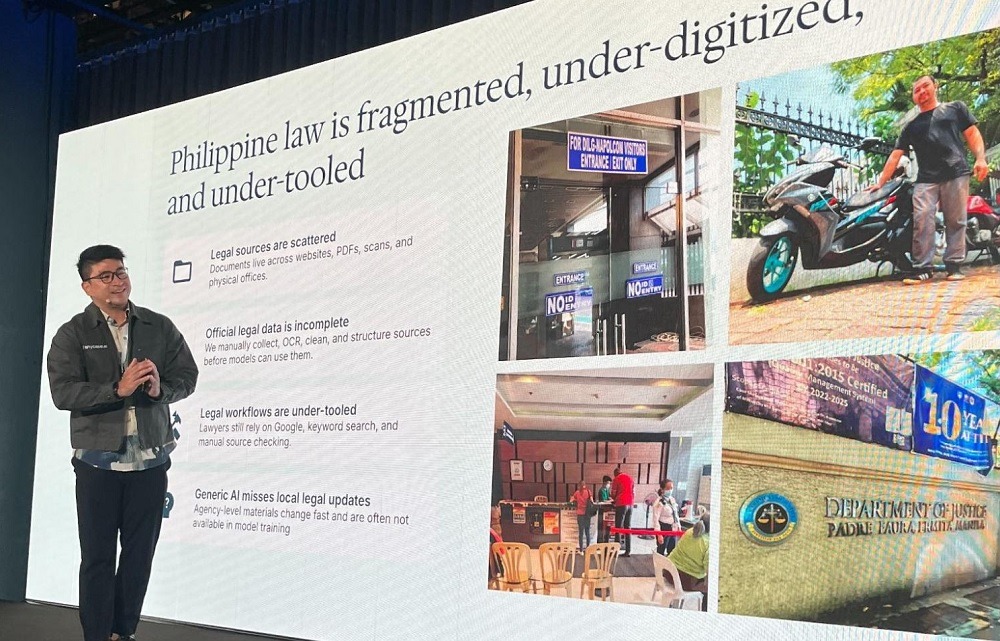
A Filipino legal technology startup says the biggest challenge in applying artificial intelligence to Philippine law is not the AI models themselves, but the lack of complete and reliable legal data.
At OpenAI’s Founder Day in Singapore, Anycase.ai was one of five Southeast Asian startups invited to present their products. During the event, company CEO and co-founder Beato Bongco explained how the startup built its AI-powered legal research platform around a proprietary database of Philippine legal materials that are often difficult or impossible to find online.
In a recollection of Bongco’s presentation, Anycase.ai co-founder Gio Tiongson said the company initially believed the problem was that Philippine lawyers still relied on keyword searches and general search engines for legal research.
“The real problem is the data,” Tiongson said. “Philippine legal information is technically public, but it’s spread across more than 150 national-level government agencies and departments, each maintaining their own website at varying degrees of reliability and completeness.”
According to the company, many government agency websites lack historical legal issuances that remain relevant to legal practice, making it difficult for general-purpose AI systems that rely primarily on publicly available online information to produce reliable answers.
To address the problem, Anycase.ai said it built what it calls a “Legal Intelligence Layer” by collecting legal documents directly from government agencies instead of relying solely on information available on the web.
The process involves requesting records from agencies, digitizing printed materials, applying optical character recognition (OCR), cleaning the data, and having lawyers and paralegals verify the documents before they are added to the platform.
Tiongson recounted that Bongco highlighted the work of one employee whose primary responsibility is visiting government agencies to obtain records, a process that can take anywhere from two weeks to three months.
“We know how this sounds. It’s slow. It’s expensive. It doesn’t scale the way software is supposed to scale,” Tiongson quoted Bongco as saying. “But here’s the thing: no one else was doing it. And without this data, everything else we build is just a better search box on top of the same broken foundation.”
Beyond building its legal database, the company said it has developed proprietary retrieval and reranking models and evaluation benchmarks based on Philippine Bar Examination questions and specialized practice areas such as banking and finance.
Anycase.ai claims its platform achieves up to 95% accuracy in Bar examination-style evaluations, which it attributes to the quality of its legal database combined with AI models.
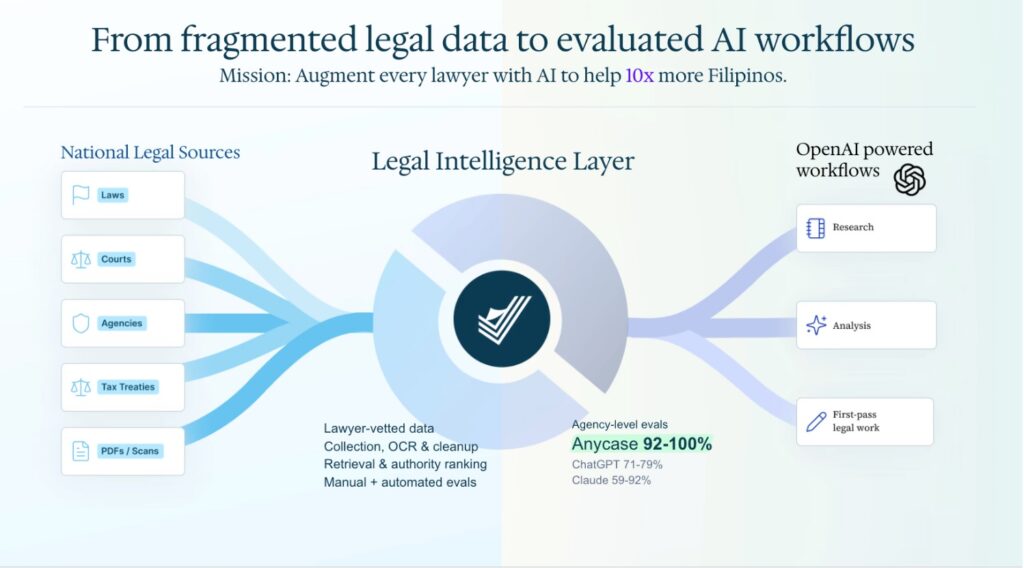
During the Singapore demonstration, Bongco showed how the platform analyzes a labor dispute by identifying legal issues, retrieving relevant statutes, regulations, and Supreme Court decisions, outlining available remedies, and helping lawyers prepare procedural requirements for cases before the National Labor Relations Commission.
Tiongson recalled Bongco emphasizing the practical value of the platform for lawyers handling cases outside their usual fields of practice.
“This is very important for lawyers who don’t practice labor,” Tiongson recalled Bongco saying. “If I’m a criminal lawyer taking on a labor case, I don’t actually know the procedure.”
According to the company, the platform can also generate draft legal arguments and automatically recommend supporting jurisprudence for specific portions of legal pleadings.
For Tiongson, the effort is about more than building another AI application.
“I’ve always believed the Philippines should not just be a market that imports software built elsewhere,” he wrote. “We can build deep, local, domain-specific AI too.”