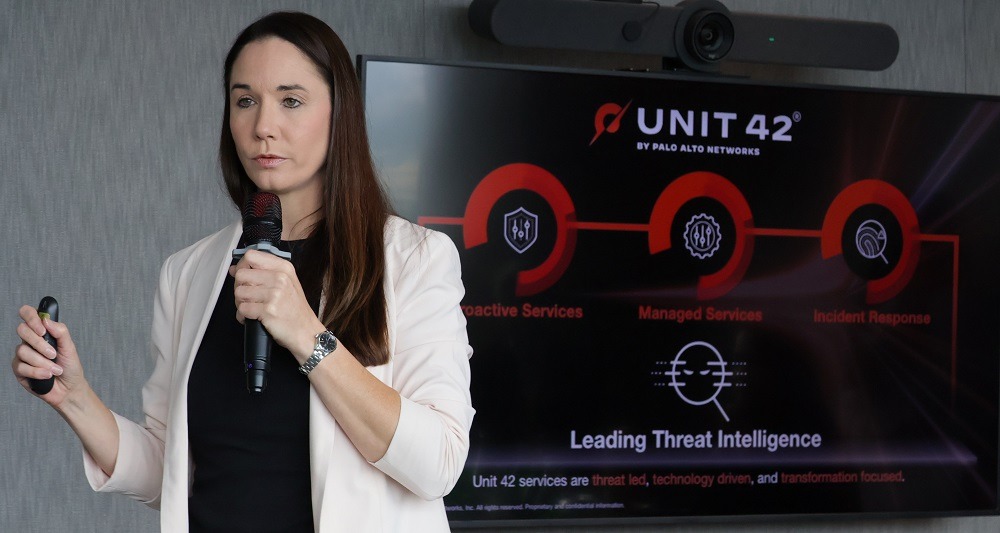
Cybersecurity is no longer just an IT issue but a business risk that now demands board-level attention, according to Palo Alto Networks, as artificial intelligence speeds up both cyberattacks and the tools used to defend against them.
Ahead of the company’s “Ignite on Tour” event, Philippa Cogswell, vice president and managing director for Asia Pacific at Unit 42, said the rise of “Frontier AI” is reshaping the cyber threat landscape and forcing organizations to strengthen defenses as attacks become faster and more sophisticated.
Unit 42, Palo Alto Networks’ threat intelligence and incident response arm, said it handled more than 750 major cyber incidents across 50 countries over the past year.
Among the trends it is seeing is a growing focus by attackers on operational systems, a shift that could disrupt productivity and manufacturing operations.
Cogswell said four themes are shaping the current threat environment: AI-driven amplification of attacks, the exploitation of identity-related weaknesses, a rise in software supply chain vulnerabilities, and increasingly stealthy tactics by nation-state actors.
The company also pointed to the shrinking window for response, saying cyber compromises now happen in as little as 72 minutes, leaving human analysts with less time to react and increasing the need for machine-speed detection and response.
Palo Alto Networks said it has been using AI models from companies such as OpenAI and Anthropic in its security research, including efforts to identify vulnerabilities, assess misconfigurations, and correlate leaked credentials with exposed APIs. The company said these tools have helped surface weaknesses, including older vulnerabilities that could still be exploited.
Cogswell said businesses pursuing AI adoption should focus not only on innovation but also on securing identities across users, machines, and AI systems, reducing attack surfaces, and applying zero-trust principles to limit the spread of threats.
“Cybersecurity has transitioned from a technical IT challenge to a crucial business imperative that commands attention at the board level,” Cogswell said.
She added that companies need to prioritize secure digital transformation to protect innovation, customer trust, and long-term enterprise value as cyber risks continue to rise.