
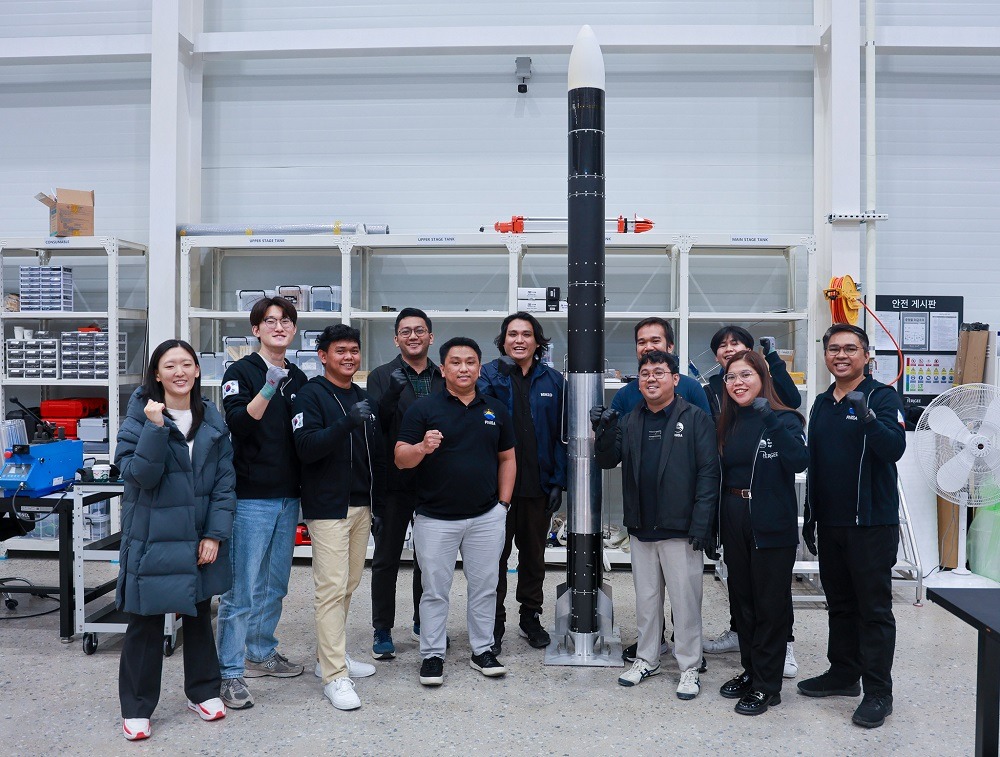
The Philippines plans to conduct its first liquid-fueled sounding rocket launch from local soil in Cagayan in 2027 as part of efforts to develop domestic launch capabilities and lay the groundwork for a commercial spaceport.
Pres. Ferdinand Marcos Jr. highlighted the planned test flight during his State of the Nation Address on Monday, July 27.
“Cagayan is both geographically and economically primed to serve as our gateway to space and host the country’s first spaceport. A sounding rocket launch test is slated for next year,” Marcos said.
The rocket will carry a locally developed payload weighing up to two kilograms and is expected to reach an altitude of at least five kilometers, according to the Philippine Space Agency (PhilSA).
The planned altitude is well below the commonly recognized boundary of space at 100 kilometers. The test is intended primarily to demonstrate the launch of a liquid-fueled rocket from Philippine territory and help Filipino engineers gain experience in rocket technologies and launch operations.
“Yes, we are going to launch a rocket into space,” Marcos said.
PhilSA is implementing the project with the Department of Information and Communications Technology (DICT), Cagayan Economic Zone Authority (CEZA), airport operator Ascend International Gateway Inc., and South Korean launch vehicle developer Perigee Aerospace Inc.
The partners signed a memorandum of understanding during the Philippines–Korea Business Forum on March 4, 2026. The government is also preparing interim rules for rocket launches and related activities.
PhilSA director general Gay Jane Perez said the country’s location could support future launch and recovery operations, particularly with the Pacific Ocean to its east and its proximity to the equator.
“As global launch rates continue to accelerate, existing spaceports cannot serve this increasing demand. With the Pacific Ocean to its east and its proximity to the equator, the Philippines is well positioned for safe and secure rocket launch and recovery operations, helping reduce costs, improve launch efficiency, and create opportunities for future launch services,” Perez said.
PhilSA is pursuing a public-private partnership for the proposed Philippine spaceport. The agency said it wants the facility to operate commercially under a government regulatory framework.
“Our vision is for the Philippines to have a spaceport that serves as a gateway for safe, responsible, and sustainable space access for the region and the world. It will be a commercial-driven, government-enabled spaceport, with predictable timelines for launch licensing and authorization,” Perez said.
“Apart from location, launch companies also take into consideration the approval process: whether it is clear, whether the approvals arrive on a schedule they can plan around, and whether the country meets its international obligations. That reliability is where the Philippines intends to compete, and it marks a shift in the country’s role in the regional space economy, from a user of space services to one that helps provide them,” she added.
Under the second phase of a technology transfer and training program, selected Filipino engineers will undergo advanced training and hands-on work involving Perigee’s Blue Whale-class sounding rocket platform.
PhilSA’s engagement with Perigee began under former director general Joel Marciano Jr. through an agreement signed in October 2022. The first phase of the small-launch-vehicle training program was conducted in October and November 2025.
DICT secretary Henry Aguda said developing a domestic launch capability could eventually support the deployment of communications, Earth observation, and navigation satellites.
“Space-based technologies are an essential foundation of modern ICT infrastructure. Sovereign launch capability will allow the Philippines to independently deploy communications satellites, Earth Observation systems, and navigation assets. This advances the country’s long-term vision of building a secure, resilient, and inclusive digital ecosystem, ensuring that the Philippines remains competitive in the digital age” Aguda said.
However, the planned 2027 sounding rocket test is an early-stage demonstration and would not by itself provide the country with the capability to place satellites into orbit. Achieving that goal would require more powerful launch vehicles, supporting infrastructure, and a licensing and safety framework for orbital missions.


