The credit confidence of Filipinos climbed to a record high in 2026 despite inflation and rising living costs, as more consumers turned to digital banks and formal financial products, according to TransUnion.
The credit information company said the Philippines scored 75 out of 100 in its latest Credit Perception Index (CPI), the highest since the index was introduced.
The increase was driven by a four-point improvement in consumer favorability toward credit, as well as three-point gains in both trust in credit products and knowledge of how they work.
“What stands out this year is that confidence in credit continued to improve even as consumers faced a more challenging economic environment,” TransUnion Philippines president and CEO Peter Faulhaber said.
The findings suggest that Filipinos are increasingly using credit as part of their financial planning even as their broader economic outlook becomes less optimistic.
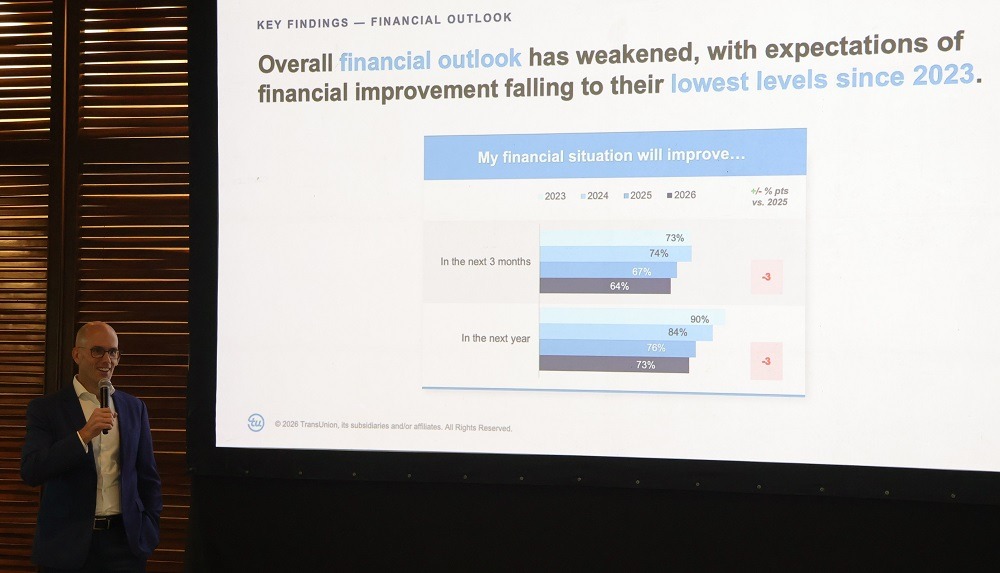
Only 64% of respondents expected their financial situation to improve over the next three months, while 73% anticipated an improvement within the next year. Both figures were three percentage points lower than in 2025.
Inflation, higher living costs, and rising energy prices remained among consumers’ main concerns.
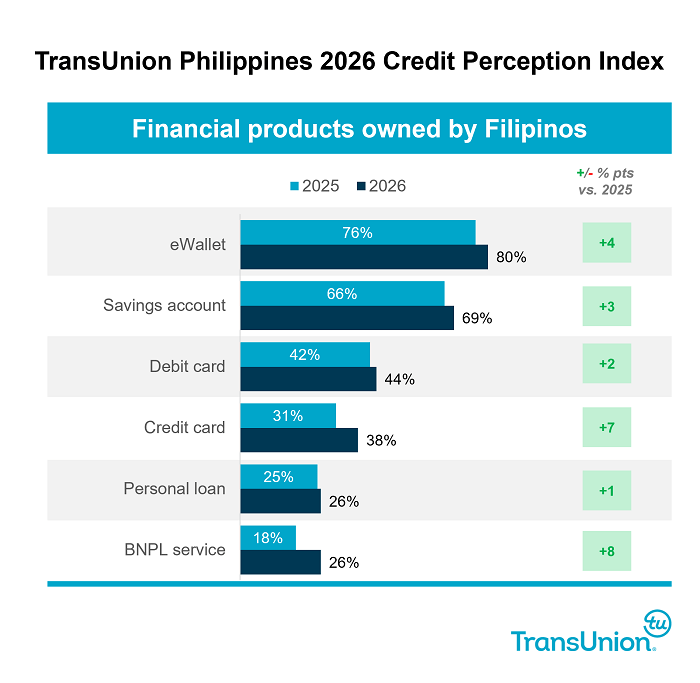
At the same time, the adoption of several financial products increased. Credit card ownership rose seven percentage points to 38%, while the use of buy now, pay later services climbed eight points to 26%.
Personal loan adoption edged up one point to 26%. eWallets remained the most widely held financial product, rising four points to 80%.
TransUnion said digital banks were also gaining acceptance, partly because consumers had become more confident in security measures such as multi-factor authentication and real-time fraud monitoring.
The report also cited parental controls that allow guardians to monitor or restrict their children’s spending, although it did not provide figures showing how widely these features were being used.
Despite the increased use of credit, saving remained the most commonly planned financial action, cited by 86% of respondents. The results indicate that consumers are combining greater access to credit with efforts to build financial buffers against continued economic uncertainty.