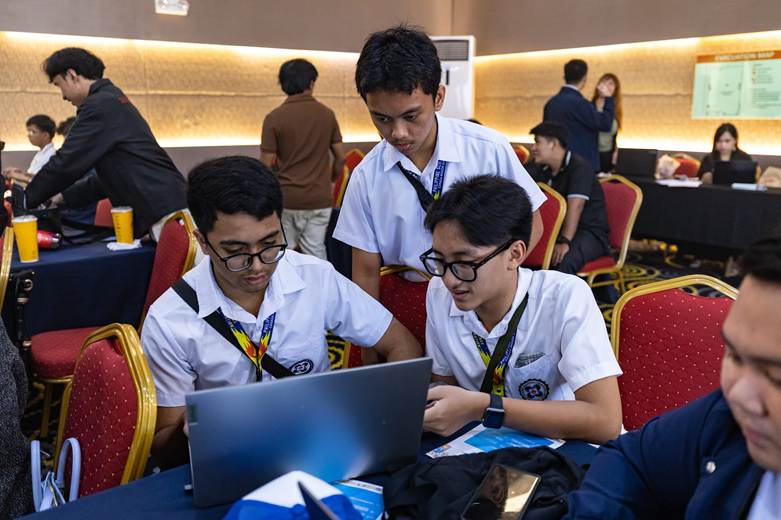
Junior high school students from Philippine Science High School-Caraga Region Campus have developed an online emergency management platform designed to help schools account for students during fires, earthquakes, shootings, and other emergencies.
Called “Ligtas Skwela,” the platform provides teachers, emergency responders, and school administrators with information on the location and status of students during an incident.
The project won first place among nine finalists in the student category of the Startup Technology Pitching Competition held in Butuan City during the Regional Science, Technology and Innovation Week in Caraga from Aug. 27 to 29.
“With the recent happenings in Ateneo De Zamboanga or other school shootings or maybe earthquakes or fire, we’ve noticed that sometimes in the system, they tend to not focus on the students and where they are in school. And so, while we were worrying about that, we were trying to find a solution where students can be easily accessed and they can easily be found,” said Lorenzo S. Pariñas, who handles the project’s Internet of Things and cloud storage components.
Ligtas Skwela currently operates as an online, subscription-based platform, although the team is working on an offline version that could remain accessible when internet connectivity is disrupted.
The system has separate interfaces for teachers and emergency commanders.
“It is split into two modes. There is teacher mode and commander mode. In commander mode, you’re able to see all the classrooms, all the teachers managing them and their status. So, if a room is secure or people in need of medical aid, you can see all kinds of status. There’s also event logs where you can see what’s happening,” project leader Kush D. Shekar said.
In teacher mode, faculty members can report the condition of their classes. Instead of relying solely on headcounts, the platform records students by name, allowing school administrators to identify who remains unaccounted for.
“Currently, the website is working, the platform is working, it’s all functional but we’ve only tested it so far in our campus. For now, we plan to expand it further since it’s still in the development stage,” said Vic Andrei P. Hernando, the team’s market research head.
Based on the team’s current projections, the service would cost P30,000 annually for every 1,000 students, equivalent to P30 per student.
The developers also plan to connect physical emergency buttons and alarm systems to the platform.
“Our future plans include incorporating hardware into our platform. I think it will be way more useful to have buttons since it’s way easier to access to perform the drills and [trigger] the alarm,” Hernando said.
The team said it was also preparing to apply for a patent for the technology.
Shekar, Pariñas, and Hernando developed the project under the guidance of engineer Lyndon R. Bermoy.
“Of course, nagpapasalamat ako sa kanilang tatlo, for being the best students that they are already. Pinractice ko silang mabuti sa pitching kasi first time nilang mag pitch, at first time nilang sumali sa ganito,” Bermoy said.
Shekar’s group was the only high school team to reach the finals of the competition. Entries were evaluated based on relevance, originality, artificial intelligence integration, business viability, potential impact, and prototype functionality.