
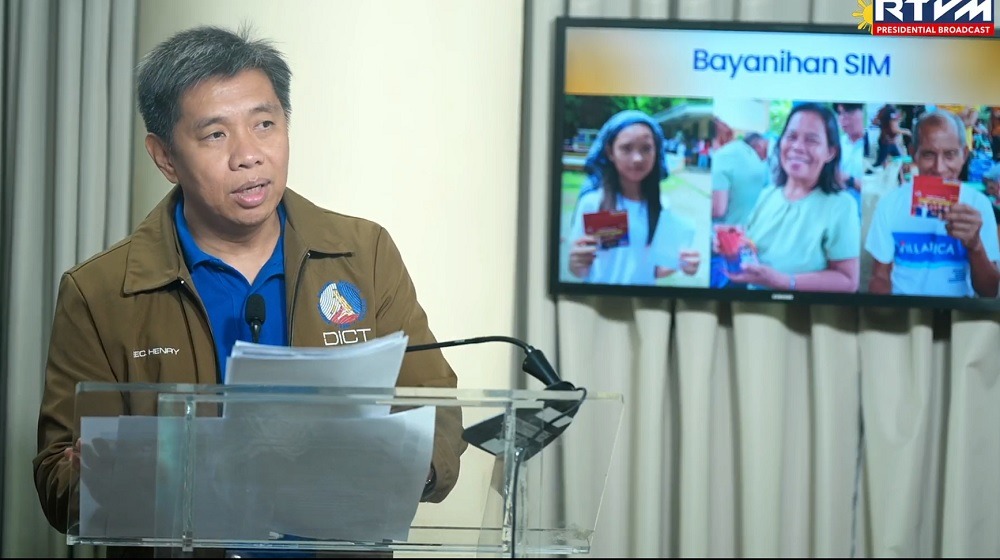
Department of Information and Communications Technology (DICT) secretary Henry Aguda on Friday, Nov. 28, said the agency’s P3-billion Bayanihan SIM Project ultimately underwent full competitive bidding after initially seeking permission for direct contracting.
During a recent budget hearing, Sen. Risa Hontiveros questioned the DICT’s original plan to pursue direct contracting.
Aguda, who was not in the Senate during the budget hearing, emphasized that the agency’s procurement strategy changed after reviewing legal requirements and market conditions, as well as the concerns raised by lawmakers.
According to Aguda, the DICT first considered direct contracting only in cases where a single telecom provider operated in a remote barangay — circumstances where public bidding would not be practical.
However, he said the department realized that telecom coverage could change quickly over the months-long bidding process, which meant a supposedly “sole provider” barangay could later have multiple providers.
“When we looked at the bidding, let’s say there’s a barangay in San Carlos and there’s only one provider. But what if in the 2–3 months of bidding, a new cell site appears? Then it’s no longer a single-source case,” Aguda explained.
Because of this, he said, the DICT abandoned the direct-contracting route and subjected the entire P3-billion program to full bidding.
Aguda stressed that only minor items — such as office supplies or equipment with only one available manufacturer — go through direct procurement.
He said that the SIM project, which involves data allocations and partnerships with major telcos, falls under mandatory competitive bidding.
“For the big items, it’s public and competitive bidding,” Aguda said.
He added that the DICT required NTC certifications to confirm sole-provider situations in any locality, further supporting the agency’s pivot to competitive procurement instead of exemptions.
Hontiveros earlier accused Aguda and his team of misleading the Senate when they claimed that the new Government Procurement Act’s implementing rules and regulations (IRR) was “not yet promulgated” at the time the DICT wrote to Malacañang seeking approval for direct contracting.
The senator emphasized that the IRR had been published months earlier, prompting Aguda to clarify the agency’s process and reiterate that the final procurement was compliant.


