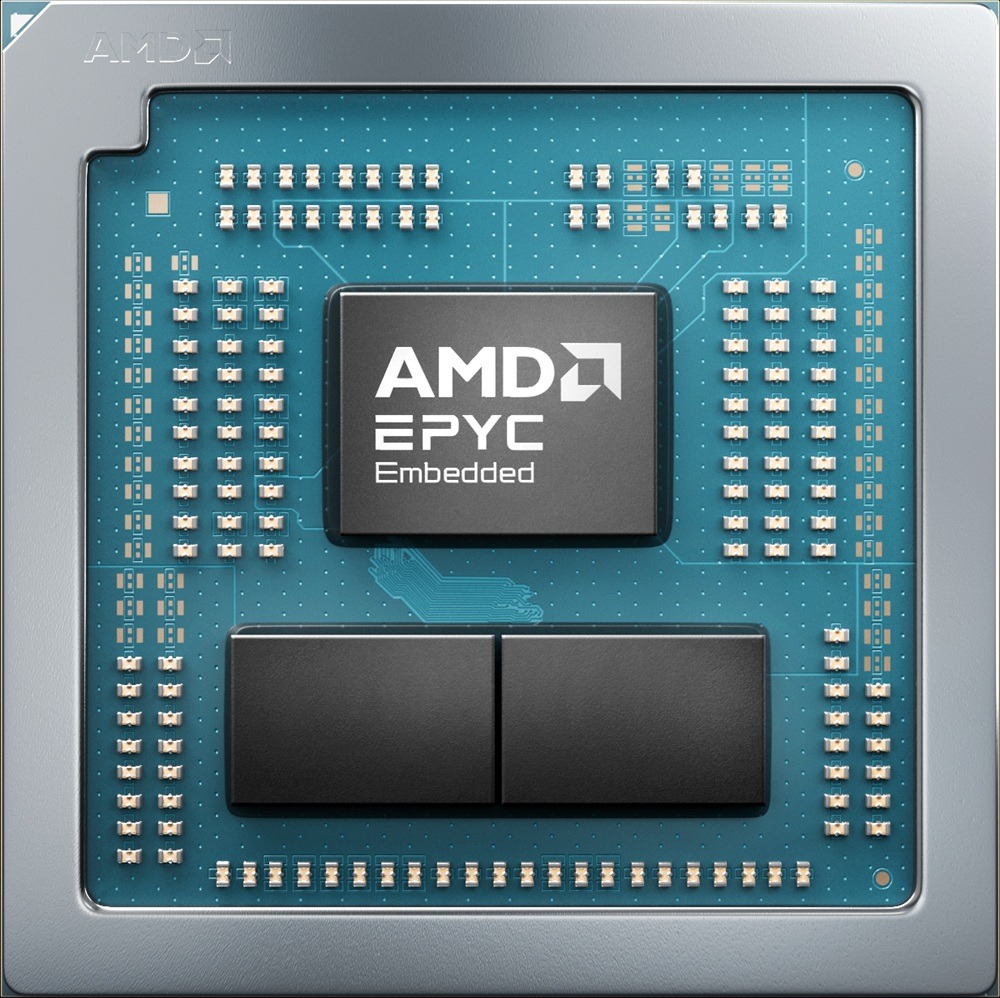
Chipmaker AMD has introduced its new EPYC Embedded 2005 Series processors, a compact line of chips designed for power- and space-constrained equipment such as networking gear, storage systems, and industrial devices that require continuous 24/7 operation.
The processors, built on AMD’s latest “Zen 5” architecture, come in a 40mm × 40mm BGA package and offer up to 16 x86 cores, 64MB of shared L3 cache, and configurable thermal design power ranging from 45W to 75W.
AMD says the smaller form factor allows higher I/O density and improved thermal performance compared with competing solutions.
The company claims the new chips deliver higher clock speeds at half the thermal envelope of comparable Intel Xeon 6500P-B processors, enabling improved performance per watt for equipment where energy efficiency and limited space are key design constraints.
Targeted at long-life infrastructure deployments, the EPYC Embedded 2005 Series is rated for up to 10 years of continuous field operation and comes with extended component ordering and software support.
Reliability features include enhanced error detection and correction, PCIe hot-plug support, and integration options such as baseboard management controllers commonly used in networking and storage hardware.
Security capabilities under AMD’s Infinity Guard suite — such as a dedicated secure processor, platform secure boot, and memory encryption — are included to protect systems in industrial and mission-critical environments.
The processors also support PCIe Gen5 with 28 available lanes and DDR5 memory, giving system builders bandwidth for high-speed NICs, accelerators, or storage controllers. AMD says the chips are already supported across major open-source development stacks, including Yocto, kernel drivers, and EDK II.
With the EPYC Embedded 2005 Series, AMD is aiming to expand its footprint in embedded infrastructure used in telecommunications, cloud storage, robotics, aerospace, and industrial automation — sectors increasingly shaped by AI-driven workloads and rising compute demands in smaller devices.