
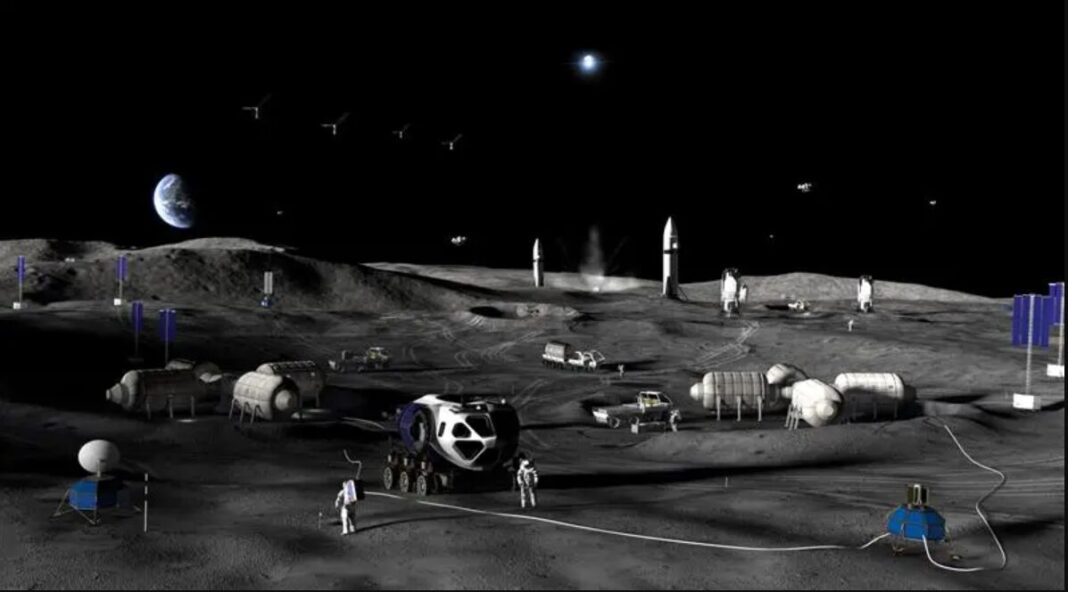
Chipmaker AMD is pitching its computing technologies as essential to the next phase of space exploration, as the United States pivots toward sustained lunar operations and deeper space missions.
The company said growing mission complexity — including projects such as Artemis II and the NISAR Earth observation satellite — is driving demand for high-performance, autonomous computing systems capable of operating far from Earth with minimal latency.
“With NASA recently announcing a shift from short-duration missions to sustained lunar presence and deep-space exploration, autonomous, high-performance computing is no longer optional – it’s mission-critical,” AMD said.
AMD highlighted its portfolio of CPUs, GPUs, field-programmable gate arrays (FPGAs), and adaptive system-on-chips (SoCs), which it said are already used in missions ranging from Mars rovers to Earth observation satellites. These technologies enable onboard data processing, reducing reliance on limited communication bandwidth with Earth.
The company pointed to recent industry collaborations, including the use of its Versal AI Edge adaptive SoCs in Blue Origin’s lunar lander development and in Japan’s planned optical communication satellite constellation with NEC.
AMD said moving compute capabilities closer to spacecraft and surface systems allows real-time data analysis, which is critical for autonomous operations on the Moon and beyond.
It also emphasized the role of reconfigurable hardware, which can be updated after deployment to adapt to evolving mission requirements.
For data-intensive missions such as NISAR, AMD said onboard AI processing can filter and compress large volumes of radar data before transmission, improving efficiency and enabling faster insights for applications like climate monitoring and disaster response.
The company also underscored the reliability of its space-grade hardware, noting its use in missions such as the Mars Perseverance rover and the OSIRIS-REx asteroid sample return project. These systems are designed to withstand radiation and extreme conditions while supporting long-duration missions.
AMD said its technologies are aimed at enabling more flexible, autonomous, and resilient space systems as NASA and its partners pursue long-term exploration goals.


