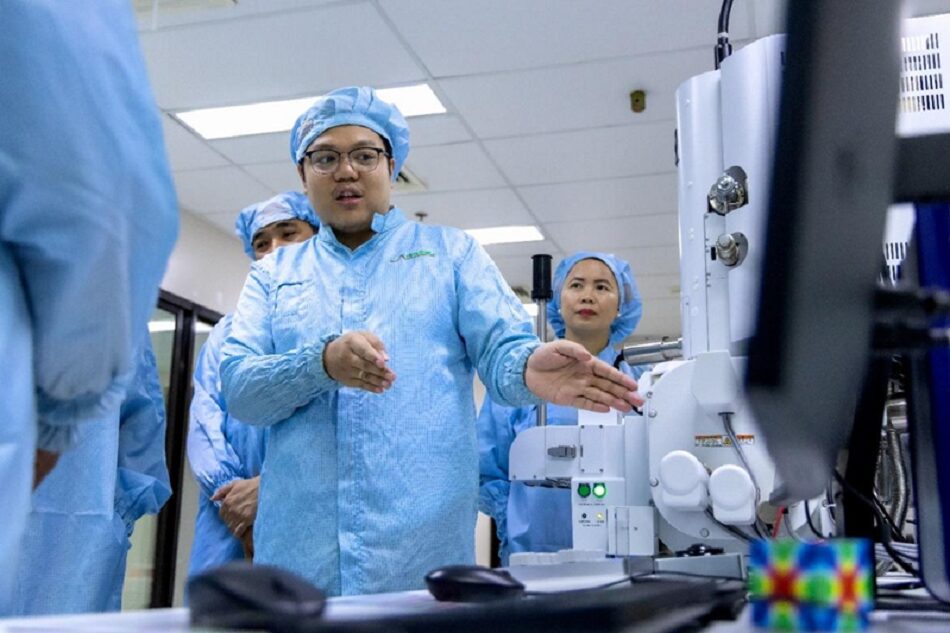
The Department of Science and Technology (DOST) has rolled out a new nanoscale analysis facility aimed at supporting the country’s semiconductor and electronics industries, as well as research institutions.
The agency recently unveiled a Field Emission Scanning Electron Microscope (FE-SEM) at the Advanced Device and Materials Testing Laboratory (ADMATEL) in Bicutan, Taguig.
The system, paired with Energy Dispersive X-ray (EDX) and Electron Backscatter Diffraction (EBSD) analyzers, is expected to expand the laboratory’s capability for failure analysis and material characterization.
The equipment allows researchers and manufacturers to examine materials at the nanoscale, helping detect defects that could affect the performance of electronic devices such as smartphones and laptops.
“Investing in a FE-SEM is a strategic step toward strengthening the country’s advanced research and manufacturing capabilities. With its ability to reveal materials at the nanoscale, this technology enables precise characterization of nanoparticles, nanotubes, and advanced materials, as well as detailed analysis of thin films and multi-layer coatings essential to modern technologies,” said DOST secretary Renato U. Solidum Jr.
The facility is expected to serve semiconductor firms, academic institutions, and research organizations. Beyond electronics, the microscope can also be used to analyze biological samples and other advanced nanomaterials.
“The launching of this new equipment strengthens our country’s capacity to support the semiconductor and electronic sectors, as well as advanced materials in research and development industries,” Solidum added.
“It empowers our local companies not just to fix problems, but to design better, more reliable products from the start. In today’s fast-changing technological landscape, the semiconductor and electronics industries are essential engines of economic growth.”
Project leader John Kenneth Valerio said the technology enables high-magnification imaging needed to detect even the smallest defects.
“As electronic devices become smaller and more efficient, we need equipment that can analyze materials at a much smaller scale,” he said. “This technology allows us to capture extremely high-magnification images and detect even the smallest defects or contaminants that affect product performance.”
Dan Lachica, president of the Semiconductor and Electronics Industries in the Philippines Foundation Inc. (SEIPI), said the equipment would help improve reliability and manufacturing processes.
“The FE-SEM helps enable precise examination of device structures, interfaces, materials behavior, and process-induced variations that may directly affect performance and reliability. It plays an important role in identifying defects, supporting root cause analysis, process improvement, validating processes, and helping resolve complex reliability issues,” he said.
DOST undersecretary Leah J. Buendia said the system will support a wide range of applications, including defect identification, failure analysis, and contamination detection at the nanoscale.
“Through this latest FE-SEM, we can now support a wide range of critical applications. These include identifying defects in semiconductor devices, analyzing microstructural failures in electronic components, and detecting contamination at a nano scale, resulting in improving product reliability and quality assurance processes,” she said.
DOST said ADMATEL will continue offering testing services to local and international clients, with collaboration open to industry and academic partners.