
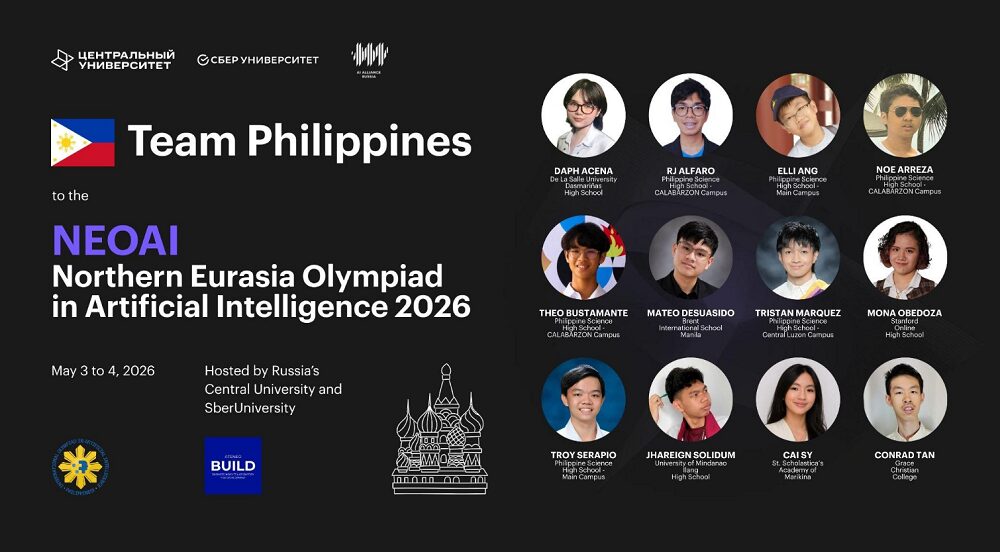
The Philippines ranked third among national delegations at the 2026 Northern Eurasia Olympiad in Artificial Intelligence (NEOAI), with eight Filipino students placing in the global top 100 of the international competition.
The Philippine delegation, selected through the International Olympiad in Artificial Intelligence Philippines (IOAIPH) organized by Ateneo de Manila University’s Business Insights Laboratory for Development (BUILD), competed against 224 participants from countries including Russia, Romania, Iran, Malaysia, Serbia, Cyprus, and Mongolia.
The competition, hosted by Central University and SberUniversity, tested participants on machine learning, computer vision, and audio processing through a two-day series of artificial intelligence engineering challenges.
Leading the Philippine contingent was Juan Mateo J. Desuasido of Brent International School Manila, who ranked 17th globally with 365.79 points.
His score placed him in the equivalent gold tier and made him the highest-ranked competitor outside the Russian and Romanian delegations.
Daphne Eunice U. Acena of De La Salle University–Dasmariñas High School and Theo Lorenzo T. Bustamante of Philippine Science High School–Calabarzon Region Campus earned equivalent silver-tier finishes, ranking 51st and 56th globally, respectively.
Five other Filipino students placed in the equivalent bronze tier: Ryan James L. Alfaro of Philippine Science High School–Calabarzon Region Campus, Conrad Jeffrey C. Tan of Grace Christian College, Troy Dylan T. Serapio of Philippine Science High School–Main Campus, Tristan Japheth L. Marquez of Philippine Science High School–Central Luzon Campus, and Aretha Cai Faustine M. Sy of St. Scholastica’s Academy of Marikina.
Ellison Matthew S. Ang of Philippine Science High School–Main Campus received an equivalent honorable mention after a strong performance on the competition’s second day.
Also representing the country were Almond Rose M. Obedoza of Stanford Online High School, Jhareign S. Solidum of University of Mindanao Ilang High School, and Noe Nathan Y. Arreza of Philippine Science High School–Calabarzon Region Campus. All 12 members of the delegation received official international certificates from the organizers.
Based on the average scores of each country’s top three competitors, the Philippines placed third overall among national delegations, behind Russia and Romania. The Philippine team also achieved a 100% certification rate.
The results highlight the growing presence of Filipino students in international artificial intelligence competitions, a field that combines computer science, data science, and advanced mathematics.


