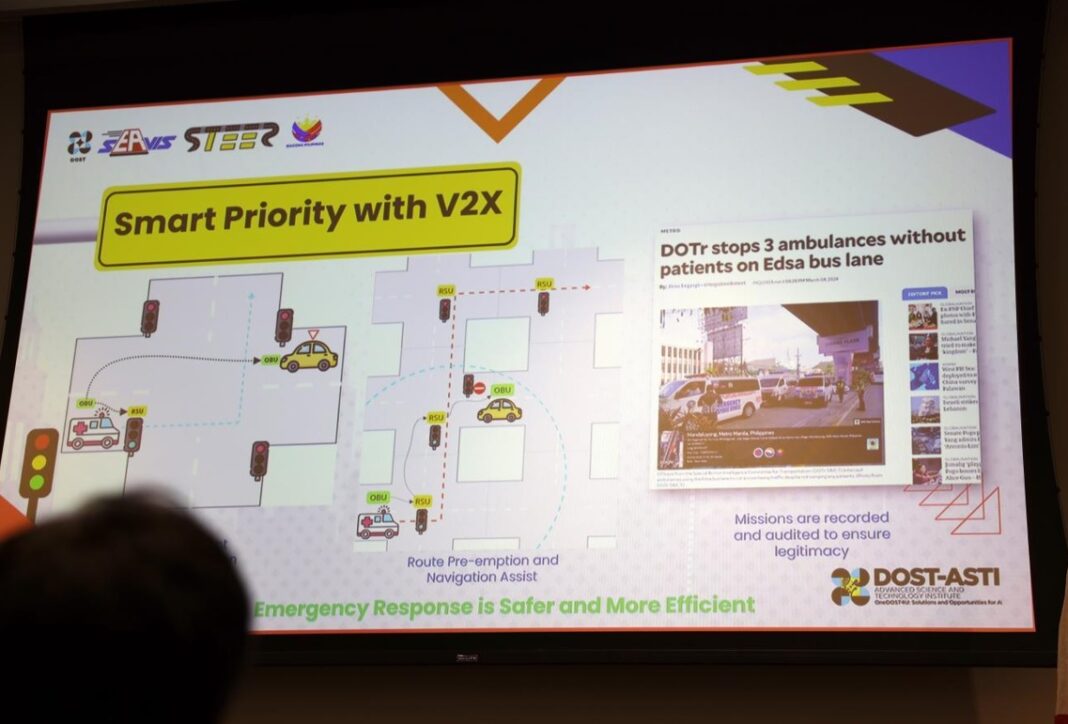
The Department of Science and Technology (DOST) is preparing to pilot a smart traffic management system designed to give ambulances, fire trucks, and other emergency response vehicles faster access through congested roads.
Developed by the DOST’s Advanced Science and Technology Institute (DOST-ASTI), the Swift Emergency Response Vehicle Integration System with Smart Traffic and Electronic Enforcer on the Road (sERVis-STEER) uses Vehicle-to-Everything (V2X) wireless technology to allow emergency vehicles to communicate directly with traffic infrastructure and automatically receive priority at intersections.
The project seeks to address delays faced by local government emergency response vehicles during critical situations, when responders often rely on traffic enforcers to manually override traffic signals or direct counterflow traffic.
According to DOST-ASTI, such methods can be inefficient and may create safety risks for other motorists.
Under the system, emergency vehicles are equipped with onboard communication units that interact with roadside infrastructure, triggering intelligent traffic signal adjustments to create a clear path.
The platform is also linked to an Emergency Response Information Exchange Server Platform, which allows hospitals, dispatch centers, traffic management agencies, and field responders to coordinate in real time.
The centralized platform includes monitoring, scheduling, and auditing functions intended to verify emergency missions and prevent the misuse of emergency sirens and traffic privileges by unauthorized vehicles.
DOST secretary Renato Solidum Jr. said the project’s success would depend on the cooperation of local government units, government agencies, and the public.
“We need a full partnership of our local government units, partner agencies, and all of you to bring the same sense of urgency that our emergency responders bring to the road every day. DOST has always believed that science is most meaningful when it reaches the people who need it most,” he said.
Solidum added that the initiative represents more than a research effort.
“It is a commitment to the Filipino people that their safety is our priority and that their government is investing in solutions that are both innovative and practical — the true embodiment of Agham na Ramdam,” he said.
To prepare for deployment, DOST-ASTI recently convened local government units, national agencies, and partner organizations during an Intelligent Transportation Systems (ITS) Stakeholders’ Summit held on June 4.
The event included technology demonstrations, discussions on deployment requirements, and presentations on the country’s broader ITS roadmap.
Project leader Ramon Vann Cleff B. Raro said the initiative forms part of DOST-ASTI’s Philippine Road Safety Initiatives Program, which explores the use of computer vision, wireless communications, and other digital technologies to improve road safety and traffic management.
Beyond emergency response, DOST-ASTI said the project could serve as a foundation for future intelligent transportation systems, smart public transit networks, and other smart city applications in the Philippines.