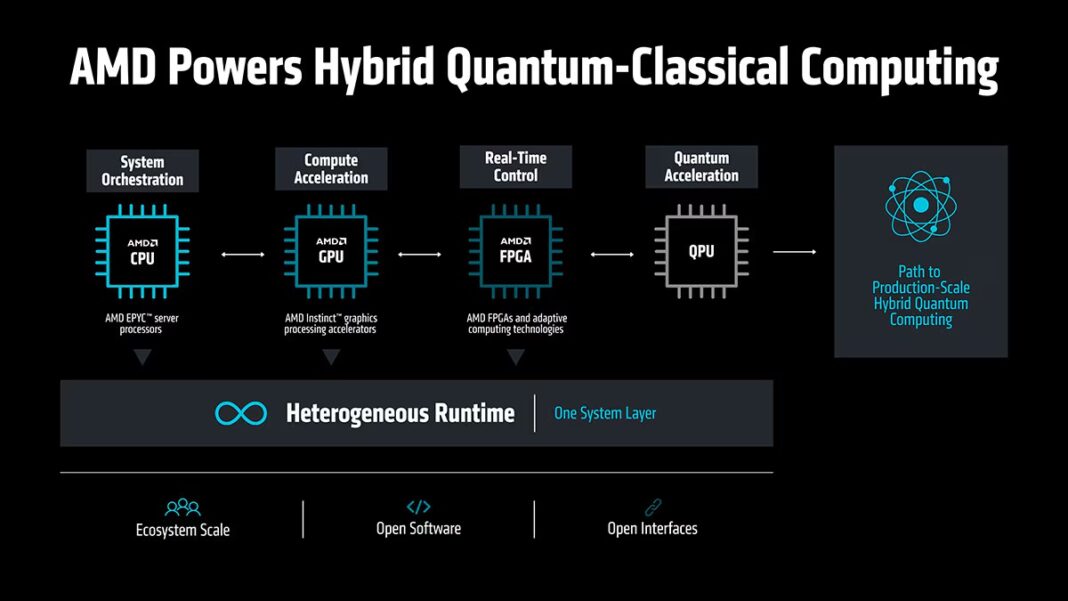
Chipmaker AMD is positioning its processors, accelerators, networking technologies, and software as key components of the emerging hybrid computing infrastructure expected to support the commercialization of quantum computing.
The company said the industry is shifting away from viewing quantum computers as standalone systems, arguing instead that future quantum workloads will rely heavily on conventional high-performance computing (HPC) and artificial intelligence (AI) platforms.
AMD’s position comes as governments and research institutions increase investments in quantum technologies. In May, the US Department of Commerce announced plans to invest more than $2 billion in quantum computing and quantum manufacturing initiatives as part of efforts to strengthen the country’s domestic quantum ecosystem.
According to AMD, quantum processors are designed to solve specific classes of problems that are difficult for conventional computers, including applications in chemistry, materials science, drug discovery, energy research, optimization, and scientific modeling.
However, current quantum systems still face technical limitations such as error rates, coherence constraints, and scalability challenges.
As a result, AMD said today’s quantum systems continue to depend on classical computing for tasks such as system control, calibration, simulation, data preparation, orchestration, error correction, and post-processing.
“As we see it, the future is increasingly centered on hybrid quantum-classical computing, where quantum processors serve as specialized accelerators within larger computing environments,” AMD said.
Under this model, quantum processors would handle specialized computational tasks while CPUs and GPUs perform the surrounding workloads needed to prepare data, manage operations, and process results.
AMD said its portfolio of EPYC server processors, Instinct GPU accelerators, FPGA-based adaptive computing devices, networking products, and ROCm software platform are intended to provide the classical infrastructure needed to support multiple quantum computing technologies.
Rather than backing a single quantum hardware approach, the company said it aims to support different quantum architectures, including superconducting, trapped-ion, neutral-atom, and photonic systems.
AMD also highlighted collaborations with IBM, JPMorganChase, and Oak Ridge National Laboratory to explore how quantum processors can be integrated with AI and HPC systems.
The company said its work with IBM focuses on quantum-centric supercomputing architectures that combine quantum processors with conventional computing resources.
AMD acknowledged that large-scale, fault-tolerant quantum computers remain a long-term objective, but said near-term progress will depend on hybrid workflows, advances in error correction, and tighter integration between quantum and classical computing systems.
“We are building infrastructure to support a broad range of quantum modalities,” the company said. “As the quantum era transitions from ambitious laboratory curiosity to commercial necessity, AMD isn’t just participating in the ecosystem. We are building foundational computing technologies to support quantum computing at scale.”