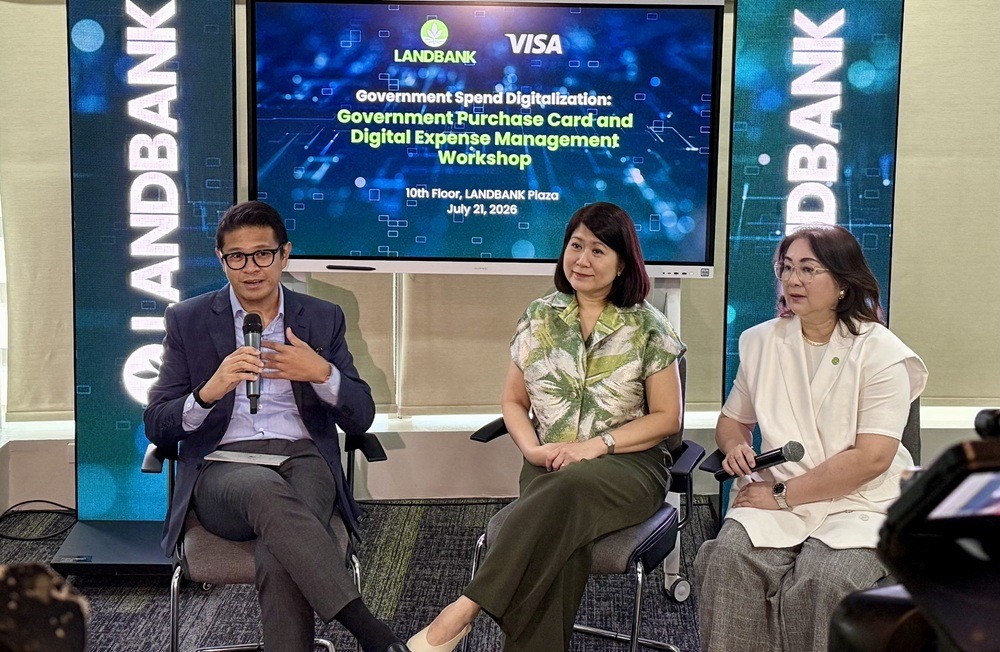
State-owned Landbank and Visa have launched a government purchase card equipped with spending controls and a digital expense management system designed to reduce government agencies’ reliance on cash advances and manual reimbursements.
The Landbank Visa Government Purchase Card allows agencies to set credit limits, restrict transactions to approved merchant categories, and monitor purchases digitally. It is intended for low-value procurement, official travel and recurring expenses, among other expenditures permitted under government rules.
The Bureau of the Treasury is among the first government institutions to adopt the card. It manages the custody and disbursement of government funds through its 16 regional offices.
Landbank executives said 107 agencies have been enrolled in the government purchase card program since 2023, with about 770 cards issued mainly to agency heads and selected senior officers. The state-run bank is targeting as many as 2,000 participating agencies by the end of 2026.
The card itself is not a new concept in government, but Landbank and Visa said the latest version is distinguished by an expense management system scheduled to go live in the fourth quarter.
The platform will automate transaction capture, reconciliation, approval workflows and reporting. Agencies will be able to view expenses by cardholder, office, week or month and compare recorded transactions with receipts.
Visa Philippines country manager Jeffrey Navarro said the technology goes beyond replacing cash with a card.
“What’s really more important is the governance behind it,” Navarro said. “Government agencies can have more control, visibility, transparency and the ability to audit government spending for that department.”
The platform can automatically reject purchases that exceed a cardholder’s spending limit or fall outside merchant categories authorized by the agency. These controls can be customized based on an agency’s budget, operating requirements and historical spending.
“In simple terms, the GPC is a customizable credit card,” a Landbank executive said. “It is up to the agency to decide the allowed merchant categories and the credit limits assigned to each cardholder.”
Landbank said the government purchase card operates like a credit card, but agencies are required to settle the full amount after every billing cycle. Since spending is tied to an approved government budget, bank executives said cardholders cannot charge amounts beyond the allocations and limits set for them.
The Commission on Audit (COA) may also be given access to the expense management system, allowing auditors and agencies to review the same transaction data.
“From the time you use your card, that is already visible in the expense management system,” a Landbank executive said. “This expense management system can be viewed by COA. We can give them access, and they can see the spending.”
However, the officials did not say whether transaction records would also be accessible to the public. The transparency feature discussed during the launch was primarily designed for internal agency oversight and government auditing.
The Department of Budget and Management has identified the types of expenses that may be charged to government purchase cards under its circulars. Specific limits and permitted uses will also be stated in agreements between Landbank and participating agencies.
Landbank president and chief executive officer Lynette V. Ortiz said the card would provide agencies with stronger oversight of their spending.
“Through our strengthened partnership with Visa, we are bringing global payments innovation to the public sector to drive transparency and accountability while advancing the National Government’s digitalization agenda. This empowers agencies with stronger financial oversight while building a more responsive digital experience for Filipinos,” Ortiz said.
Navarro said the card would use the same fraud detection, cybersecurity and data governance systems applied to Visa’s consumer payment products, including artificial intelligence tools that analyze transaction patterns for possible fraud.
“Visa as a global company, one of our biggest investments is always in fraud, cybersecurity, data governance, and now going to AI,” Navarro said. “We use a lot of AI also to understand the patterns of fraud, and we layer it with many fraud solutions.”
He said the expense platform adds another layer of protection by allowing agencies to tailor spending limits and merchant restrictions to individual users.
Navarro also said real-time data could help managers identify unusual spending patterns and assess how allocations are being used without going through piles of reimbursement documents.
“If I can demonstrate that I have been using the budget the right way, then it also makes it easier to ask for and prove where I really need more,” he said.
Landbank executives said adoption of the expense management platform would proceed at each agency’s own pace. Seventeen agencies and offices were initially brought into discussions on the new system, while institutions already holding government purchase cards may be enrolled later.
The bank is also looking at agencies with substantial spending requirements, including those in healthcare and national defense. It eventually plans to extend the program to government-owned and controlled corporations, state universities and colleges, local governments and possibly barangays.
“Digitalizing public finance management amplifies the power of Visa in helping the government make transactions more secure, seamless, and digital,” Navarro said.
“Through this innovation, we see this impactful collaboration with Landbank giving government agencies greater control over their processes, enabling them to be more agile and transparent to ultimately improve delivery of services to the Filipino public.”