
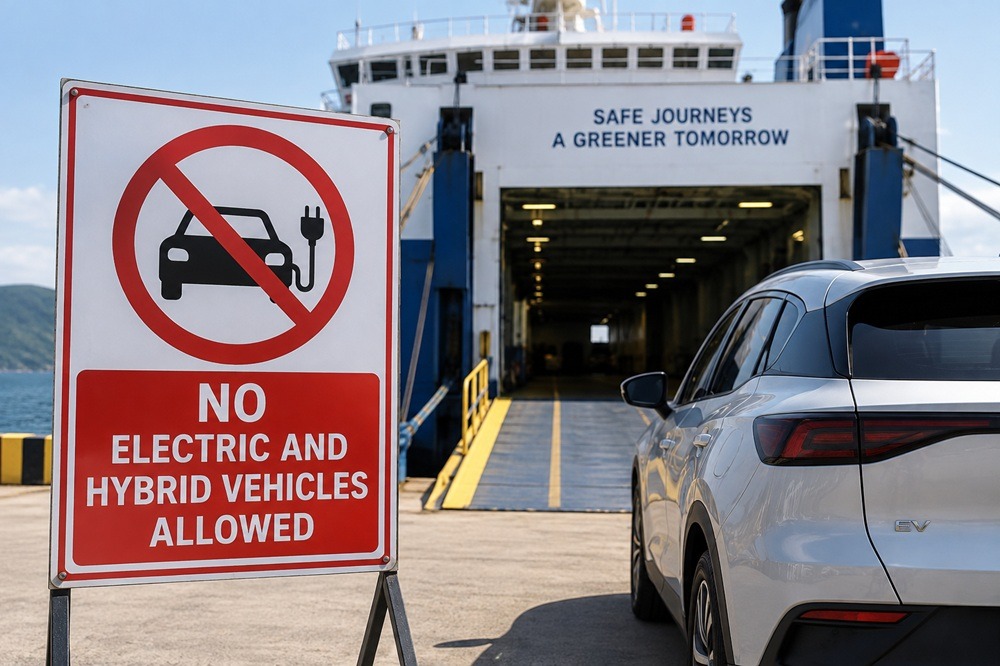
At least three domestic shipping companies have stopped accepting electric and hybrid vehicles aboard their vessels following the deadly MV June Aster fire off Coron, Palawan, raising questions over how battery-powered vehicles should be transported on Philippine ferries.
Montenegro Shipping Lines and Starhorse Shipping Lines have issued directives prohibiting electric vehicles (EVs) and hybrid electric vehicles (HEVs) from their vessels, citing concerns over fires involving lithium-ion batteries. Island Water has also imposed a similar restriction on its passenger vessels.
The moves came after the MV June Aster caught fire on Sept. 9 while sailing to Coron. The Philippine Coast Guard (PCG) has reported 77 fatalities, 43 survivors, and eight people still missing from the disaster. The vessel was carrying an electric vehicle, five motorcycles, a forklift, a pickup truck, and other cargo.
Authorities have said the fire began in the vessel’s cargo hold, based on the initial account of a surviving crew member. The crew member said what appeared to be a small fire rapidly grew within seconds.
However, investigators have not established that the EV aboard the June Aster caused the fire. The Department of Energy (DOE) has cautioned against drawing that conclusion while the investigation remains underway.
Despite the absence of a final finding, Montenegro Shipping Lines said in a Sept. 16 memorandum that initial information indicated the explosion “may have originated from an electric vehicle,” prompting the company to impose an immediate prohibition.
“Effective immediately, all Masters are hereby instructed NOT to allow any Electric Vehicle (EV) or Hybrid Electric Vehicle (HEV) to be boarded or carried onboard our vessels, whether for passenger or cargo carriage,” the company said.
Montenegro said the restriction was a preventive measure intended to reduce the risk of “fire, explosion, thermal runaway, and other potential hazards associated with electric and hybrid vehicle batteries during vessel operations.”
Its vessel masters, terminal personnel, ticketing staff, and cargo personnel have been instructed to identify vehicles before boarding and refuse EVs and hybrids until further notice.
Starhorse Shipping Lines followed with its own fleet-wide restriction on Sept. 18, saying domestic roll-on, roll-off vessels were not yet adequately equipped to handle some of the risks associated with battery fires.
“The batteries used in today’s electric and hybrid vehicles present risks that domestic RORO service is not yet equipped to manage,” Starhorse said in its advisory.
The company pointed to the enclosed or semi-enclosed vehicle decks on RORO ships and the difficulty of controlling lithium battery fires once thermal runaway occurs.
“A lithium battery fire can enter thermal runaway, is difficult to cool and contain with the firefighting systems now fitted on our vessels, and may reignite after it appears to have been put out,” Starhorse said.
Effective immediately, the company said it would no longer accept fully electric, hybrid, or plug-in hybrid cars, SUVs, vans, and trucks for carriage on any vessel in its fleet.
Starhorse stressed that the restriction was precautionary rather than a rejection of electric transportation.
“This is a precaution. It is not a judgment on electric mobility, and it is not permanent by design,” the company said.
The company said it would review the restriction once the Maritime Industry Authority (MARINA) and DOE issue clearer guidance and its vessels can comply with the resulting safety requirements.
The decisions exposed a regulatory gap as EV adoption expands in the Philippines. Current regulations do not specifically prohibit EVs from being transported aboard domestic vessels, according to the DOE.


