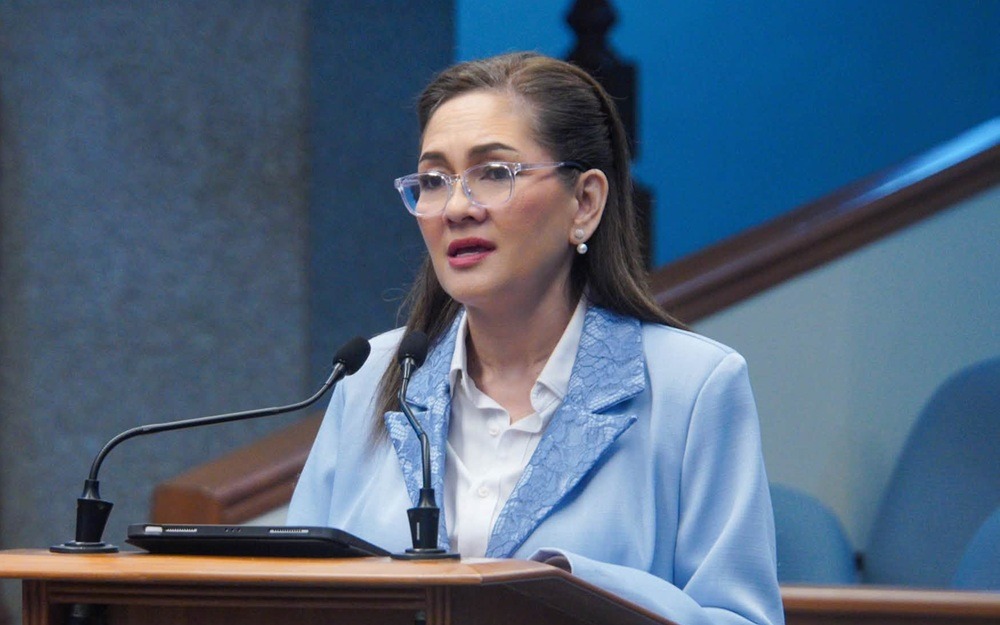
Sen. Risa Hontiveros has opposed the Senate-approved bill restricting access to high-risk social media platforms for Filipinos below 18 years old, warning that the measure could deprive young people of livelihood opportunities, access to information, and support networks while potentially exposing them to greater online risks.
In her explanation of vote on Senate Bill No. 2424, or the Safe Media Access and Responsible Technology for Kids in Digital Spaces (Smart Kids) Act, Hontiveros called for age-based restrictions and stronger safeguards instead of a blanket prohibition.
The Senate approved the measure on third and final reading on Thursday, Oct. 8, with 16 affirmative votes, one negative vote, and no abstentions.
Sponsored by Sen. Robinhood Padilla, the bill seeks to prohibit minors from accessing digital services classified as high-risk, potentially affecting platforms such as Facebook, Roblox, and Gorebox.
Under the proposed legislation, covered platforms would be required to implement age-verification mechanisms and suspend, restrict, disable, or remove accounts determined to be owned or used by minors.
However, the restrictions would not automatically cover all online services. The bill exempts email, private messaging applications, educational platforms, news services, professional collaboration tools, and online gaming services not primarily intended for social networking.
Hontiveros acknowledged the dangers posed by social media, including cyberbullying, online sexual abuse and exploitation, grooming, harmful content, and violent extremism, but argued that banning minors from digital platforms would not necessarily address these threats.
“But the question is not simply whether we should protect children. Ang usapin ay kung paano natin sila epektibong mapoprotektahan,” she said.
The senator cited the experiences of young Filipinos who depend on social media for income, education, family communication, and emotional support.
Among them was a 17-year-old working student who earns money through online selling on TikTok and working as a virtual assistant for social media personalities.
She also cited a student who used social media to expose harassment after school authorities allegedly failed to act on a complaint, a child of an overseas Filipino worker who relies on digital platforms to communicate with his mother, and a minor abuse survivor who found support through online communities.
“Social media has become a space where young people build and maintain their connections with their friends, communities, families, and loved ones. An outright ban strips away these very connections that have become so important in their day-to-day lives,” she said.
Hontiveros also questioned the proposed age threshold, arguing that treating all individuals below 18 as having the same level of maturity ignores differences in adolescent development.
“Eighteen is the legal threshold for adulthood. But it is certainly not a developmental threshold. Napatunayan na sa mga pag-aaral na iba-iba ang level of development ng mga kabataan. A 13 year old and a 17 year old are both minors, but they are not developmentally equivalent,” she said.
Hontiveros pointed to the United Nations Convention on the Rights of the Child, which recognizes the evolving capacities of children as they mature and develop their ability to make decisions.
Instead of a blanket ban, she proposed tiered restrictions that would impose stricter protections on younger adolescents while gradually allowing older teenagers greater autonomy.
These safeguards would include stronger default privacy settings, restrictions on contact with adults, limitations on targeted advertising and profiling, and enhanced parental and educational supervision.
She also called for tighter regulation of algorithms and platform designs that encourage excessive social media use among minors.
Hontiveros said a minimum age threshold of 15 could serve as an alternative to the proposed under-18 restriction, noting that she had earlier proposed a threshold of 13.
She pointed out that Filipinos aged 15 can already vote in Sangguniang Kabataan elections and are legally permitted to work, subject to labor regulations.
The senator argued that restricting their access to social media could affect their ability to obtain information about candidates and participate in community affairs.
It could also disrupt the livelihoods of teenagers who earn money as online sellers, content creators, and virtual assistants.
“Hindi binigyang pansin ng panukalang batas na ito na maraming kabataan ang nagtatrabaho sa social media bilang online sellers, content creators, virtual assistants, para sa kanilang kabuhayan at pagtulong sa kanilang pamilya,” she said.
Hontiveros also raised concerns about the enforceability of a social media ban, citing Australia’s restrictions on users below 16 years old.
She claimed that Australian regulators had found that eight in 10 teenagers remained active on social media despite the restrictions.
The senator warned that a similar prohibition in the Philippines could encourage young people to circumvent age-verification requirements or move their online activities to less visible platforms.
“Suddenly withholding this from them may have a concerning unintended consequence: driving them to conduct their social media activities underground, beyond the watchful eyes of authorities, on the dark web,” she said.
Such a development, she argued, could make it more difficult for parents, schools, and regulators to monitor online activities and protect minors from exploitation.
Under the Senate-approved bill, the Department of Information and Communications Technology (DICT) would be responsible for implementing the restrictions and establishing a publicly accessible reporting system for suspected violations.
Digital service providers that violate the proposed law could face fines ranging from P5 million to P20 million per violation, plus an additional P100,000 daily fine for continuing violations.
Parents and guardians who knowingly help minors bypass age-verification mechanisms could also face fines of up to P50,000 or be required to perform community service and attend digital parenting and child safety programs.
Hontiveros maintained that digital literacy should be a central component of child protection policies.
She said young people need to understand how social media algorithms operate, how platforms collect personal data, how misinformation spreads, and how to identify grooming, scams, cyberbullying, and other forms of online abuse.
“These are now considered essential life skills. Navigating the digital world has become a necessity, and we should prepare them to do so with their security in mind,” she said.
The senator also called for greater accountability among technology companies, saying social media platforms should be required to incorporate child protection measures into their products and business models.
She said her position was consistent with calls from the Council for the Welfare of Children, the Department of Social Welfare and Development, and child rights advocates for stronger platform safeguards rather than a blanket prohibition.
“I believe that our objective is not simply to keep children off social media but to make sure that the online environment is safe for them, and that they are well equipped to find their way in that world safely and productively,” Hontiveros said.
The Smart Kids Act has yet to complete the remaining legislative process before it can become law.
Hontiveros maintained that protecting children online should focus on regulating harmful platform practices and equipping young people with the skills to navigate digital spaces rather than excluding them entirely.
“Taking it away from them all of a sudden without providing adequate ways for them to cope with its absence is not the answer to their needs and it is not the answer to our collective fears,” she said.