Semiconductor manufacturer AMD is seeking to capitalize on growing demand for agentic artificial intelligence (AI) with its next-generation Ryzen AI Max 400 series processors, which are designed to run continuous AI workloads locally rather than relying entirely on cloud services.
During a virtual media briefing on Wednesday, Sept. 30, AMD demonstrated the capabilities of its latest AI PC processors and highlighted the potential cost savings of running AI agents directly on personal computers.
“We’ve seen all the big cloud vendors right now. As we’ve moved into agentic and the agents are the ones driving the tokens, they have a meter turning that’s saying how many tokens are you using and you’re paying per token,” said Michael Nordquist, AMD corporate vice president for client product marketing.
“If you’re able to take that and run it all locally, sure you have the device cost and the power cost, but it’s almost like getting free tokens and you’re still able to get quality,” he added.
When AI PCs were first introduced, running AI workloads locally meant trading performance for long-term cost savings. Open-source models were less capable, while processors could handle only tens of billions of parameters, resulting in a narrower scope of work, slower generation, and lower-quality output compared with cloud-based models.
However, improvements in open-source models and processor technology have expanded the capabilities of locally deployed AI systems.
AMD’s latest Ryzen AI Max 400 portfolio, launched in May 2026 with the first major partner releases in September, supports models with more than 300 billion parameters.
AMD claims the series is the first x86, Windows-native client processor capable of running models exceeding 300 billion parameters locally.
According to the company, this capability allows users to run a model equivalent to an Opus 4.8 agent or multiple Opus 4.7-class agents locally while maintaining a discrete KV cache.
In tests involving an agent running on GLM 5.3 Flash, the Ryzen AI Pro Max+ processor processed up to 20 tokens per second. When running multiple agents on Qwen 3.8 Flash, it processed up to 42 tokens per second.
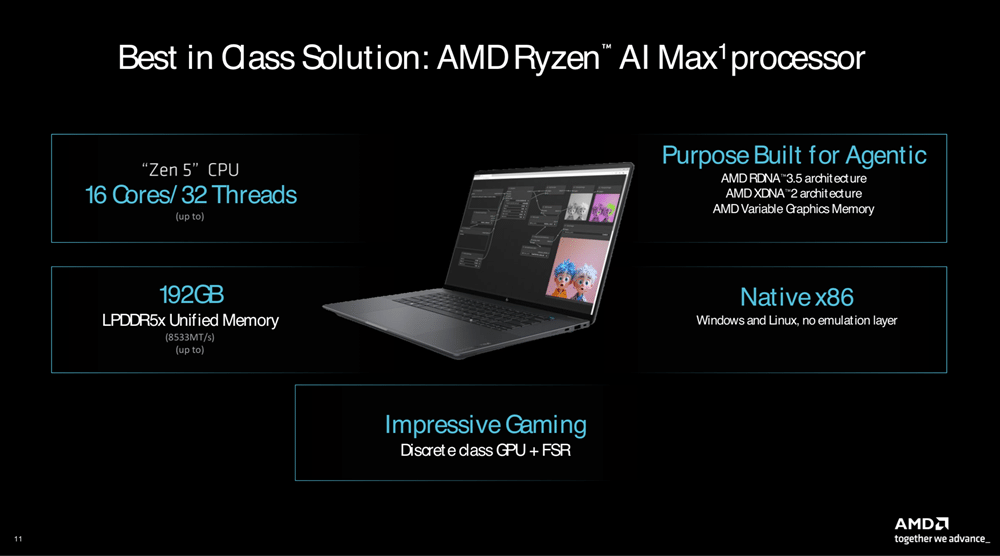
The performance is supported by up to 192GB of unified memory, AI-ready processing units, and Windows-native software.
The 192GB unified memory ceiling represents a 50% increase over the previous Ryzen AI Max 300 series. AMD said the additional memory enables the new processors to support 300-billion-parameter models, compared with the 200-billion-parameter models supported by their predecessors.
The Ryzen AI Max 400 series uses AMD’s Zen 5 CPU architecture, featuring up to 16 cores and 32 threads, making it suited for the cyclical reasoning and task-completion processes required by AI agents.
The processors also integrate AMD RDNA 3.5 graphics and an AMD XDNA 2 neural processing unit (NPU) designed for AI workloads.
Although the processors can also run Linux, their x86 architecture allows devices to work with existing Windows applications, peripherals, and professional software.
Many open-source large language model (LLM) tools also operate within x86 and CUDA-oriented software environments, potentially making it easier for developers and users to deploy these models on Ryzen AI Max 400-powered PCs.
AMD also stressed that hardware capabilities must be supported by a software ecosystem to make agentic AI practical for users.
“Having hardware is great, but if you don’t have the ecosystem and the software infrastructure for it, you really can’t capitalize on the capability,” Nordquist said during the briefing.
He cited AMD’s partnerships across its technology stack, including support for Perplexity’s Portable Computer on Ryzen AI Max devices.
The application runs in the background and automatically determines whether AI workloads should be processed locally or sent to frontier cloud models.
This hybrid approach allows users to take advantage of local processing while retaining access to more powerful cloud-based AI systems when necessary.
“Hopefully you got a sense of how we’re leading in the agentic area, how we’ve invested heavily in the hardware area, our best-in-class solutions with Ryzen AI Max…and broad application and ecosystem support. It’s not just hardware and working with some of the silicon partners. We have full support across the OS, the application providers that are out there, as well as emerging AI folks,” Nordquist said.
The company is positioning its latest processors as an option for users and enterprises seeking to run increasingly complex AI agents locally while reducing dependence on cloud-based processing and per-token charges.