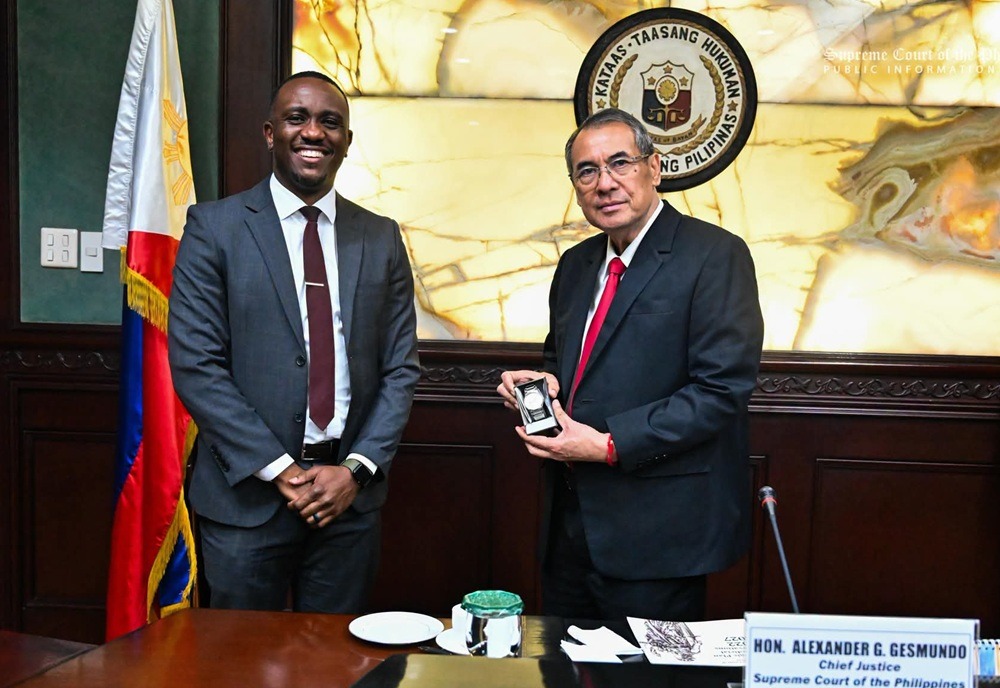
The Supreme Court (SC) and the US State Department’s Office of International Narcotics and Law Enforcement Affairs (INL) are looking to deepen cooperation on artificial intelligence, cybersecurity, and other emerging technologies as the judiciary adapts to the challenges of digital-era justice.
The technology-focused discussions took place during INL director Navarro Moore’s courtesy visit to SC chief justice Alexander G. Gesmundo on Oct. 6 at the SC En Banc Conference Room in Ermita, Manila.
Gesmundo thanked the INL for its sustained support for the Philippine judiciary through judicial education and training programs that have helped equip judges and court personnel with specialized knowledge on emerging issues, including digital evidence, artificial intelligence, cybercrime and transnational organized crime.
The initiatives complement the judiciary’s Strategic Plan for Judicial Innovations 2022–2027 (SPJI), which seeks to build a more efficient, innovative and accessible justice system through technology adoption and continuing institutional development.
Moore, for his part, reaffirmed the INL’s commitment to strengthening cooperation with the Philippine judiciary, particularly in enhancing the capacity of judges and court personnel to address increasingly complex legal issues arising from technological advances and cross-border criminal activities.
The two sides also discussed future opportunities for collaboration in emerging technologies, cybersecurity, and judicial education, highlighting the growing need for technology-ready courts and digitally capable justice professionals.
The partnership comes as courts increasingly confront legal questions involving AI, cybercrime and electronically generated or stored evidence.
Beyond adopting digital tools, judicial institutions must also ensure that judges and court personnel have the skills to understand, evaluate and properly handle technology-related evidence and issues.
The SC and INL underscored that their partnership is institutional and is expected to continue beyond Gesmundo’s retirement in November 2026.
They noted that the SPJI was designed as a long-term reform program that transcends changes in leadership and remains a shared commitment of the judiciary and its development partners.
The meeting also highlighted the broader Philippines-US relationship. Moore presented Gesmundo with a customized commemorative watch marking the 80th anniversary of Philippines-US relations, symbolizing eight decades of bilateral cooperation and partnership.
Joining Gesmundo and Moore were SC associate justice Jose Midas P. Marquez, deputy clerk of court and chief technology officer Jed Sherwin G. Uy, Office of the Chief Justice deputy judicial staff head Antonio Ceasar R. Manila, INL deputy director Sam Hargadine and INL legal specialist Chudney Ngo.