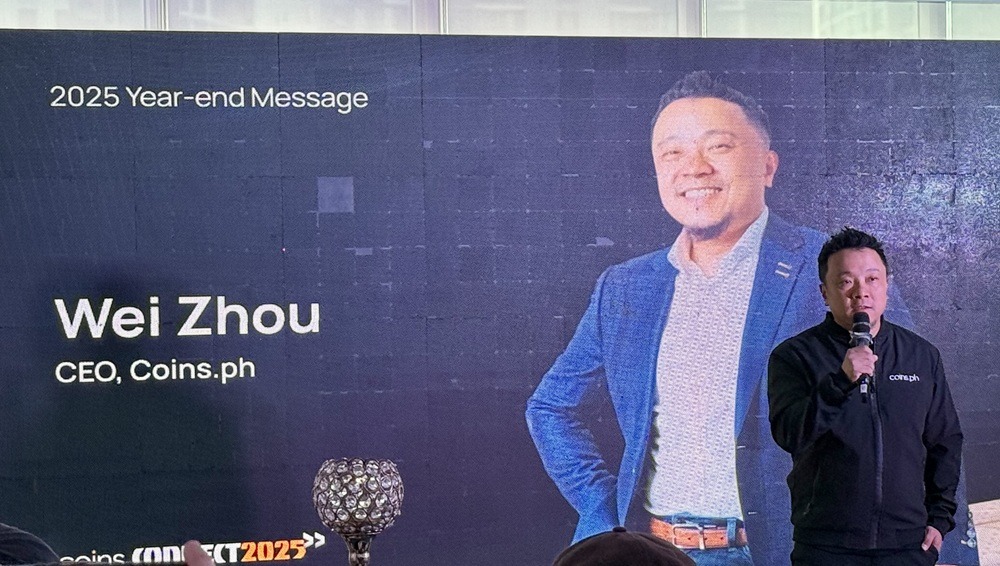
Coins.ph chief executive officer Wei Zhou expects 2026 to be a stronger and more stable year for global financial markets, citing a shift toward a looser monetary environment led by interest rate cuts in the United States and mirrored by easing policies in the Philippines.
In an interview, Zhou said the anticipated decline in US Federal Reserve rates — following several years of monetary tightening — is likely to benefit both traditional assets and digital markets.
“As the US Fed lowers interest rates, and you’re already seeing the BSP doing the same, we’re moving into a loosening monetary environment,” Zhou said. “That should bode well for financial markets. Stocks and crypto should do better in 2026 than they did in 2025.”
He added that while 2025 was marked by volatility and uncertainty, particularly due to the political transition in the US, conditions are expected to stabilize as markets adjust to the new geopolitical and policy landscape.
“2025 was a massive transition year,” Zhou said. “As the world gets used to the new norm, I actually see less chaos in 2026 compared to 2025.”
Zhou is the former chief finance officer of Binance, the world’s largest crypto exchange. A holder of an economics degree from Harvard University, he began his career in investment banking at Goldman Sachs Hong Kong before finding his way into cryptocurrency.
Zhou said stablecoins will be a major growth driver for Coins.ph next year, particularly in cross-border payments and remittances — an area the company has been investing in for years.
“Stablecoins have been a key part of our business already. We’ve been pushing this use case for five or six years,” he said.
A stablecoin is a type of cryptocurrency designed to keep a stable value, usually by being pegged to a real-world asset like a national currency, most commonly the US dollar. Unlike Bitcoin which is known for big price swings, stablecoins are meant to stay steady — for example, 1 stablecoin is equal to $1.
He noted that regulatory developments in the United States, including the passage of the Genius Act (Guiding and Establishing National Innovation for US Stablecoins Act), have enabled US-based financial institutions to legally use stablecoins.
This, he said, has triggered renewed interest from global remittance and payment companies with Philippine corridors.
“Now all these clients with cross-border payment and remittance needs involving the Philippines are looking for stablecoin solutions,” Zhou said. “We already have the infrastructure, so it’s very easy for us to onboard them.”
According to Zhou, stablecoins allow payment providers to lower costs and reduce working capital requirements, potentially enabling more competitive pricing compared to traditional money transfer services.
“Cross-border payments are the first wave, but anytime you’re transacting with the US, stablecoins can be used,” he said.
Zhou said crypto adoption in the Philippines has historically come in waves, starting with Bitcoin, followed by Ethereum-based ICOs, and later Web3 gaming led by Axie Infinity. However, adoption slowed over the past two years after the gaming-driven boom subsided.
“I think the fourth wave is coming,” Zhou said. “And that wave will be driven by stablecoins.”
He said stablecoins offer a more practical, everyday use case compared to earlier crypto cycles, particularly for payments, savings, and financial services.
Zhou confirmed that Coins.ph has had discussions with local government units (LGUs) and non-government organizations (NGOs) on the use of digital payments and stablecoins, particularly for collections, disbursements, and improving accountability in fund transfers.
“We’ve been talking to some LGUs about payments, and with NGOs that want more transparency and accountability in how funds are used,” he said.
He also cited growing interest in blockchain as a tool for transparency following recent corruption controversies, though he cautioned that blockchain is not a “silver bullet.”
“It’s not an end-all solution, but it’s one of the tools that can be used,” Zhou said. “We’re very open to helping government agencies deploy blockchain or use stablecoins as part of their services.”
Zhou also acknowledged proposals in Congress related to Bitcoin, including discussions around a potential Bitcoin reserve, as well as Coins.ph’s plans to roll out a Bitcoin savings program aimed initially at college students.
Zhou described Coins.ph’s long-term vision as a “money super app” that integrates payments, savings, investments, and, eventually, lending.
“We’re in the business of moving money, storing money, and investing money,” he said. “Whether it’s InstaPay, PesoNet, QR Ph, stablecoins, or crypto, it’s all part of the same ecosystem.”
While Coins.ph’s investment offerings are currently focused on crypto, Zhou said the company plans to expand into other regulated investment products as the Securities and Exchange Commission releases clearer guidelines.
He likened the platform’s development to building with Lego blocks. “Each service is a block,” Zhou said. “You just keep adding blocks, and eventually you build a complete financial ecosystem.”