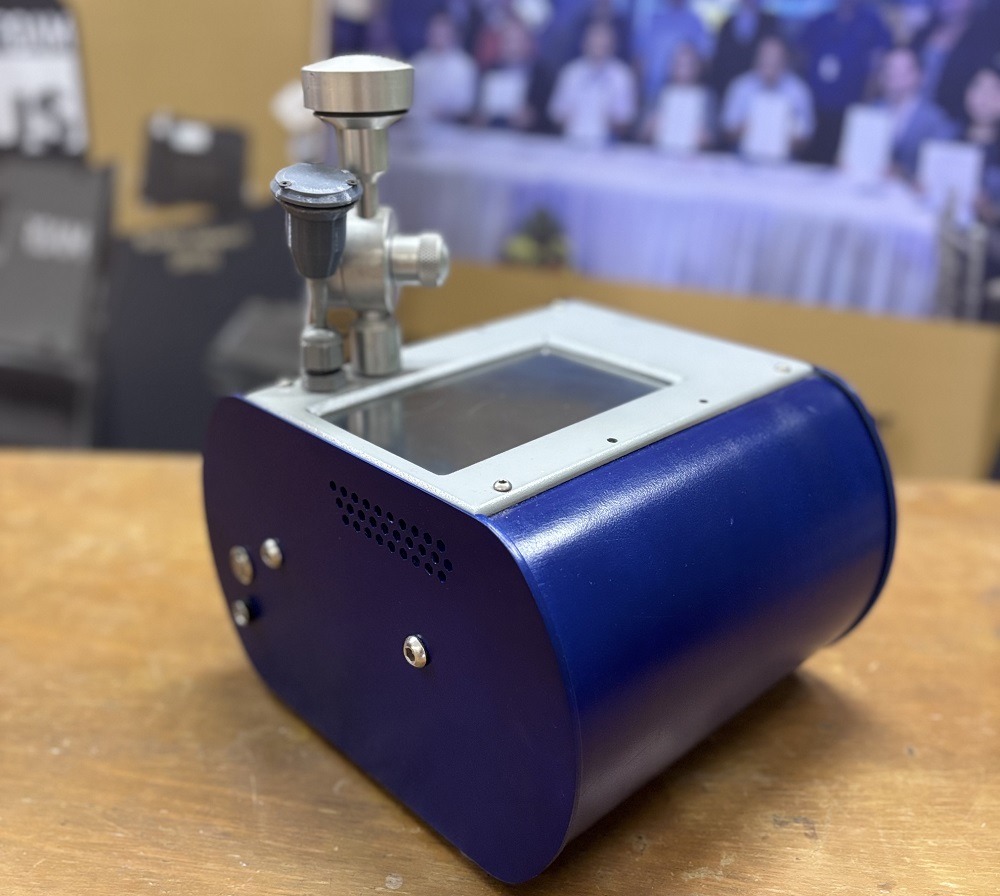
Researchers from the University of the Philippines (UP) have developed a locally made air quality monitoring device designed to operate for extended periods in dusty and polluted environments while keeping maintenance and repair costs low.
Called the “Robust Optical Aerosol Monitor” or ROAM, the device counts airborne particles using an optical system that its developers compare to a microscope.
The project was co-developed by Dr. Len Herald Lim of the UP Diliman College of Science’s Institute of Chemistry and engineer Paul Alexander Darvin of the UP Los Baños Department of Electrical Engineering.
Development began in 2014 as an experiment in measuring air quality.
“In a sense, ROAM is an air microscope. If you’ve experienced microscopy before, like cell counting under a microscope, this is very similar. The difference is that instead of cells, what we are counting are particles in the air,” Lim said during the sixth Innovation Impact Stories webinar of the UPD-CS Innovation Program.
According to UP, ROAM’s performance is comparable to aerosol monitoring equipment used by industry and the Department of Environment and Natural Resources–Environmental Management Bureau.
Unlike some conventional monitoring devices, ROAM does not depend on a small pinhole that can become clogged by heavy concentrations of airborne particles. Its construction also does not require the machining of very small components, according to Lim.
The device underwent its first long-term field deployment in Cauayan, Isabela, where it operated for about six to eight months in a dusty location.
“The unit stayed there for about six to eight months. There wasn’t anything particularly dramatic about it, except that it was placed in a dusty environment,” Lim said.
Researchers initially thought the unit might have been damaged when it was returned because its exterior was covered in dirt. An inspection, however, showed that it remained operational.
“It was impressive because I really expected it to be completely clogged. The outside of the unit was so dirty, but it was still working. That’s because it doesn’t rely on a pinhole — it functions like a microscope,” Lim said.
“And since it works like a microscope, its saturation limit is much higher than normal air monitoring equipment.”
Another unit was deployed in South Cotabato and remained functional after being left unattended for nearly six months, according to the project team.
Lim said local government units have emerged as the primary users of the technology, which could provide communities with a more accessible way to collect local pollution data.
“Right now, we’ve found that the best adopters of this technology are local government units (LGUs). That was actually how we positioned and advanced Project ROAM. People started coming to us — we didn’t even know who referred them,” he said.