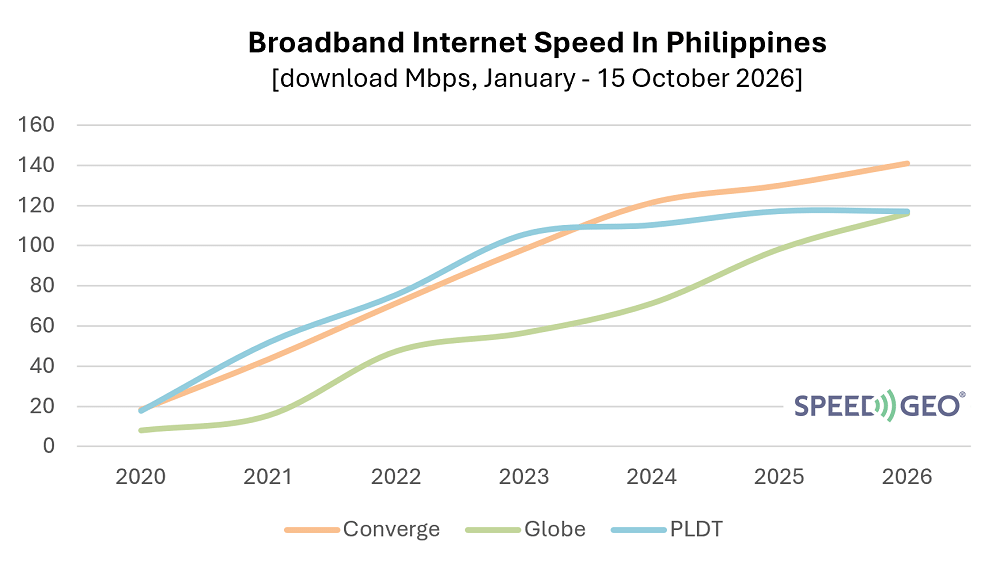
Average fixed broadband download speeds in the Philippines increased nearly eightfold from 14 megabits per second (Mbps) in 2020 to 109 Mbps in 2026, but outdated Wi-Fi equipment and slow connections continue to affect Internet users, according to a SpeedGeo report.
Published on Oct. 27, the report attributed the improvement to fiber-optic network expansion and competition among the country’s three major broadband providers: Converge ICT Solutions, PLDT, and Globe Telecom.
The analysis was based on 5.3 million user tests from V-Speed applications, including SpeedGeo, covering the period from 2020 to Oct. 15, 2026.
Converge recorded the fastest average download speed among the three providers at 140.7 Mbps, followed by PLDT at 117.1 Mbps and Globe at 116 Mbps.
Converge has led the rankings since 2024. The company operates a fiber-optic network, which SpeedGeo identified as a factor in its performance.
Globe posted the biggest improvement over the six-year period, with its average download speed increasing from 8 Mbps in 2020 to 116 Mbps in 2026. PLDT’s speed rose to 117.1 Mbps from levels comparable to Converge’s in 2020, although its growth slowed after 2023.
Despite faster broadband networks, the report identified home Wi-Fi equipment as a major factor affecting the speeds experienced by subscribers.
Devices using Wi-Fi 4 recorded average speeds of only 28 Mbps to 44 Mbps, depending on the provider. This is below the capacity of even an entry-level 50 Mbps broadband plan.
PLDT and Globe each had a 44% share of tests conducted using Wi-Fi 4, compared with 29% for Converge.
Converge also had the highest share of tests using the faster 5 GHz Wi-Fi band, at 66%, compared with 44% to 46% for its competitors.
For Wi-Fi 5, Converge recorded average speeds of 193 Mbps, ahead of the 148 Mbps to 153 Mbps reported for the other providers.
Globe recorded the highest average speed for Wi-Fi 6 at 297 Mbps, while Converge had the largest share of Wi-Fi 6 tests at 17%.
The report noted that Wi-Fi performance depends on the router’s supported standards and frequency bands, as well as the quality of the connection between the router and the user’s device.
A portion of broadband speed tests continued to register download speeds below 10 Mbps.
Globe had the highest share of such tests at 29%, followed by PLDT at 18% and Converge at 15%.
SpeedGeo attributed these results to several factors, including users testing their connections far from routers, poor Wi-Fi performance, older devices, and slower fixed wireless access services.
The report also found evidence that broadband plans’ advertised speed limits affect measured performance. Tests clustered around the speed thresholds of common plans, including 50, 100, 200, 300, and 500 Mbps.
SpeedGeo estimated that between 10.5% and 21.7% of PLDT tests, 8.3% and 15.8% of Globe tests, and 9.1% and 21.4% of Converge tests were affected by possible plan speed caps.
The estimates represent ranges based on the distribution of test results around the speed thresholds.