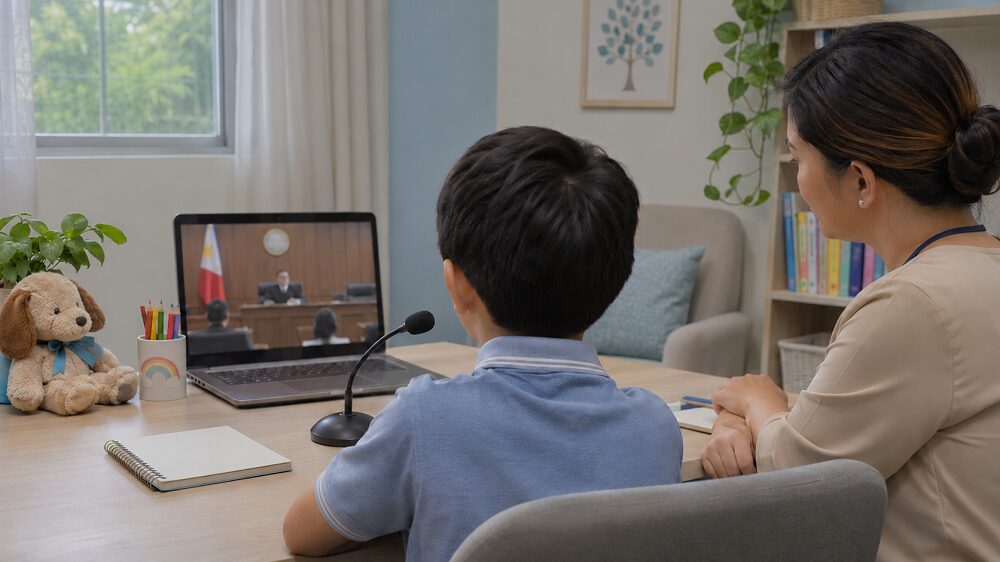
The Supreme Court (SC) has approved revised rules allowing wider use of videoconferencing, recorded depositions, and recorded interviews in proceedings involving child witnesses to reduce the trauma of recounting painful experiences.
Approved by the court on June 17, 2026, the Revised Rule on the Examination of Child Witnesses (RRECW) also strengthens confidentiality requirements and introduces additional safeguards for children participating in judicial proceedings.
Under the revised rule, courts may allow children to testify through videoconferencing from outside the courtroom if appearing in person is likely to cause them trauma.
Courts may limit whom a child can see and hear during remote testimony, including the accused, while preserving the accused’s constitutional rights, including the right to confront the witness.
When identification is necessary, the accused may briefly turn on the camera, or the child may identify the accused through an image displayed on screen.
Children who cannot testify at trial or through videoconferencing because of a disability, health concerns, or other reasons may give testimony through an electronically recorded deposition. This must be conducted in the presence of the judge and lawyers for both sides, and the recording may substitute for courtroom testimony.
The revised rule also allows a recorded interview conducted by a team of professionals, or its transcript, to be presented as evidence to reduce repeated questioning and retraumatization.
If the child cannot testify, the recorded interview may be presented instead, provided the interviewer used neutral, open-ended, age-appropriate, and trauma-informed questions without suggesting answers.
If the child testifies at trial, the recording may replace earlier written statements. All parties must receive a copy and an opportunity to view the recording, while the interviewer must be available for questioning at trial.
Other technological tools may also help children explain their experiences, alongside existing testimonial aids such as dolls, drawings, and puppets.
The RRECW covers children who are crime victims, children in conflict with the law, and child witnesses in criminal, civil, special, and administrative proceedings.
It incorporates restorative justice, the principle of “do no harm,” and sensitivity to gender, culture, and a child’s experiences as a victim.
The rule also provides that children cannot be forced to appear in court and must not be present when sexually explicit material is shown.
Records concerning child witnesses must remain confidential. Anyone who publishes identifying information, including a child’s social media accounts, may be held in contempt of court.
Courts must also ensure that children who have suffered abuse receive therapy to support their recovery.
The revisions were proposed by the SC Committee on Family Courts and Juvenile Concerns.