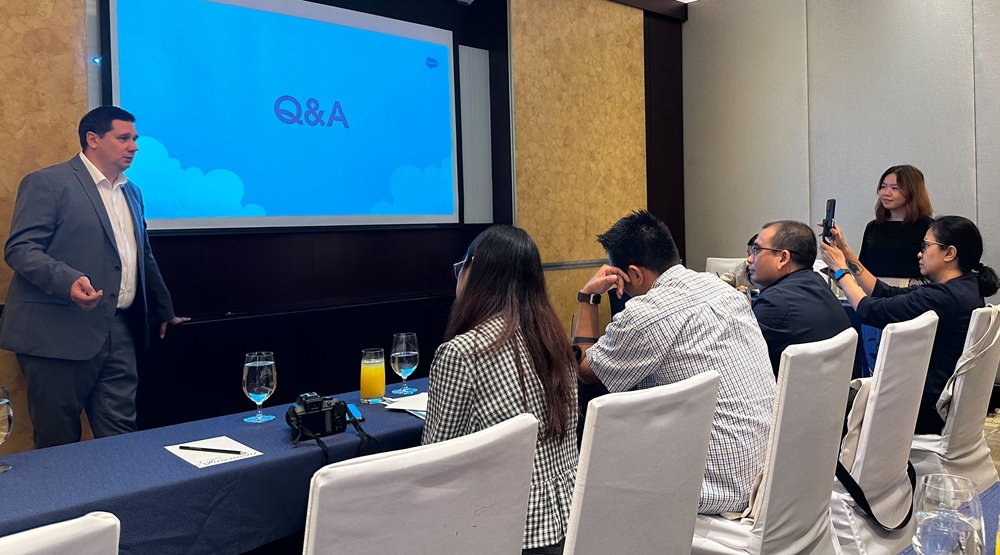
Cloud computing firm Salesforce recently held an intimate media event in Makati City to introduce its AI-powered Agentforce solution in the country.
Below is the Q &A session conducted by Gavin Barfield, vice president and chief technology officer for solutions at Salesforce Asean, with members of the local media:
Q: For companies to avoid being complacent, what risks should they be looking out for when using agentic AI?
A: Companies should start with defined use cases. If I’m going to go online and say I need to update my telephone number, I’m okay for an AI agent to do that. I don’t need to speak to a human. If I’ve got a really complicated problem, or I’ve got something which has some emotion behind it, I want to just talk about something to somebody, and might not want an agent to do it.
Businesses have to look carefully around where humans need to fit in and where agents can fit in, and look at where the agentic stuff can add value and where humans still add that value.
This is about humans and agents working together. This is about augmenting, not replacing humans. People can do creative stuff. We build relationships. We have empathy. All of those things that we all want people to do, we make sure people do more while agents handle the mundane, autonomous tasks.
Q: There are recent reports that AI integration would place a threat to the Philippine BPO industry. There’s a possibility that 300,000 BPO employees might lose their jobs. How and what can employees or employers can do to avoid, or at least mitigate, the potential job loss?
A: Agentforce gives opportunities for companies to reimagine how they use human capital — to think about where they use people and where they use autonomous agents, and move people into higher value tasks by reimagining the customer experience.
Customer service, routine tasks, updating of customer details, inventory management, refunds, etc. should be moved to autonomous agents.
I don’t want an AI agent to tell me that suit looks good. I want a human to tell me, right? There are things you want a human to have some empathy for. I don’t want an AI agent to say, according to my calculations, this suit looks nice on you.
People won’t lose their jobs to AI. They’ll lose their jobs to people who can use AI better.
Ultimately, business leaders should ensure that people in the workplace know how to use and utilize AI in the right place. It will be the people who can use AI effectively to boost their productivity, to get things done, that will excel. Those who don’t use AI, who still try to do things manually and aren’t able to use the technology, may struggle.
At Salesforce, we are committed to help companies address the skills gap and build AI skills. Trailhead is a free learning platform by Salesforce where people can learn about AI and various other technologies to help bridge that skills gap, and so that they know how to use AI effectively within their organizations.
AI is yet another technological step change. Like a steam train, nobody’s going to be able to stop it.
If you look back, horses got replaced with cars. Typewriters have been replaced with computers. If you’re going to excel in your job, you have to know how to use a computer; how to surf the Internet; how to write an email. You would be much better at your job than people who could only use a typewriter.
The same is true of AI. It’s the people and businesses who now know how to use it, and invest in upskilling and addressing the skills gap, who stand to gain the most out of it.
Q: In your experience, do a lot of companies invest in the upskilling of their employees?
A: They do, but not enough. There’s more that every company could do in terms of upskilling their employees.
Technology is changing so quickly. Just as an example, we had a 30- to 40-page transcript that comes out of our investor meeting with our CEO. I’ve never read it. No one sits and reads a 40-page transcript of what the financial reports and earnings are, unless you’re in that business.
But what my boss did is he took this document and placed this into Notepad and ran it and created a 20-minute podcast. On the plane yesterday, I listened to this 20-minute podcast of two people talking about the document.
That’s an example of how I’ve got more information and more knowledge because I’ve used AI. I’d have never read the 40-page document, but I used AI to be able to do something different and be more productive.
Q: How can MSMEs utilize or benefit from Agentforce?
A: One important thing to know about Salesforce is that when we started 25 years ago, our goal was always to democratize access to software.
Mark Benioff and Parker Harris noticed then that only large companies have access to enterprise software. Companies had to have millions of dollars in order to have top grade secure enterprise software.
What Salesforce said, in that multitenant environment, you could be the biggest company in the world or a two-personnel operation – whether you are spending $100 a month or a million dollars a month, you get access to the same technology.
The features can be switched on and off, and the number of users may change, but that technology stack is the same.
Salesforce has always been committed to supporting small, medium enterprises, giving them access to enterprise technology without them having to invest millions of dollars, and we’re doing the same for AI.
Whether it’s a start-up or a 20,000-staff enterprise, they can get access to these AI capabilities. They don’t have to build up data scientists in-house. They don’t have to employ AI experts. They don’t need to have anyone with a PhD in their team, they can start using generative AI and agents directly from Agentforce out of the box–even through a small organization, a medium one or a large one.
That’s critical to us – we think this technology should be available for businesses of all sizes – a bakery with five people who might want an AI agent to be able to handle ordering of birthday cakes, or a small hardware store that might want people to check their inventory online with five people in it. They should have the same access to that software as large banks, telcos, or airlines.
Q: Which business processes would be most ideal to integrate AI?
A: Customer service is the first use case. That’s the most obvious one. Agentforce can go directly to customers and address their concerns.
Another use case is around sales. In Salesforce, we get loads and loads of inquiries — people looking at our website, asking a question or so, and it takes a huge amount of our time to respond to every one of those questions.
So, what we do now is an AI agent will automatically respond to queries. That agent will have that initial conversation – “Hey, you asked us a question about service cloud. How can we help?” “Yeah, tell me a bit more about your product. What’s the pricing?”
Remember, at scale, we can have one of these or a million of these reach out to every customer instantly and have a conversation with them. And then at some point, the agent will determine whether it needs to be handed over to a human.
On my point about guardrails, it’s not about agents completing the sale. It’s about agents understanding this is a good lead.
Thirdly, we’re seeing employee agents or supporting HR functions, increasingly important. We have loads of questions that we ask as employees — “Hey, what about my leave?”, “Can I claim this on my benefit?”, “How do I get my new credit card activated?”
Q: Are you open to being connected with government agencies because agents could be very helpful for Filipinos?
A: We have a big public sector practice globally. We work with governments in the US, in the UK, and in Singapore, to name some. Often, we help them understand these new technologies. We have particular offerings that we do for government agencies around citizen engagement, for example, and we bring Agentforce into that.
They’re also not just interested in the technology itself. The conversations also usually revolve around upskilling. They want our help and opinions on how they can upskill citizens on AI.
The Philippine government would be great to engage with as well on these matters, and we’ve had a number of conversations with them over time.
Q: In terms of use cases, we mostly discussed customer service and customer service and queries. How about in the industrial setting? Where do you think an AI agent will be the most useful?
A: One of our key customers that has launched Agentforce is Panasonic. Panasonic has introduced their AI agent to the Philippines at panasonic.com/ph. That AI agent helps with warranty management and product inquiries for enterprise and individual customers.
Example: If a business has a problem with their commercial microwave or air conditioners, it can use all of this knowledge that it has from all the warranty, knowledge articles, and handbooks. So there’s a lot of uses for it in industrial applications as well.
Salesforce also has predictive AI, which shouldn’t be ignored. This type of AI is increasingly integrated in products like our manufacturing cloud where we can drive a lot of value from predictive analytics.