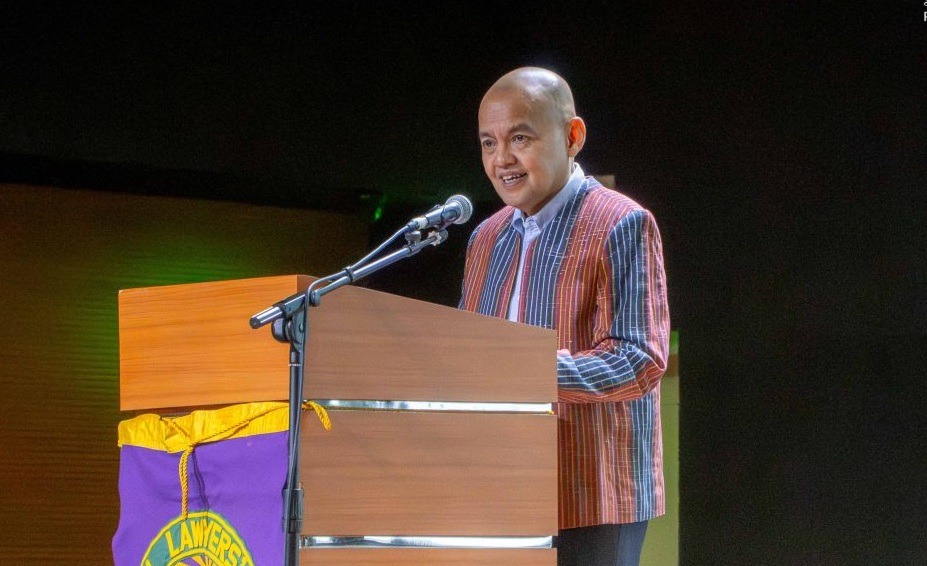
Supreme Court (SC) senior associate justice Marvic Leonen has urged lawyers and judges to use artificial intelligence cautiously, warning that the technology must not replace independent reasoning, human judgment, or accountability in the justice system.
Speaking at a law and technology conference organized by the University of the Philippines Women Lawyers’ Circle on July 16 at UP Bonifacio Global City in Taguig, Leonen said AI could improve legal work but should remain subordinate to constitutional values, the rule of law, and social justice.
“A lawyer who grasps AI will outperform one who does not. She will work more efficiently, identify more insights, and provide more superior service to her clients. This is not a danger, but a straightforward reality of the profession and competition,” he said.
Leonen distinguished AI from the judiciary’s broader digitalization efforts, including eCourtPH and electronic filing. While digital systems are intended to improve court access and efficiency, he said AI could directly affect legal reasoning and decision-making and therefore requires stricter governance.
Under the SC’s Governance Framework on the Use of Human-Centered Augmented Intelligence in the Judiciary, AI may support but cannot make, replace, or override judicial decisions.
Leonen outlined five disciplines for its use: preserving independent thought, verifying AI-generated claims and citations against primary sources, maintaining audit records and disclosing AI use, setting limits on which tasks may be delegated, and developing human qualities such as empathy, creativity, and moral judgment.
He also emphasized the need to protect confidential client information when using AI tools.
The SC framework sets six principles for AI use in courts: human primacy, explainability, auditability, equal access, institutional sovereignty, and continuous learning.
It also calls for the judiciary to retain control over its technological infrastructure and regularly examine AI systems for errors and bias.
“Justice cannot be fully automated, but its administration can undergo transformation,” Leonen said.
He acknowledged that AI could help organize information, reduce court backlogs, and improve efficiency but said machines could not understand human experience, exercise compassion, or bear moral responsibility for a judgment.
“Our oath is not to a machine. It is to our Constitution. It is to the people who appear before us, who still trust being judged by a human being who understands what is at stake. It is to people who still yearn for social justice,” he said.
Court administrator Ma. Theresa Dolores Gomez-Estoesta, who spoke during a panel on AI use and ethical limits, likewise warned lawyers and judges against accepting machine-generated material without scrutiny.
She cited a Sandiganbayan case involving fabricated case citations generated by AI and said legal practitioners remained responsible for checking all authorities, factual assertions, and citations appearing in their submissions.
“As AI becomes faster and more sophisticated, the temptation to rely on its outputs without sufficient scrutiny will inevitably grow… In the end, it is not artificial intelligence, but the ethical use of artificial intelligence that will define the future of justice,” Gomez-Estoesta said.
The SC has created a permanent Committee on Human-Centered Augmented Intelligence to oversee the development, evaluation, and use of AI tools in the judiciary.