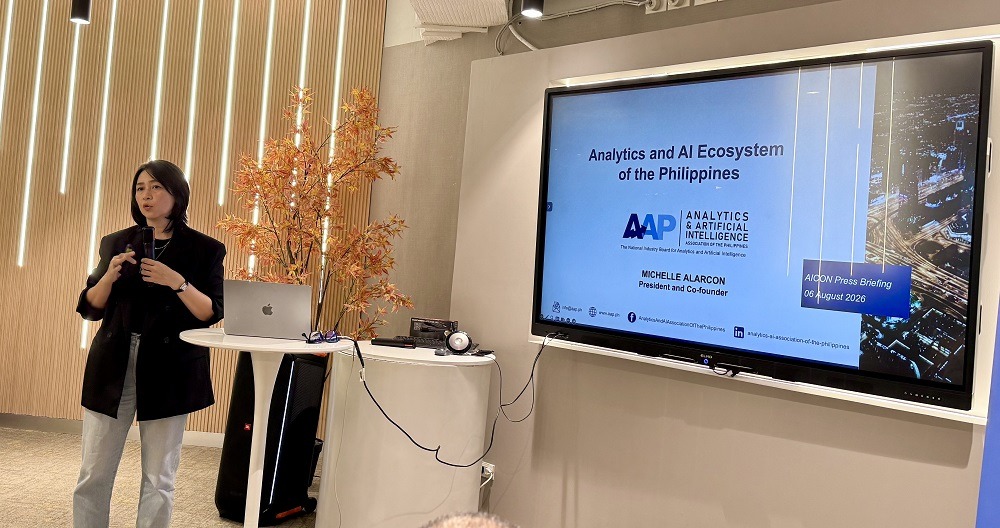
The Philippines should first establish the actual demand for artificial intelligence infrastructure before embarking on an aggressive data center buildout, according to the head of the Analytics and AI Association of the Philippines (AAP).
AAP president and co-founder Michelle Alarcon raised questions over projections for new data center capacity as discussions continue over Pax Silica and broader government efforts to position the Philippines as a regional AI and technology hub.
Alarcon said the association has discussed Pax Silica but has yet to adopt a formal position, particularly since details remain under discussion.
“We have gone through that discussion but we have yet to make a position paper,” she said during a press briefing for AI Con Manila 2026, its flagship conference taking place on August 25 at SPACE at One Ayala in Makati City.
Rather than immediately backing or opposing more data center investments, Alarcon said policymakers should examine how much computing capacity Philippine businesses actually need and how existing facilities are being used.
“Our question is not so much a reaction but more of, where did their demand projections for data centers come from? How are corporations using that? It’s mostly driven by the demand of use cases of AI and other technologies,” she said.
She noted that data center utilization in the Philippines had been relatively low even before the surge in interest in generative AI, raising questions over assumptions behind planned capacity expansion.
“If they want to be here, invest here, then that’s fine. But again, what are the business cases they need to support in here? And where did that come from?” Alarcon said.
Alarcon said the debate should extend beyond how much infrastructure the country can build to what AI applications would justify the additional computing resources.
She said the same scrutiny should apply to national AI initiatives, particularly claims that AI will improve the lives of Filipinos.
“Who is defining what problems of the Filipinos it’s supposed to solve? And who is actually using AI to solve those problems?” Alarcon said.
The questions come as the Philippines seeks to attract investments in data centers and other digital infrastructure while government and industry promote the country as a potential AI hub.
Alarcon, however, said AI readiness involves more than building computing infrastructure.
At AI Con, she pointed to basic connectivity as one of the gaps that still needs to be addressed.
She cited Internet connectivity, power, water and data as among the underlying requirements for widespread AI adoption.
“In Metro Manila, you don’t even get stable Internet if it rains,” Alarcon said. “Can they access AI and be leveraged from AI if that is the situation?”
Data readiness is another concern, she said, noting that having large amounts of information does not necessarily mean that organizations are prepared to deploy AI.
Alarcon said some Philippine industries and large companies may already have the resources and skills to deploy AI, but that readiness does not extend evenly across the economy, particularly among smaller businesses.
“I would say, we have all intents to be AI literate as a country, but we are not yet, I would say, mature enough to know how to prepare for it and how to use it responsibly,” she said.