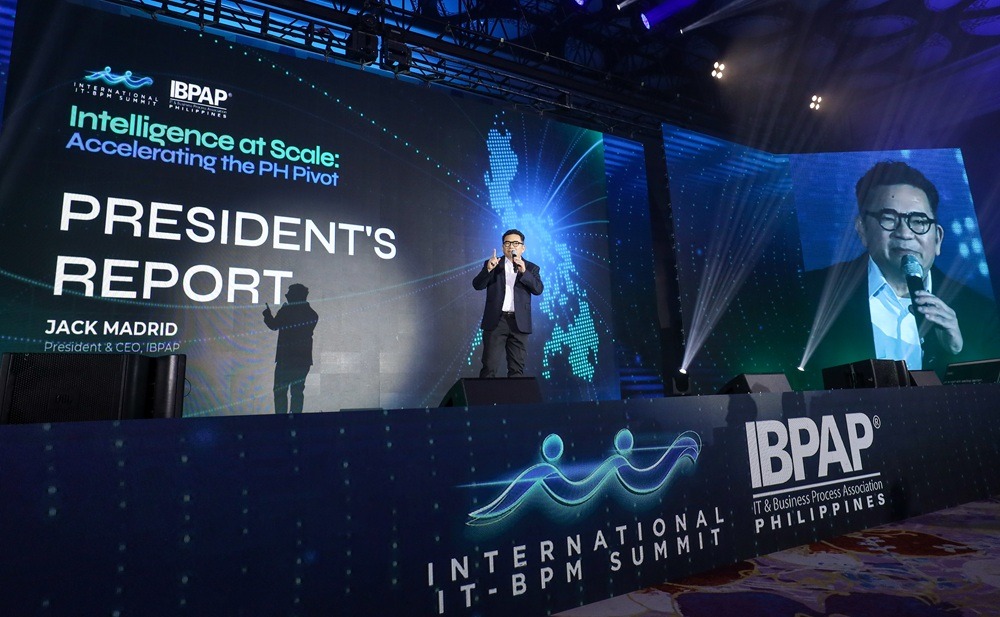
The Philippine IT and business process management (IT-BPM) industry could generate $50.5 billion in revenue and employ 2.14 million people by 2028 under an accelerated growth scenario, as the sector increasingly shifts toward artificial intelligence and higher-value services.
The IT and Business Process Association of the Philippines (IBPAP) disclosed the projections in a preview of the Philippine IT-BPM Roadmap 2028 during the International IT-BPM Summit 2026, ahead of the roadmap’s full release in October.
The accelerated scenario would translate to $10.2 billion in additional revenue and 250,000 more employees compared with 2025.
But the roadmap also outlines a slower-growth scenario in which revenue would increase to $43.3 billion by 2028 while employment declines slightly to 1.85 million from 1.89 million, highlighting the possibility that revenue growth may no longer translate directly into more jobs.
The projections come as AI begins reshaping the industry, with companies deploying the technology in selected functions and testing broader applications.
IBPAP said enterprise-wide adoption remains limited by skills gaps, legacy systems, data quality and governance, security concerns, and uncertainty over returns on investment.
“We are entering the most decisive stretch of this roadmap. The foundations are in place, and this is the point where our strategy must become shared, everyday action on the ground,” said Celeste Ilagan, president and CEO-designate of IBPAP.
“The upper end of our 2028 outlook is completely within reach, but only if industry, government, and academe move together with real urgency. Beyond revenue numbers, investing in scalable talent development, accelerating the shift to higher-value services, and strengthening our competitiveness, create meaningful, sustainable opportunities for Filipinos and ensure that our country strengthens its position as a premier destination and a trusted partner for IT-BPM services,” she added.
IBPAP said growth is expected to be concentrated in global capability centers, healthcare information management, and banking and financial services. Emerging areas include AI operations, model evaluation, data work, animation, and game development.
The industry group is positioning what it calls the “AI-Enabled Digital Filipino Worker” at the center of its talent strategy. The concept combines AI proficiency and domain expertise with human skills such as judgment, empathy, and leadership.
IBPAP said its Enterprise-Based Education and Training framework, implemented with the Technical Education and Skills Development Authority and Department of Information and Communications Technology, has so far reached 25,500 learners through 164 programs in 24 companies. More than P100 million has been secured for industry training.
The association has also issued an Ethical AI Use and Risk Governance Policy Framework covering governance, data protection, workforce transition, and incident response.
The framework is voluntary, with IBPAP arguing that companies should establish AI governance even in the absence of a comprehensive Philippine law specifically regulating AI.
“Responsible AI should not slow innovation,” Ilagan said. “Our objective is to provide organizations with practical guidance that allows them to operationalize AI confidently while preserving the trust that the Philippine IT-BPM industry has earned from clients and partners around the world.”
Outgoing IBPAP president and CEO Jack Madrid said the industry’s strategy has shifted from expanding headcount toward developing capabilities for AI and higher-value work.
“We set out to prepare this industry for a future defined by AI and higher-value work, not simply continued headcount growth,” Madrid said. “That direction is now firmly in place. The challenge for the next two years is to turn that strategy into capability at scale. The next chapter belongs to the AI-Enabled Digital Filipino Worker.”