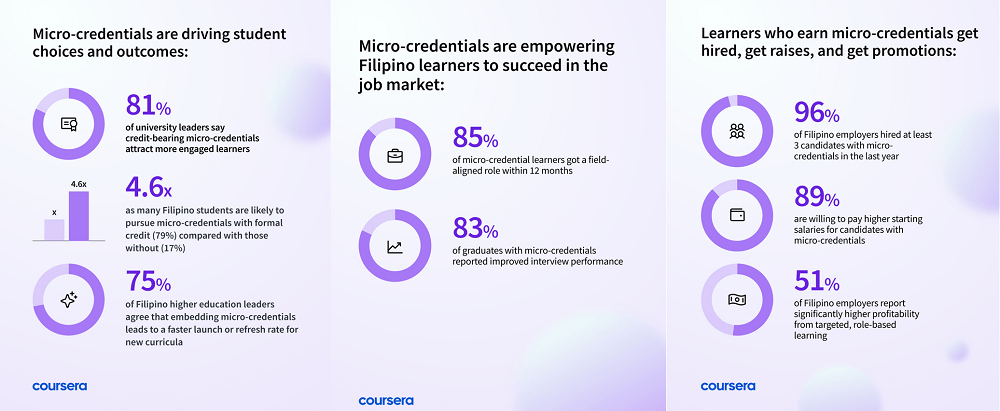
Nearly nine out of 10 Filipino employers are willing to offer higher starting salaries to graduates who hold micro-credentials, reflecting a growing preference for skills-based hiring amid the rise of artificial intelligence and other emerging technologies.
According to Coursera’s Micro-Credentials Impact Report 2026, 89% of employers in the Philippines said they would pay higher starting salaries to graduates with micro-credentials, while 36% indicated they would offer salary increases of more than 15% for candidates with generative AI-related credentials.
The report also found that 96% of Filipino employers hired at least three candidates with micro-credentials over the past year, underscoring the growing acceptance of alternative credentials as proof of workplace readiness.
In addition, 90% said entry-level employees with micro-credentials perform better during their first year on the job, while 77% said such candidates move through hiring processes more quickly.
Coursera cited a Google estimate that AI could generate about $50.7 billion in productivity and cost benefits for the Philippines by 2030, provided the country develops a workforce equipped with relevant digital skills.
The findings come as the Commission on Higher Education (CHED) rolls out a national framework for industry-aligned and stackable micro-credentials under Commission on Higher Education Memorandum Order No. 1, Series of 2025. The policy aims to integrate industry-recognized skills training into higher education programs.
Among graduates surveyed, 85% said they secured jobs aligned with their field of study within 12 months of earning micro-credentials.
The report also found that Filipino students are 4.6 times more likely to pursue micro-credentials when these can be credited toward a degree program.
“As AI reshapes the workplace, employers are placing a premium on candidates who can prove they have practical, job-ready skills. In the Philippines, micro-credentials are no longer just a differentiator – they are becoming an essential signal of employability,” said Ashutosh Gupta, managing director for Asia Pacific at Coursera.
“The data shows strong alignment between employers, students, and higher education leaders: learners want credentials that count toward degrees, employers are willing to pay more for them, and universities see them as critical to staying relevant. CHED’s CMO is a pivotal step, giving universities the policy foundation to embed micro-credentials at scale. Those that move fast will define the next generation of Filipino talent,” Gupta added.
The report was based on surveys conducted among learners, employers, and higher education leaders in seven countries, including the Philippines, between February and March 2026.