
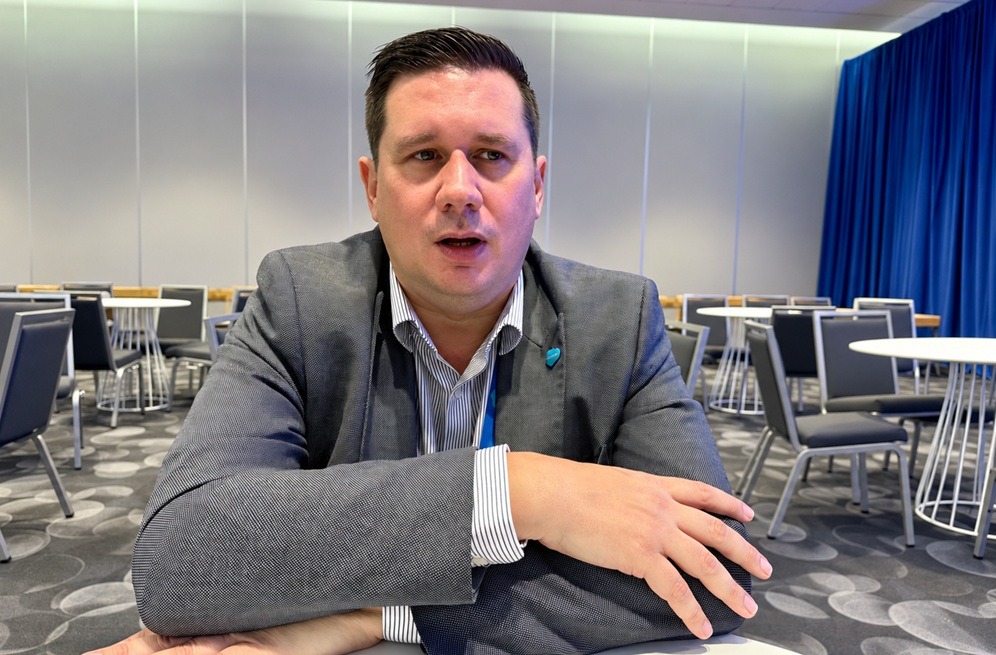
SAN FRANCISCO — Philippine companies are beginning to move their artificial intelligence projects out of experimental environments and into actual operations, according to a regional executive of enterprise software firm Salesforce.
Gavin Barfield, chief technology officer and vice president for solution engineering at Salesforce Asean, said businesses are increasingly rejecting proof-of-concept projects that cannot demonstrate a direct effect on revenue, costs, or customer service.
“We’ve definitely seen companies in the Philippines and globally move away from POCs and pilots to actually start deployments. And that’s been the big shift,” Barfield said in an interview at the Dreamforce 2026 conference.
He said many early generative AI projects failed to progress because companies adopted the technology before identifying the business problems it was supposed to address.
“A lot of money was spent playing around with the technology because it was technology looking for a business problem,” he said.
Businesses are now demanding AI applications linked to specific performance indicators, such as faster case resolution, fewer calls handled by contact center employees, shorter sales cycles and higher conversion rates, Barfield said.
“No more science experiments or vanity projects. I need things that affect and adjust my KPIs,” he said, describing the position now being taken by customers.
Barfield did not disclose adoption figures or identify most of the Philippine companies that have advanced beyond trials, citing customer confidentiality. He pointed, however, to health maintenance organization Maxicare as one local deployment.
According to Barfield, Maxicare is using Salesforce’s Agentforce platform to process dental letters of authorization. The system checks a member’s coverage, remaining benefits and the cost of the proposed treatment before issuing the authorization.
He said the process, which previously took about 20 minutes or longer, can now be completed in less than 30 seconds.
“It’s made life easier for the dentist. It’s made life easier for the patients. And that’s one use case,” Barfield said.
He added that Salesforce is pursuing an incremental approach in which companies initially deploy an agent for a narrowly defined task, measure the result and then expand into other applications.
“We’re going to show value, incrementally improve. And that’s the right way to do it as well,” he said.
For the Philippine market, Barfield said Agentforce already supports Tagalog and is being used by some customers in the language, although he could not identify them or provide details about their deployments.
Salesforce is also testing a language-switching feature that would allow an AI agent to follow conversations that alternate between Tagalog and English, a common practice among Filipino speakers.
“This new beta feature, which will come out soon, allows a conversation to seamlessly switch between the languages and for Agentforce to respond in the right language,” he said.
Barfield said the feature’s effectiveness would still have to be tested in actual conversations, particularly in handling local accents, expressions and linguistic nuances. He added that Salesforce expects to support more regional languages over time.
The increased use of autonomous agents, however, also raises questions about accountability when an AI system makes a wrong decision. Barfield declined to give a legal view on whether responsibility should rest with the software provider, systems integrator, customer or employee.
“I don’t think even globally there’s a consensus on where this goes,” he said.
He said companies would need systems for discovering and monitoring AI agents, limiting their access to data and applications, enforcing internal policies and tracking their costs. This would become more important as organizations deploy agents built by different technology providers, he added.
“It’s super important to have the right governance layer to be able to control what that agent does,” Barfield said. “It’s super important to be able to make sure that agent is grounded on good-quality, accurate data, and that the guardrails that that agent follows follow the company policy.”
Salesforce is also positioning ready-made agents for use by small and medium enterprises, which account for the vast majority of businesses in the Philippines. Barfield said smaller companies should be able to activate agents for basic tasks without maintaining dedicated AI development teams.
“We cannot have a divide where the big companies with money can afford AI and the smaller companies don’t, because that will create a big divide,” he said.
As an example, he said a small cake shop could upload its price lists, delivery policies and product information to a customer-service agent, allowing the system to answer routine questions while the owner concentrates on production.
Barfield acknowledged that more advanced deployments would still require additional technical resources. The test for agentic AI by the end of 2026, he said, would not be the number of agents installed but whether companies could show measurable improvements in operating performance.
“By the end of 2026, we should be able to really see key measures, actual benefits, against metrics that are important for businesses,” he said.


