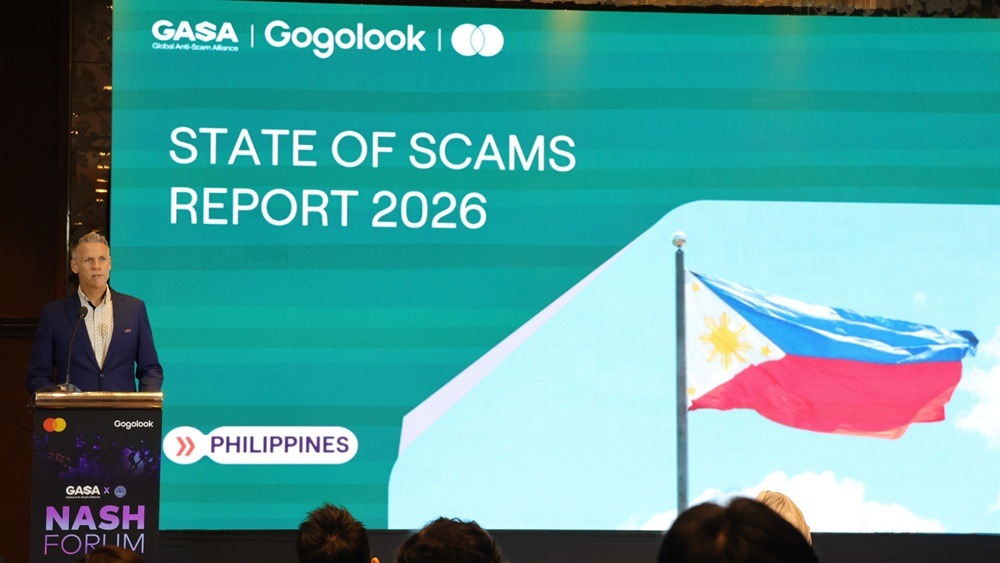
More than eight in 10 Filipino adults encountered a scam attempt over the past year, with fraudsters increasingly using digital wallets, messaging apps, and social media to target victims, according to a new report by the Global Anti-Scam Alliance (GASA).
The State of Scams Philippines 2026 Report, conducted by GASA in collaboration with Mastercard and Gogolook, found that 84% of Filipino adults experienced at least one scam attempt, up from 77% in 2025.
Based on a survey of 1,160 adults, the report estimated that Filipinos encounter an average of 151 scam attempts annually, or roughly one every two to three days.
The study estimated total annual scam losses in the Philippines at P121.8 billion, with 15% of respondents reporting financial losses from scams, including cases involving stolen personal data. Victims lost an average of P10,427.
Shopping, investment, and employment scams were among the most common types encountered, with fraudsters targeting consumers purchasing products online, seeking employment, or looking for investment opportunities.
Messaging apps and social media emerged as major channels for fraudulent activities. About 39% of respondents said they were approached through instant messaging apps, while 36% encountered scams through social media posts.
Overall, 88% of reported scam attempts involved platforms with direct-messaging capabilities.
The report also noted a sharp increase in the use of electronic wallets to transfer illicit funds. The proportion of respondents reporting scammers’ use of e-wallets rose from 34% in 2025 to 73% in 2026.
In contrast, the reported use of bank account transfers declined from 36% to 12%, making the Philippines the only Southeast Asian market covered by the study to register such a decrease.
The report noted that the decline coincided with measures such as the Anti-Financial Account Scamming Act and initiatives to identify and track money mule accounts.
Despite widespread exposure to scams, 58% of Filipino adults expressed confidence in their ability to recognize fraudulent schemes. However, the findings showed that awareness did not necessarily prevent consumers from engaging with scammers.
Beyond financial losses, the study found that 82% of scam victims said their experience affected their mental well-being, while 22% reported being unable to pay for basic necessities after falling victim to fraud.
One in five parents also said their child had experienced a scam.
The report identified low reporting rates and limited recovery of stolen funds as persistent problems.
Only 4% of respondents said they reported scams to authorities, although the figure increased to 29% among those who suffered financial losses.
Among respondents who reported losing money, just 12% said they were able to recover their funds or obtain reimbursement.
To address these gaps, the report recommended stronger coordination among government agencies, financial institutions, telecommunications companies, and digital platforms.
Proposed measures include the establishment of a National Anti-Scams Hub (NASH), a common case management system, expanded intelligence-sharing, and faster mechanisms to trace or freeze stolen funds.
Brian D. Hanley, Asia-Pacific director of GASA, said the responsibility for preventing scams should not rest solely on consumers.
“Behind every scam statistic is a person: someone who trusted the wrong message, clicked the wrong link, or simply believed the person on the other end of the phone,” Hanley said.
“We cannot put the burden of stopping scams on consumers alone. We need to build an environment where people are protected before a scam becomes a loss.”