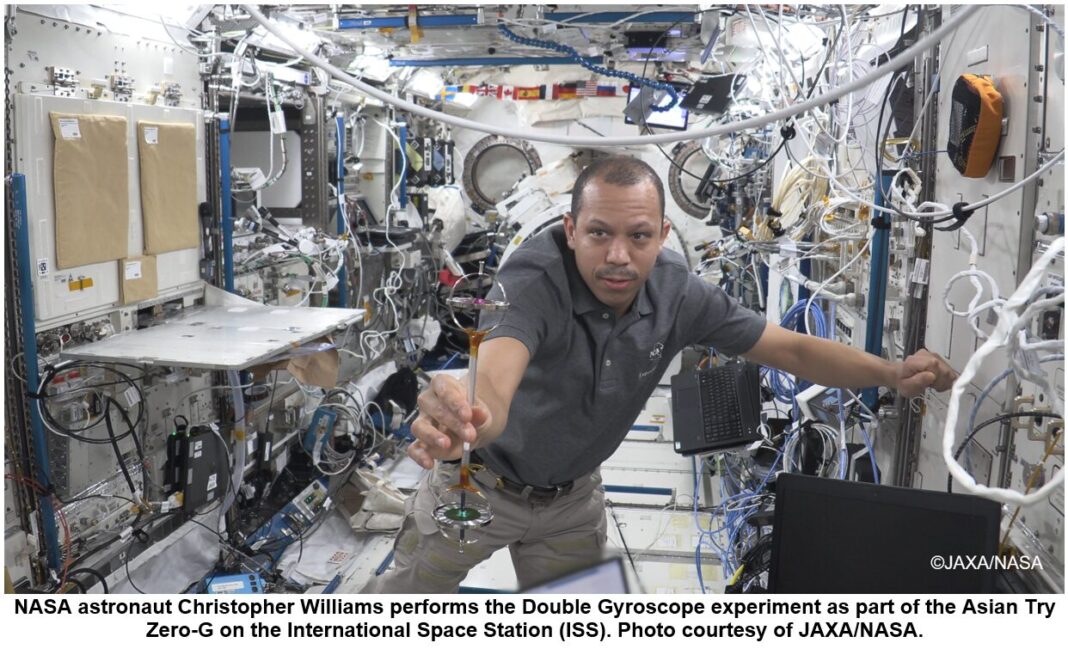
Filipino students from Rizal Technological University (RTU) successfully saw their space experiment carried out aboard the International Space Station (ISS) after it was performed by a National Aeronautics and Space Administration (NASA) astronaut as part of an Asia-Pacific microgravity competition.
The “Double Gyroscope” experiment, developed by third-year astronomy students Christopher Tumamac, Ryan Andrew Doña, and Rose Ann Cezar, was conducted inside the ISS Kibo module on March 24, 2026 by NASA astronaut Christopher Williams under the 2025 Asian Try Zero-G (ATZG 2025) program organized by the Japan Aerospace Exploration Agency.
The experiment was among 11 finalists selected from countries across the Asia-Pacific region, including Australia, Bangladesh, Japan, Malaysia, Singapore, Taiwan, Thailand, and the UAE.
The finalists watched the live execution of their experiments from the JAXA Tsukuba Space Center in Japan.
According to the Philippine Space Agency, which serves as the Philippine organizer for the competition, the ATZG program encourages students to design experiments that can only be tested in microgravity conditions aboard the ISS.
The “Double Gyroscope” experiment explored how two spinning gyroscopes behave in zero gravity when rotating in opposite directions.
The students hypothesized that the opposing motions could stabilize the system, although slight differences in spin could gradually alter its orientation over time. Astronaut Williams repeatedly spun the gyroscopes while observing their movement in microgravity.
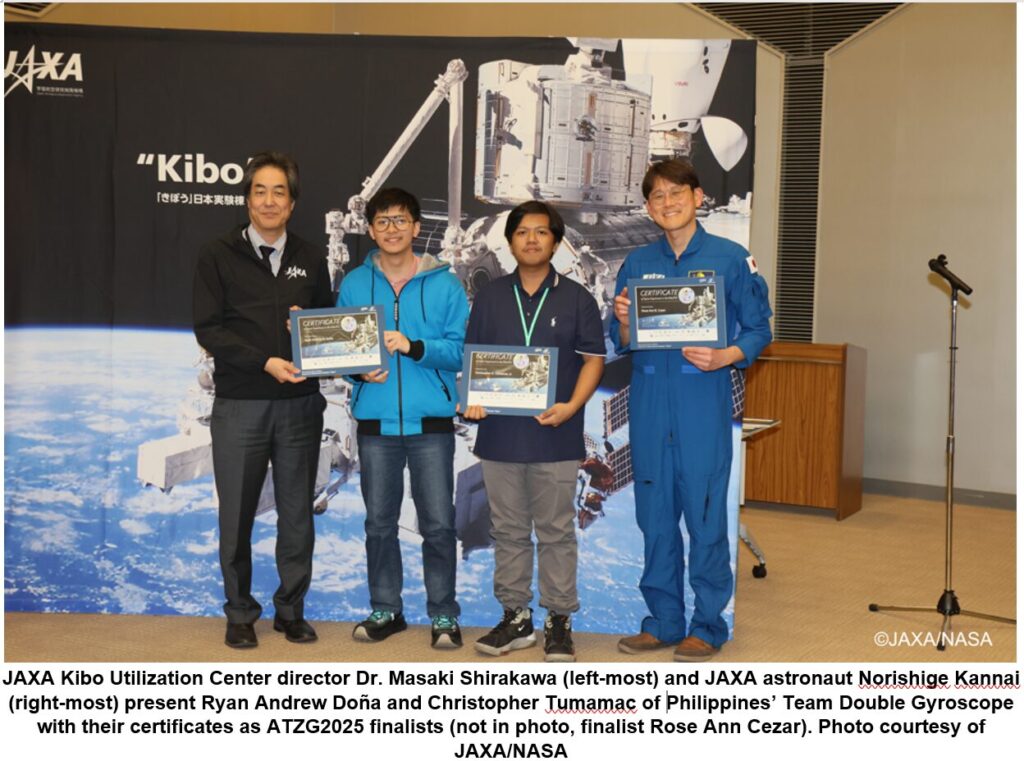
Team members Doña and Tumamac also presented their proposal at the Tsukuba Space Center before the live demonstration. The students said the results matched the hypotheses outlined in their study.
“We are very thankful for this opportunity given to us by PhilSA and I hope in the next batches of ATZG, more Filipino students will apply so they can also experience proposing an experiment in zero-gravity, see their experiment carried out, and learn a lot,” the Philippine team said.
PhilSA said Filipino entries have consistently reached the ATZG finals since 2022, with previous experiments from local students also performed aboard the ISS.