
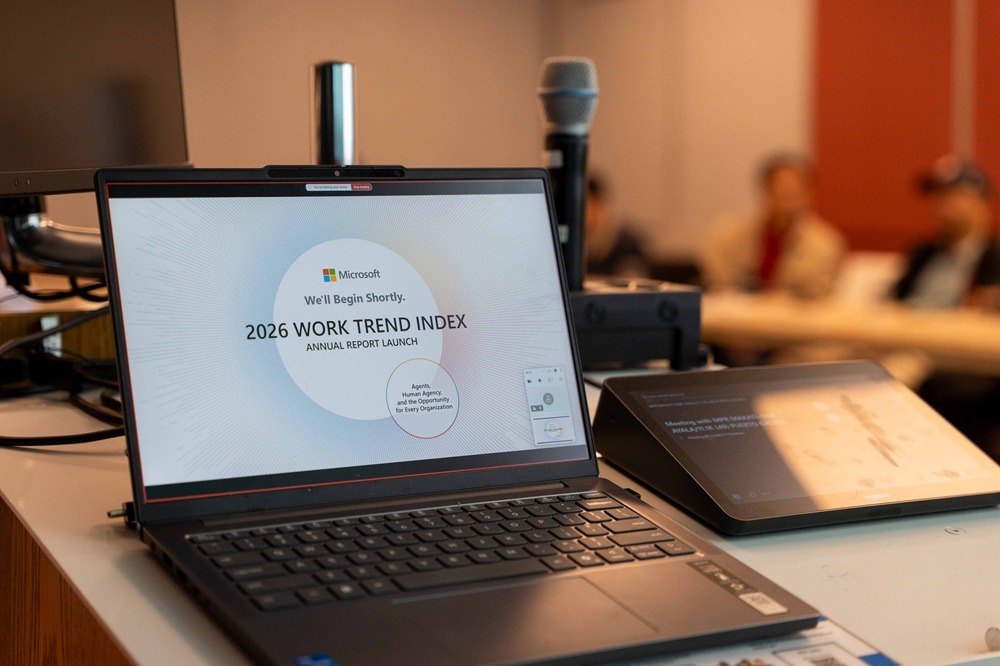
One in four Filipino workers is now considered an advanced user of artificial intelligence, exceeding the global average of 16%, according to Microsoft’s 2026 Work Trend Index, as AI tools increasingly move beyond corporate experiments into everyday work and public school classrooms.
The report said 25% of workers surveyed in the Philippines qualified as what Microsoft calls “Frontier Professionals,” or people who routinely use AI agents for multi-step tasks and incorporate the technology into their workflows.
Microsoft’s findings were based on a survey of 20,000 full-time workers in 10 countries conducted from Feb. 18 to April 20, as well as anonymized Microsoft 365 usage data.
Among Filipino AI users, 77% said they were producing work they could not have produced a year earlier, compared with 58% globally. The figure rose to 86% among Filipino respondents classified as Frontier Professionals.
At the same time, 65% of Filipino AI users identified critical thinking as the most important human skill as AI assumes more tasks, the highest percentage among the countries surveyed and above the 46% global average.
The study, however, also pointed to a gap between individual adoption and organizational readiness. Only 35% of Filipino AI users said their organizations’ leadership was clearly and consistently aligned on AI, although this was higher than the 26% global average.
Some 66% were worried about falling behind if they failed to adapt quickly to AI, while 53% said it felt safer to concentrate on existing priorities instead of redesigning their work around the technology.
PLDT and Smart are among the Philippine companies attempting to expand AI use across their operations. The telcos recently deployed 1,000 Microsoft 365 Copilot seats as part of a broader effort to incorporate generative AI into regular workplace processes.
“At PLDT and Smart, AI is not just a technology rollout. The real opportunity is to rethink how work gets done, so our teams can simplify processes, respond faster, and create more meaningful value for customers,” said Gilbert Gaw, first vice president and head of information technology and the Transformation Office at PLDT and Smart.
“Frontier transformation happens when AI moves from pilots into everyday workflows, supported by the right training, governance, and people adoption. That is how AI becomes real business impact.”
AI deployments are also expanding into the Philippine public school system.
The Department of Education (DepEd) and Microsoft Philippines have also rolled out AI initiatives aimed at addressing reading and literacy gaps, reducing teachers’ administrative workload, and building digital and AI skills across a public school system serving more than 24 million students.
Microsoft said its Reading Progress tool is being used to automate reading-fluency assessments and help teachers identify students requiring additional intervention.
Under DepEd’s ARAL program, Microsoft has begun enabling educators in 25 school districts and is targeting 3,000 teachers in 1,500 schools during 2026. DepEd’s separate AGAP.AI program aims to provide AI-literacy and responsible-use training to 1.5 million students, teachers, and parents.
Earlier deployments indicate that the technology can significantly cut the time spent on routine school work. In a Microsoft-DepEd AI immersion initiative covering eight DepEd regions, teachers reported saving an average of nine hours a week on ancillary tasks, with some reporting savings of up to 20 hours.
In Bais City, the Reading Progress tool reduced the time needed for reading assessments from two days to two hours while being used to assess about 14,000 learners.
The system allows students to record their reading and uses AI to analyze accuracy, reading rate, and pronunciation, reducing manual assessment work for teachers.
The results mirror the productivity argument being made for workplace deployments such as PLDT and Smart: AI is increasingly being used to eliminate or shorten repetitive work, although the reported productivity gains in both corporate and education settings remain largely based on company or participant assessments.
Microsoft’s 2026 report also found that 93% of Filipino respondents regarded AI-generated material as a starting point rather than a finished product, while 59% identified quality control of AI output as a priority.
The use of AI agent across the Microsoft 365 ecosystem, meanwhile, grew 15-fold from a year earlier and 18-fold among large enterprises, according to Microsoft.


