

As demand for data center capacity continues to increase, many people are concerned about how data centers consume water and how that consumption may impact their own communities.
At Equinix, we are dedicated to being responsible stewards of water, and this includes making thoughtful decisions about how and where we consume it. To achieve this, we’re pursuing a multifaceted approach that includes:
- Evaluating the water context of each new site to determine if the area is facing water stress and if local water planning efforts indicate it would be sustainable and responsible to use water for cooling in that location. Then, we design for optimal water efficiency at the site level.
- Measuring our water efficiency efforts, including the trade-off between water consumption and energy consumption.
- Exploring alternative sources of water, such as reclaimed water and desalinization, to reduce our demand for potable water in specific locations.
Let’s explore each of these initiatives in more detail.
Optimizing water efficiency requires a localized approach
Equinix operates data centers in many different communities throughout the world, and we recognize that applying the same water strategy in each community wouldn’t be ideal. Different communities are experiencing different levels of water stress and have different climates, so it wouldn’t make sense for all our data center cooling systems to be designed the same way.
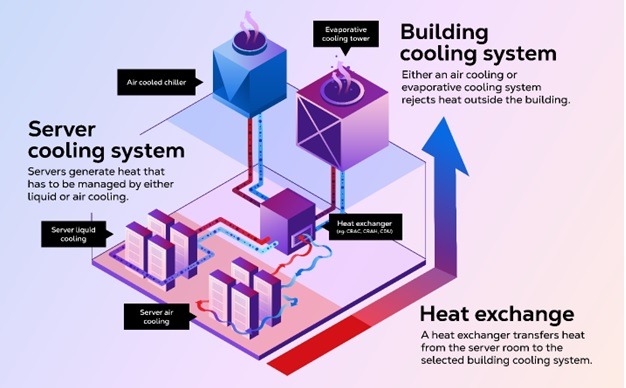
The choice of cooling technology is the biggest factor that impacts how efficiently a particular data center uses water. Specifically, using air-cooled chillers to reject heat outside the building does not consume water. This is why air cooling is the preferred choice for data centers in locations that are experiencing water stress.
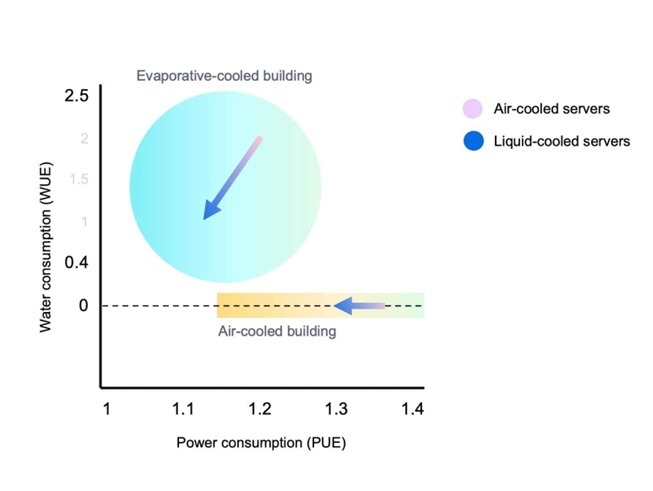
The trade-off is that air cooling also uses more energy than evaporative cooling. We aim to balance the benefits of using air cooling in areas that are experiencing water stress and evaporative cooling in places with power-constrained grids.
Data centers require cooling at both the building level and the server level. Evaporative cooling at the building level is not to be confused with liquid cooling at the server level. Liquid cooling uses a small amount of liquid coolant that moves continuously in a closed loop, and this liquid does not evaporate. So, despite what the name might indicate, server liquid cooling has a negligible impact on data center water consumption.
How we measure water efficiency
Data center operators use water usage effectiveness (WUE) to measure water efficiency, just like we use power usage effectiveness (PUE) to measure energy efficiency. And just like PUE, WUE is not a perfect metric, but it can be a valuable one if we take the time to understand its nuances.
WUE compares the amount of water consumed in a data center for cooling to the amount of energy consumed by IT equipment. Therefore, it’s measured in cubic meters of water per megawatt hour of energy (m3/MWh). Cooling technology and specific equipment used, weather conditions, operations management, and overall capacity filled at a data center are all conditions that affect WUE in practice.
PUE and WUE are two metrics that must be measured together, because a change in one directly impacts the other. If a data center operator sets aggressive WUE reduction targets without also considering its PUE targets, it could have unintended effects.
That’s because the easiest way to reduce WUE quickly is by avoiding evaporative cooling altogether. Since air cooling consumes more energy than evaporative cooling, this move can drive a corresponding increase in PUE. The relationship between PUE and WUE represents the trade-off that data center operators have to balance between energy consumption and water consumption.
Among the limitations of WUE is the fact that not all data center operators report it the same way. If an operator reports only a single WUE figure, you’d have no way of knowing if that figure includes all its data centers, just the ones that use evaporative cooling or just one specific building.
At Equinix, we report two different WUE figures: one for our entire data center portfolio and one exclusively for data centers that use evaporative cooling. In 2024, the last year for which complete statistics are available, these figures were .95 and 1.55, respectively.
Another drawback is that WUE treats every liter of water consumed equally, despite the fact that water can come from different sources, such as ground water, surface waters, municipal supply, or post-consumer reclaimed water. As we’ll see below, data center operators are pursuing a variety of alternative water sources to reduce demand for potable water.
Exploring alternative water sources
Using water responsibly is important because less than 1% of Earth’s freshwater supplies are accessible to humans. Alternative sources of water, such as reclaimed water and desalinated water, can help reduce demand for potable water in data centers.
Reclaimed water is wastewater that’s been treated to an acceptable level for non-potable uses, such as evaporative cooling in data centers. It’s commonly called “purple pipe” water, after the special-colored pipes used to ensure that reclaimed water doesn’t mix with a system’s potable water supply.
In the US alone, wastewater plants treat approximately 34 billion gallons every day. Unfortunately, most of this wastewater is not treated to reclaimed water standards due to a lack of state-level regulations allowing reclaimed water use. Increasing the proportion of reclaimed wastewater would increase the supply of non-potable water available to both consumers and industrial users. We are a member of the Coalition for Water Recycling of the WateReuse Association to advocate for policies that will enable more access to reclaimed water for industrial uses.
Desalinization is another alternative water source. It’s a valuable option because the supply of water that could hypothetically be desalinated is significant. However, desal has its own challenges that impede wider access. The key reasons include the trade-off between water consumption and energy consumption, brine production, potential coastal environmental impacts, and costs of operating and maintaining these systems.
Pursuing a sustainable approach to digital infrastructure
At Equinix, we remain dedicated to being responsible stewards of water. We do this by assessing the local water context of all new builds and optimizing our data centers for water efficiency, measuring and reporting water usage effectiveness, and proactively working with partners and communities to expand the availability of alternative water sources.
Responsibly using water and other natural resources is just one example of our sustainability strategy in action. Our other goals include decarbonizing our global operations, optimizing energy efficiency and renewable energy coverage, and pursuing circularity to minimize and dispose of waste properly. At a time when many enterprise leaders are wondering how they can pursue technological innovation in a more sustainable manner, Equinix is here to help.
The author is the program manager for water & nature at Equinix


