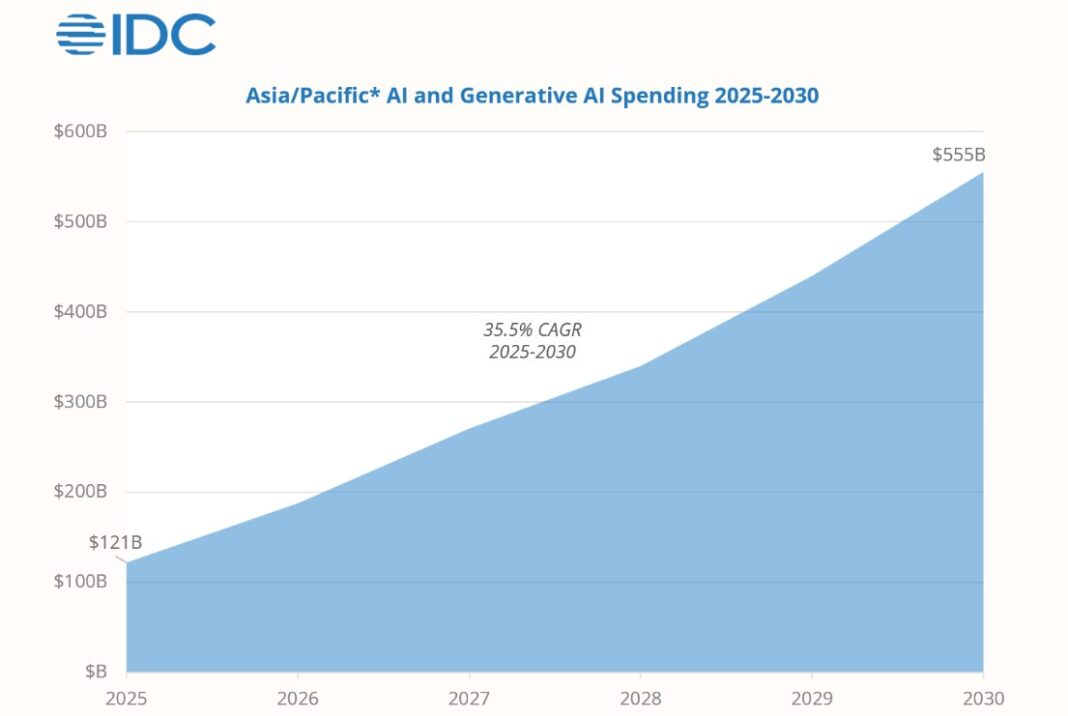
Spending on artificial intelligence and generative AI in the Asia-Pacific region is projected to more than quadruple from $121.5 billion in 2025 to $555.2 billion by 2030 as companies move deployments beyond pilot projects, according to research firm IDC.
The forecast, which includes China and Japan, represents a compound annual growth rate of 35.5% over the five-year period.
IDC said agentic AI and orchestration platforms would be major drivers of the increase as businesses integrate predictive, generative, and prescriptive AI capabilities under common governance systems.
“The next phase of AI adoption in Asia/Pacific will be defined by how effectively organizations can move from experimentation to scaled, operational deployments,” said Vinayaka Venkatesh, senior market analyst for data and analytics at IDC Asia-Pacific.
Venkatesh said agentic AI was advancing from pilot projects to production faster than many organizations had expected. Governments, meanwhile, are developing AI governance frameworks as enterprises and hyperscalers expand data-center capacity to support heavier workloads.
Infrastructure availability could become a constraint as adoption grows, raising the importance of scalable and resilient computing systems, IDC said.
China is expected to remain the region’s largest AI market, with spending forecast to rise from $63.7 billion in 2025 to $303.4 billion in 2030. This translates to annual growth of 36.6%.
Japan’s AI spending is projected to increase from $16.7 billion to $88.9 billion during the same period. Its annual growth rate of 39.8% would be the fastest among the markets covered by the forecast.
Spending in the rest of Asia-Pacific, excluding China and Japan, is expected to climb from $41 billion in 2025 to $162 billion by 2030, representing annual growth of 31.7%.
Software and information services will account for the largest share of regional AI and GenAI spending at 42.7% in 2026. Financial services will follow with 9.8%, while government and telecommunications will account for 7.7% and 6.2%, respectively.
Together, the four industries are expected to generate about two-thirds of the region’s AI spending throughout the forecast period.
AI infrastructure provisioning remains the largest use case, accounting for about 32% of total spending. Investments cover computing resources, cloud-native services, and data-center capacity needed to develop and operate AI applications.
IDC also identified customer engagement, AI governance and risk management, and operational efficiency as growing areas of investment.
Companies are deploying AI in customer service and guided selling, while expanding its use in fraud analysis, threat intelligence, compliance, planning, logistics, and IT optimization.
The forecast was based on IDC’s Worldwide AI and Generative AI Spending Guide, which tracks spending on software, services, and infrastructure across 42 use cases and 27 industries in 31 countries.