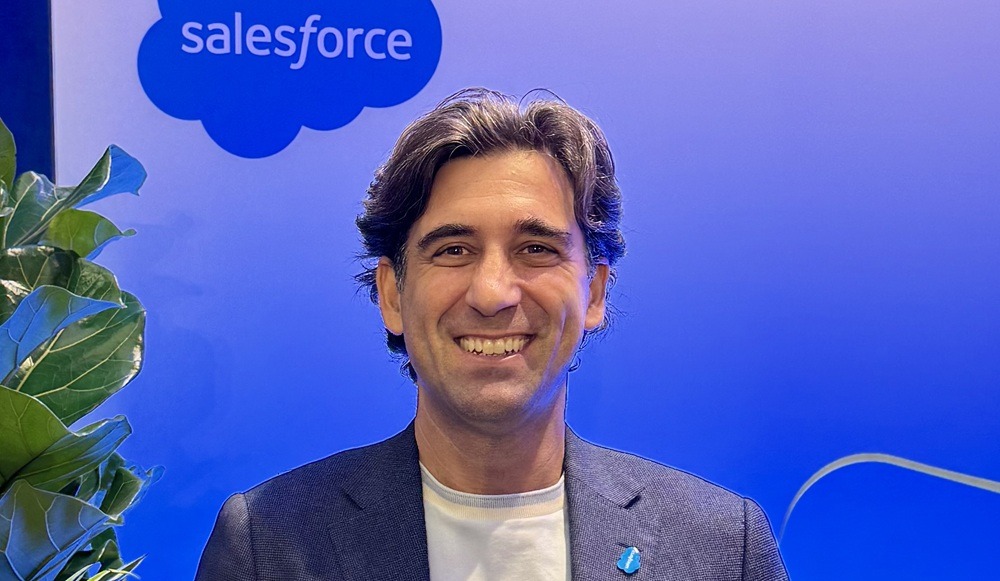
SAN FRANCISCO – Cloud computing purveyor Salesforce expects artificial intelligence to reshape the Philippines’ business process outsourcing industry by automating repetitive work while allowing employees to handle more complex and higher-value tasks.
Paul Carvouni, senior vice president and general manager of Salesforce Asean, said the shift would require outsourcing companies to redesign their operations rather than simply add AI tools to existing processes.
“I think the BPO sector will be reimagined,” Carvouni said in an interview during Dreamforce 2026. “We have great technology to help offload the drudgery, the kind of menial tasks or simple tasks, repetitive tasks, but allow those humans to focus on the higher impact, creativity, complex customer cases, high-value customer, and use their ingenuity and creativity.”
Carvouni said AI would affect roles across industries, but maintained that the technology could also generate new categories of work, comparing its potential impact with earlier technological shifts.
“Before the automotive era, we had the horse and carriage. When you had automotive, we brought mechanics, we brought auto insurance, all of these things,” he said. “Before Internet, we had no SEO, search engine optimization, and after the Internet wave, we spawned a whole industry around SEO. So, I think you’ll see new jobs created.”
He acknowledged, however, that the labor market would undergo significant changes as companies use AI to increase productivity and handle greater transaction volumes.
Carvouni cited Philippine healthcare provider Maxicare as an example of a company that redesigned a high-volume process using automation. According to him, Maxicare reduced the processing time for letters of authorization from about 20 minutes to 30 seconds.
“You’re improving the customer satisfaction because the customer doesn’t want to spend 20 minutes on it,” he said. “But you’re also helping your operational cost, so you can reinvest that in really high-value areas.”
He stressed that the improvement required the company to overhaul its workflow. “It’s not just bolting on a bit of AI. They have to start, really reimagine the process to do that,” he said.
The Philippines is among the Southeast Asian markets trying to advance from AI experimentation to deployment in core operations. Carvouni said Singapore remained the region’s most mature market for AI, aided by government policy, while the Philippines and other Asean economies were catching up.
“I think Philippines and others are fast followers and really rapidly catching up,” he said. “In Philippines, for example, the regulation is very forward-looking on financial services, very open. So, they’ve been fast adopters of cloud and mobile, and now, I’m sure, AI as well.”
Carvouni declined to give the Philippines a specific regional ranking but described it as a strategically important market for Salesforce.
“We’re investing big there — on people, on products,” he said.
Salesforce has also been establishing centers of excellence with regional partners. In the Philippines, its partner Appistoki recently opened an AI center intended to give companies hands-on access to the technology and develop reusable applications for specific industries.
One application demonstrated at the facility was designed for Philippine real estate companies. It allows prospective buyers to ask about available properties in natural language, including Tagalog, before booking a viewing or proceeding with a transaction.
Carvouni said Asean’s linguistic, regulatory and economic diversity makes a uniform approach difficult. Salesforce is addressing this by allowing its services to operate through interfaces already used by customers, including ChatGPT, Claude, and Microsoft Teams.
“Regardless of which interface you want to use — Claude or ChatGPT or Teams — it really doesn’t matter. We can bring Salesforce to the user, to where they are,” he said.
This approach could be particularly relevant in Southeast Asia, where mobile subscriptions exceed the population in several markets.
For small and medium enterprises, Carvouni pointed to preconfigured AI agents for customer support, lead qualification and sales as a way to reduce deployment time and the need for large in-house technology teams.
“MSMEs or SMEs are the backbone of the economy. In Asean, there’s 70 million of them at last count,” he said. “Those out-of-the-box agents are fantastic to help jump-start SMEs and help them scale their service, their sales, their marketing, with a very limited IT resource.”
Despite the focus on AI deployment, Carvouni said companies should judge projects using conventional business indicators instead of the novelty of the technology.
“They should measure the P&L impact,” he said. “In the end, there’s top-line customer growth, revenue acquisition — we can help scale and grow them. There’s also, obviously, bottom-line and operational cost, risk, other KPIs there.”
He added that businesses moving fastest beyond pilot projects were those investing not only in technology but also in workforce skills, centers of excellence, redesigned processes and employee adoption.
“The ones that focus on that recipe for success beyond just the tech are the ones who are adopting faster and faster,” Carvouni said.