Global smartphone shipments fell 22% year-on-year to 255.3 million units in the third quarter of 2026, marking the steepest annual decline recorded for any quarter as rising memory costs and supply constraints hit the industry, according to market research firm IDC.
The preliminary figures from IDC’s Worldwide Quarterly Mobile Phone Tracker showed the impact of an AI-driven memory crunch that has pushed component prices higher, squeezed manufacturers’ margins, and weakened demand.
“The sharp downturn the industry has been bracing for finally materialized in the third quarter this year, with shipments declining a record 22% YoY. However, the worst is yet to come,” said Nabila Popal, senior research director for Worldwide Devices at IDC.
Memory costs have surged approximately 350% since 2025 and continue to rise, Popal said. Although the rate of increase slowed to a low double-digit percentage quarter-on-quarter in the third quarter, compared with increases of roughly 50% to 100% in previous quarters, costs remain elevated.
Other critical components have also become more expensive, adding to the pressure on smartphone manufacturers.
IDC expects market growth to remain constrained through 2027, with a possible recovery pushed back to 2028 at the earliest. Manufacturers are increasingly facing what the firm described as a structural shift in industry costs.
“The third quarter shows the full impact and damage of the memory crisis,” said Francisco Jeronimo, vice president for Worldwide Devices at IDC.
“The pressure is now moving from vendors to consumers. As higher prices reach the shelf, many buyers are keeping their current devices longer. Chinese brands face a particularly difficult moment, as their exposure to low-end smartphones forces them to choose between protecting margins and defending volume just as demand weakens. Volumes will stay under pressure in the coming quarters, while vendors with scale, secure supply and a premium mix keep gaining share in a smaller market.”
The higher cost of memory and other components is expected to translate into more expensive devices, potentially discouraging consumers from upgrading their smartphones.
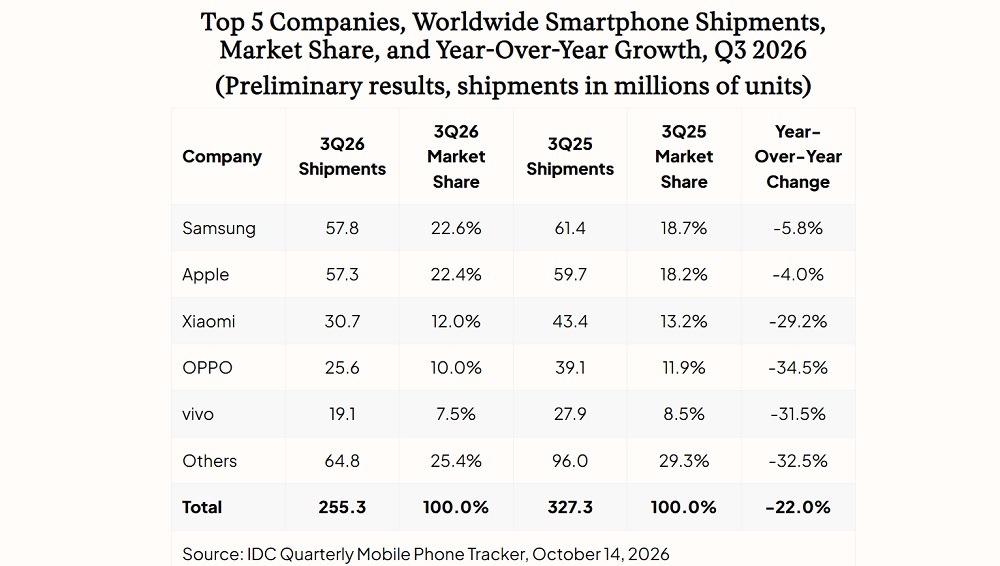
IDC said Samsung and Apple continued to gain market share, while shipment declines intensified for Chinese manufacturers Xiaomi, Oppo, and vivo. The market rankings remained broadly similar to the previous quarter.
“While vendor ranking remains similar to last quarter, Samsung and Apple continue to gain share as players like Xiaomi, Oppo, vivo shipment declines intensify,” said Kiranjeet Kaur, associate research director for Worldwide Devices at IDC.
“As prices rise, consumers who can’t put off a purchase are likely best served by holiday-quarter offers, when promotions and discounts are expected to be at their most attractive, than wait for prices to ease.”
Some manufacturers have increased production plans ahead of an expected tightening in component supplies next year. However, if consumer demand remains weak, the move could leave vendors with excess inventory heading into 2027, adding further pressure to the market outlook, Kaur said.
The outlook puts manufacturers in a difficult position as they balance higher production costs, pricing decisions, and weakening demand.
IDC said companies that adjust their product portfolios and pricing strategies to the higher-cost environment will be better positioned to gain market share.