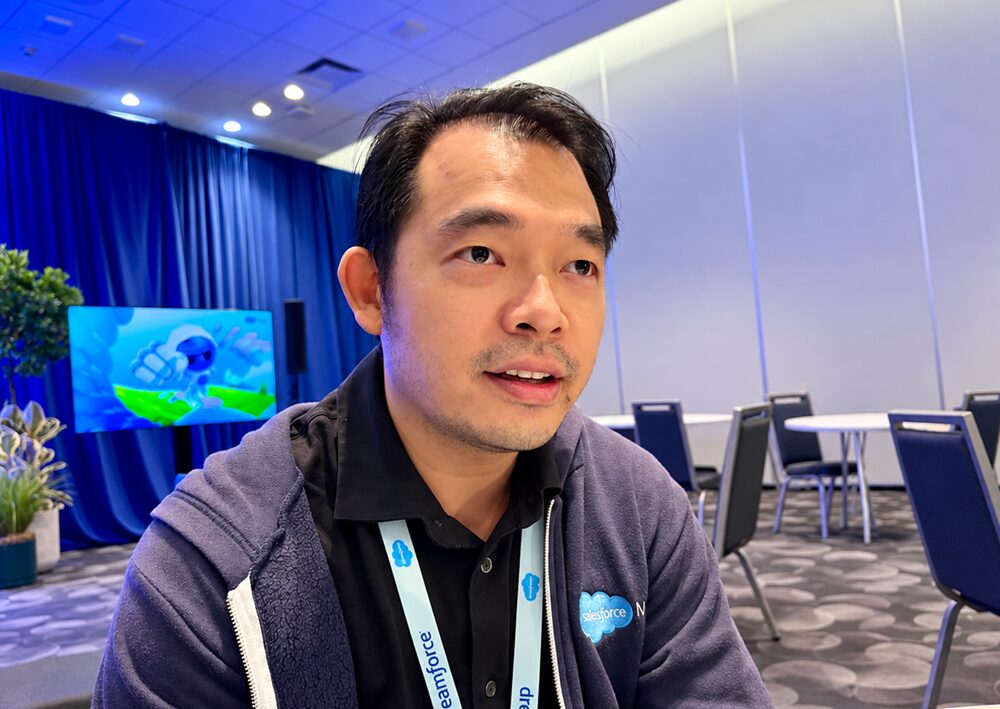
SAN FRANCISCO — Artificial intelligence may be drawing much of the attention in the enterprise technology sector, but Philippine companies will struggle to generate meaningful results unless they first address fragmented systems, poor data quality, and a shortage of people capable of designing complex technology architectures.
That is the view of Joey Chan, founder of Cloud Jedi Solutions and one of only three Salesforce MVPs in Southeast Asia, who said many local organizations remain in the experimental stage of AI adoption.
While some companies have begun deploying AI for specific functions, large-scale implementation remains limited, partly because of the work required to prepare enterprise data and the continuing cost of using large language models (LLMs).
Chan cited Maxicare’s use of AI in processing dental letters of authorization as an example of a narrowly defined application. But for broader adoption, companies must first audit their data, identify the role of each system, and understand how information moves across the organization.
“Garbage in, garbage out,” Chan said, stressing that the quality and structure of corporate data have become even more important with the emergence of generative AI.
AI systems require reliable context to produce useful results. If customer, financial, operational, and other records are incomplete or scattered across disconnected platforms, the technology is likely to return inaccurate or limited outputs.
For many Philippine companies, Chan said, implementing Salesforce itself is not necessarily the biggest challenge. The more difficult task is connecting the platform to numerous existing applications and breaking down the data silos accumulated over years of technology deployment.
Organizational readiness is another obstacle. Companies need employees with the appropriate skills or an implementation partner capable of aligning the technology with their business processes.
Chan’s assessment is based on nearly two decades of experience with the Salesforce ecosystem. He first encountered the customer relationship management platform while studying at the University of Asia and the Pacific.
After graduation and a nine-month stint as an employee, he began taking freelance projects. That work eventually developed into Cloud Jedi Solutions, a technology consulting firm with fewer than 10 employees.
Despite its small team, Cloud Jedi largely serves the US market. It also counts Philippine companies such as energy firm First Gen and automotive brand BMW among its clients.
AI changes the value of skills
Chan expects AI to change the nature of technology work, but not simply by eliminating jobs. He said automation could take over repetitive tasks, allowing employees to concentrate on activities that create greater value.
Routine customer inquiries, such as checking account balances, could increasingly be handled without human intervention. Workers could then focus on building automations, improving workflows, or addressing more complex customer concerns.
The shift presents an opportunity for workers to upgrade their skills, particularly in areas that require business judgment and a broader understanding of how technology systems fit together.
According to Chan, architect-level capabilities are becoming increasingly important in the Salesforce ecosystem. As AI tools make it faster to generate code, the more consequential questions will be “what to build” and “how it integrates.”
This places greater value on professionals who can design technology environments, determine how applications should exchange information, and connect systems into a coherent architecture.
The Philippines already has a sizable pool of Salesforce professionals compared with other Southeast Asian markets, Chan said. Much of that workforce was developed through the country’s business process outsourcing industry and the onshore-offshore operating model used by large consulting firms such as Accenture.
Salesforce previously maintained support operations in the Philippines, which also helped build a local base of practitioners, although that function has since moved to India.
Schools such as Malayan Colleges Laguna — now Mapúa Malayan Colleges Laguna — and Asia Pacific College have likewise helped introduce students to Salesforce skills and expand the talent pipeline.
But high-level architecture work is still often performed in markets such as the US and UK, while much of the execution is assigned to Philippine teams. Chan said the local architect community is seeking to change that division by developing more Filipinos capable of leading system design.
Filipino professionals have an advantage in their willingness to learn and their work ethic, he said. The abundance of training materials, however, can also leave newcomers unsure which skills and career paths to pursue.
Community-led events such as Philippines Dreamin’ seek to help practitioners distinguish among roles including administrator, developer, and architect, while connecting them with others in the Salesforce ecosystem.
Finding practical AI applications
AI has become the leading topic of interest in the local Salesforce community, but Chan said companies still need to determine when the technology is necessary and when conventional software would work better.
Some problems can be solved predictably using code or Salesforce Flows, while others may benefit from AI augmentation. The choice should ultimately be tied to a measurable business result, such as increasing revenue or reducing costs.
The same test applies to small and medium-sized enterprises. Chan said SMEs can adopt AI if projects are proportionate to their operations and aimed at clearly defined, high-return uses.
The relatively low barriers to experimentation make it possible for smaller companies to test the technology. But they must be selective and avoid applying AI to problems that do not require it, particularly as LLM usage generates real token costs that can rise when deployed at scale.
For Cloud Jedi, the next two years will involve testing how AI can augment its delivery work. The firm will continue focusing on connecting enterprise systems and building the data foundations required to make AI applications useful.