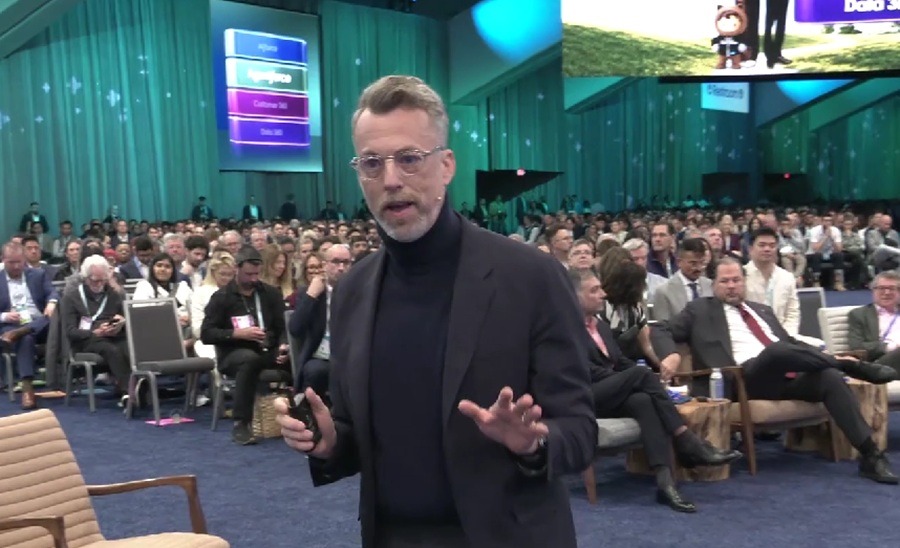
SAN FRANCISCO — Salesforce has unveiled AIforce, a new interface layer that allows employees and AI agents to access company data, workflows and business rules through platforms such as Anthropic’s Claude, Slack, and Salesforce Lightning.
Announced at the Dreamforce 2026 conference, AIforce is intended to reduce users’ dependence on conventional software menus and dashboards. Instead, employees can ask questions, update records, initiate workflows and generate customized interfaces using natural-language instructions.
AIforce connects AI models to the information and controls already stored in Salesforce, including customer records, transaction histories, permissions, security rules, business processes and application metadata.
“AI is creating an interface revolution,” Salesforce chair and CEO Marc Benioff said. “We are combining model intelligence with all the context that customers have built into Salesforce to create an intelligent, dynamic, composable system that is securely governed, built with Zero Data Retention, and designed to work with the core systems that already run your business.”
During the keynote, Benioff said AI models by themselves could not reliably run an enterprise because they operate probabilistically and may not be grounded in a company’s authoritative data.
Salesforce is positioning AIforce as the bridge between such models and the deterministic information held in corporate systems. Requests made through an AI interface remain subject to the permissions and business rules configured in Salesforce.
“Models alone cannot run the enterprise,” Benioff said during the keynote. “Models alone are not going to show us what’s possible.”
He said AIforce was built around four layers: Data 360 for integrating and harmonizing company information; Salesforce applications and their business semantics; Agentforce agents; and the new AI-driven interface layer.
According to Salesforce, AIforce uses zero data retention, meaning business data supplied to an external model for a particular request is not retained by the model provider or used to train its models.
The company is initially offering AIforce through three products: Claudeforce, Slackforce and Agentforce Coworker. It also plans to release a software development kit that companies can use to build their own AIforce applications.
Claudeforce embeds Salesforce capabilities in Anthropic’s Claude. Its first implementation, called Salesforce in Claude, uses a preconfigured Model Context Protocol server to connect Claude with Salesforce without requiring companies to build their own authentication and skill mappings.
The beta version includes 37 sales skills covering tasks such as prospecting and pipeline management. Salesforce said it plans to add Tableau analytics and skills for customer service, marketing, commerce and industry-specific work.
A separate Salesforce Development plug-in for Claude Code provides more than 40 development skills and access to other Salesforce skills hosted on GitHub.
Salesforce said Deloitte, GitLab and legal technology company Legora participated in pilots of Salesforce in Claude. The service is now available to customers in open beta.
Salesforce president of applications and marketing Patrick Stokes demonstrated Claudeforce by building a customized “command center” inside Claude Cowork. The interface combined sales pipeline, customer-service and marketing information and allowed actions to be sent back to Salesforce and Slack.
In the demonstration, the system flagged a delayed $4.8-million sales opportunity, displayed the related security review and allowed Stokes to send a message to the responsible team through Slack.
Stokes said the initial interface could be created through a conversation with Claude in about six to eight minutes, although further adjustments and added functions could take several days.
Benioff said Salesforce had been using Claudeforce internally for several months, with about 7,000 users on the system. He said company operating-unit leaders were using it to manage their businesses, although Salesforce did not release independent measurements of the productivity gains from the deployment.
Slackforce brings the same AIforce architecture into Slack. Its Slackforce Surfaces feature lets teams generate interactive interfaces using information from Salesforce, Slack and connected applications.
The system also powers Slackbot, which can analyze Salesforce records and Slack conversations before carrying out permitted actions.
Salesforce said it could, for example, identify customer accounts showing reduced activity, examine related support cases and discussions, assign an employee, create a follow-up task and draft a message to the customer.
Another component, Slack CRM, lets employees create accounts, record call notes and update Salesforce records through prompts without opening the main CRM application.
Slackforce also includes Slack Code, a collaborative environment in which multiple employees can work with an AI coding agent on code, prototypes and documents.
Agentforce Coworker, meanwhile, provides an AI assistant inside the Salesforce Lightning interface. It can review accounts and activity histories, produce insights and call other Agentforce agents previously configured by a company.
Salesforce said Coworker uses the customer’s existing permissions and business rules and can be activated without migrating data or creating a separate access-control system. The company claimed that 100,000 users activated Coworker during its first 35 days.
“As a deeply mobile-first region where people work in conversational channels, ASEAN businesses can unlock the full potential of AI through AIforce,” said Paul Carvouni, Salesforce senior vice president and general manager for ASEAN.
“By bringing the trusted context, workflows, and governance of Salesforce straight into where work already happens, AIforce empowers employees to act on enterprise data in simple, natural language,” he added.
Salesforce is also introducing AIforce Max Edition, a package that combines the underlying data, applications, agents and AIforce interface capabilities. The company did not announce pricing during the keynote.
AIforce is supported by Salesforce’s Headless Toolkit, which exposes platform functions through MCP servers, application programming interfaces, plug-ins, skills and development tools.
The company said partners including Anthropic, Amazon Web Services, Google and OpenAI are using the toolkit to connect their AI interfaces to Salesforce. Other participating companies include Lovable, Vercel, Docusign, Gamma, Jasper, Ramp and Rippling.
Salesforce said availability could vary by region and warned that the announced pricing and packaging remain subject to change.